What Every Woman Knows Play by James Matthew Barrie
WHAT EVERY WOMAN KNOWS PLAY
By James M. Barrie
WHAT EVERY WOMAN KNOWS CONTENTS
WHAT EVERY WOMAN KNOWS PLAY ACT I
WHAT EVERY WOMAN KNOWS PLAY ACT II
WHAT EVERY WOMAN KNOWS PLAY ACT III
WHAT EVERY WOMAN KNOWS PLAY ACT IV
WHAT EVERY WOMAN KNOWS PLAY ACT I
James Wylie is about to make a move on the dambrod, and in the little Scotch room there is an awful silence befitting the occasion. James with his hand poised—for if he touches a piece he has to play it, Alick will see to that—raises his red head suddenly to read Alick’s face. His father, who is Alick, is pretending to be in a panic lest James should make this move. James grins heartlessly, and his fingers are about to close on the ‘man’ when some instinct of self-preservation makes him peep once more. This time Alick is caught: the unholy ecstasy on his face tells as plain as porridge that he has been luring James to destruction. James glares; and, too late, his opponent is a simple old father again. James mops his head, sprawls in the manner most conducive to thought in the Wylie family, and, protruding his underlip, settles down to a reconsideration of the board. Alick blows out his cheeks, and a drop of water settles on the point of his nose.
You will find them thus any Saturday night (after family worship, which sends the servant to bed); and sometimes the pauses are so long that in the end they forget whose move it is.
It is not the room you would be shown into if you were calling socially on Miss Wylie. The drawing-room for you, and Miss Wylie in a coloured merino to receive you; very likely she would exclaim, “This is a pleasant surprise!” though she has seen you coming up the avenue and has just had time to whip the dustcloths off the chairs, and to warn Alick, David and James, that they had better not dare come in to see you before they have put on a dickey. Nor is this the room in which you would dine in solemn grandeur if invited to drop in and take pot-luck, which is how the Wylies invite, it being a family weakness to pretend that they sit down in the dining-room daily. It is the real living-room of the house, where Alick, who will never get used to fashionable ways, can take off his collar and sit happily in his stocking soles, and James at times would do so also; but catch Maggie letting him.
There is one very fine chair, but, heavens, not for sitting on; just to give the room a social standing in an emergency. It sneers at the other chairs with an air of insolent superiority, like a haughty bride who has married into the house for money. Otherwise the furniture is homely; most of it has come from that smaller house where the Wylies began. There is the large and shiny chair which can be turned into a bed if you look the other way for a moment. James cannot sit on this chair without gradually sliding down it till he is lying luxuriously on the small of his back, his legs indicating, like the hands of a clock, that it is ten past twelve; a position in which Maggie shudders to see him receiving company.
The other chairs are horse-hair, than which nothing is more comfortable if there be a good slit down the seat. The seats are heavily dented, because all the Wylie family sit down with a dump. The draught-board is on the edge of a large centre table, which also displays four books placed at equal distances from each other, one of them a Bible, and another the family album. If these were the only books they would not justify Maggie in calling this chamber the library, her dogged name for it; while David and James call it the west-room and Alick calls it ‘the room,’ which is to him the natural name for any apartment without a bed in it. There is a bookcase of pitch pine, which contains six hundred books, with glass doors to prevent your getting at them.
No one does try to get at the books, for the Wylies are not a reading family. They like you to gasp when you see so much literature gathered together in one prison-house, but they gasp themselves at the thought that there are persons, chiefly clergymen, who, having finished one book, coolly begin another. Nevertheless it was not all vainglory that made David buy this library: it was rather a mighty respect for education, as something that he has missed. This same feeling makes him take in the Contemporary Review and stand up to it like a man. Alick, who also has a respect for education, tries to read the Contemporary, but becomes dispirited, and may be heard muttering over its pages, ‘No, no use, no use, no,’ and sometimes even ‘Oh hell.’ James has no respect for education; and Maggie is at present of an open mind.
They are Wylie and Sons of the local granite quarry, in which Alick was throughout his working days a mason. It is David who has raised them to this position; he climbed up himself step by step (and hewed the steps), and drew the others up after him. ‘Wylie Brothers,’ Alick would have had the firm called, but David said No, and James said No, and Maggie said No; first honour must be to their father; and Alick now likes it on the whole, though he often sighs at having to shave every day; and on some snell mornings he still creeps from his couch at four and even at two (thinking that his mallet and chisel are calling him), and begins to pull on his trousers, until the grandeur of them reminds him that he can go to bed again. Sometimes he cries a little, because there is no more work for him to do for ever and ever; and then Maggie gives him a spade (without telling David) or David gives him the logs to saw (without telling Maggie).
We have given James a longer time to make his move than our kind friends in front will give him, but in the meantime something has been happening. David has come in, wearing a black coat and his Sabbath boots, for he has been to a public meeting. David is nigh forty years of age, whiskered like his father and brother (Alick’s whiskers being worn as a sort of cravat round the neck), and he has the too brisk manner of one who must arrive anywhere a little before any one else. The painter who did the three of them for fifteen pounds (you may observe the canvases on the walls) has caught this characteristic, perhaps accidentally, for David is almost stepping out of his frame, as if to hurry off somewhere; while Alick and James look as if they were pinned to the wall for life. All the six of them, men and pictures, however, have a family resemblance, like granite blocks from their own quarry. They are as Scotch as peat for instance, and they might exchange eyes without any neighbour noticing the difference, inquisitive little blue eyes that seem to be always totting up the price of things.
The dambrod players pay no attention to David, nor does he regard them. Dumping down on the sofa he removes his ‘lastic sides, as his Sabbath boots are called, by pushing one foot against the other, gets into a pair of hand-sewn slippers, deposits the boots as according to rule in the ottoman, and crosses to the fire. There must be something on David’s mind to-night, for he pays no attention to the game, neither gives advice (than which nothing is more maddening) nor exchanges a wink with Alick over the parlous condition of James’s crown. You can hear the wag-at-the-wall clock in the lobby ticking. Then David lets himself go; it runs out of him like a hymn:—
DAVID. Oh, let the solid ground Not fail beneath my feet, Before my life has found What some have found so sweet.
[This is not a soliloquy, but is offered as a definite statement. The players emerge from their game with difficulty.]
ALICK [with JAMES’s crown in his hand]. What’s that you’re saying, David?
DAVID [like a public speaker explaining the situation in a few well-chosen words]. The thing I’m speaking about is Love.
JAMES [keeping control of himself]. Do you stand there and say you’re in love, David Wylie?
DAVID. Me; what would I do with the thing?
JAMES [who is by no means without pluck]. I see no necessity for calling it a thing.
[They are two bachelors who all their lives have been afraid of nothing but Woman. DAVID in his sportive days—which continue—has done roguish things with his arm when conducting a lady home under an umbrella from a soiree, and has both chuckled and been scared on thinking of it afterwards. JAMES, a commoner fellow altogether, has discussed the sex over a glass, but is too canny to be in the company of less than two young women at a time.]
DAVID [derisively]. Oho, has she got you, James?
JAMES [feeling the sting of it]. Nobody has got me.
DAVID. They’ll catch you yet, lad.
JAMES. They’ll never catch me. You’ve been nearer catched yourself.
ALICK. Yes, Kitty Menzies, David.
DAVID [feeling himself under the umbrella]. It was a kind of a shave that.
ALICK [who knows all that is to be known about women and can speak of them without a tremor]. It’s a curious thing, but a man cannot help winking when he hears that one of his friends has been catched.
DAVID. That’s so.
JAMES [clinging to his manhood]. And fear of that wink is what has kept the two of us single men. And yet what’s the glory of being single?
DAVID. There’s no particular glory in it, but it’s safe.
JAMES [putting away his aspirations]. Yes, it’s lonely, but it’s safe. But who did you mean the poetry for, then?
DAVID. For Maggie, of course.
[You don’t know DAVID and JAMES till you know how they love their sister MAGGIE.]
ALICK. I thought that.
DAVID [coming to the second point of his statement about Love]. I saw her reading poetry and saying those words over to herself.
JAMES. She has such a poetical mind.
DAVID. Love. There’s no doubt as that’s what Maggie has set her heart on. And not merely love, but one of those grand noble loves; for though Maggie is undersized she has a passion for romance.
JAMES [wandering miserably about the room]. It’s terrible not to be able to give Maggie what her heart is set on.
[The others never pay much attention to JAMES, though he is quite a smart figure in less important houses.]
ALICK [violently]. Those idiots of men.
DAVID. Father, did you tell her who had got the minister of Galashiels?
ALICK [wagging his head sadly]. I had to tell her. And then I—I—bought her a sealskin muff, and I just slipped it into her hands and came away.
JAMES [illustrating the sense of justice in the Wylie family]. Of course, to be fair to the man, he never pretended he wanted her.
DAVID. None of them wants her; that’s what depresses her. I was thinking, father, I would buy her that gold watch and chain in Snibby’s window. She hankers after it.
JAMES [slapping his pocket]. You’re too late, David; I’ve got them for her.
DAVID. It’s ill done of the minister. Many a pound of steak has that man had in this house.
ALICK. You mind the slippers she worked for him?
JAMES. I mind them fine; she began them for William Cathro. She’s getting on in years, too, though she looks so young.
ALICK. I never can make up my mind, David, whether her curls make her look younger or older.
DAVID [determinedly]. Younger. Whist! I hear her winding the clock. Mind, not a word about the minister to her, James. Don’t even mention religion this day.
JAMES. Would it be like me to do such a thing?
DAVID. It would be very like you. And there’s that other matter: say not a syllable about our having a reason for sitting up late to-night. When she says it’s bed-time, just all pretend we’re not sleepy.
ALICK. Exactly, and when—
[Here MAGGIE enters, and all three are suddenly engrossed in the dambrod. We could describe MAGGIE at great length. But what is the use? What you really want to know is whether she was good-looking. No, she was not. Enter MAGGIE, who is not good-looking. When this is said, all is said. Enter MAGGIE, as it were, with her throat cut from ear to ear. She has a soft Scotch voice and a more resolute manner than is perhaps fitting to her plainness; and she stops short at sight of JAMES sprawling unconsciously in the company chair.]
MAGGIE. James, I wouldn’t sit on the fine chair.
JAMES. I forgot again.
[But he wishes she had spoken more sharply. Even profanation of the fine chair has not roused her. She takes up her knitting, and they all suspect that she knows what they have been talking about.]
MAGGIE. You’re late, David, it’s nearly bed-time.
DAVID [finding the subject a safe one]. I was kept late at the public meeting.
ALICK [glad to get so far away from Galashiels]. Was it a good meeting?
DAVID. Fairish. [with some heat] That young John Shand WOULD make a speech.
MAGGIE. John Shand? Is that the student Shand?
DAVID. The same. It’s true he’s a student at Glasgow University in the winter months, but in summer he’s just the railway porter here; and I think it’s very presumptuous of a young lad like that to make a speech when he hasn’t a penny to bless himself with.
ALICK. The Shands were always an impudent family, and jealous. I suppose that’s the reason they haven’t been on speaking terms with us this six years. Was it a good speech?
DAVID [illustrating the family’s generosity]. It was very fine; but he needn’t have made fun of ME.
MAGGIE [losing a stitch]. He dared?
DAVID [depressed]. You see I can not get started on a speech without saying things like ‘In rising FOR to make a few remarks.’
JAMES. What’s wrong with it?
DAVID. He mimicked me, and said, ‘Will our worthy chairman come for to go for to answer my questions?’ and so on; and they roared.
JAMES [slapping his money pocket]. The sacket.
DAVID. I did feel bitterly, father, the want of education. [Without knowing it, he has a beautiful way of pronouncing this noble word.]
MAGGIE [holding out a kind hand to him]. David.
ALICK. I’ve missed it sore, David. Even now I feel the want of it in the very marrow of me. I’m ashamed to think I never gave you your chance. But when you were young I was so desperate poor, how could I do it, Maggie?
MAGGIE. It wasn’t possible, father.
ALICK [gazing at the book-shelves]. To be able to understand these books! To up with them one at a time and scrape them as clean as though they were a bowl of brose. Lads, it’s not to riches, it’s to scholarship that I make my humble bow.
JAMES [who is good at bathos]. There’s ten yards of them. And they were selected by the minister of Galashiels. He said—
DAVID [quickly]. James.
JAMES. I mean—I mean—
MAGGIE [calmly]. I suppose you mean what you say, James. I hear, David, that the minister of Galashiels is to be married on that Miss Turnbull.
DAVID [on guard]. So they were saying.
ALICK. All I can say is she has made a poor bargain.
MAGGIE [the damned]. I wonder at you, father. He’s a very nice gentleman. I’m sure I hope he has chosen wisely.
JAMES. Not him.
MAGGIE [getting near her tragedy]. How can you say that when you don’t know her? I expect she is full of charm.
ALICK. Charm? It’s the very word he used.
DAVID. Havering idiot.
ALICK. What IS charm, exactly, Maggie?
MAGGIE. Oh, it’s—it’s a sort of bloom on a woman. If you have it, you don’t need to have anything else; and if you don’t have it, it doesn’t much matter what else you have. Some women, the few, have charm for all; and most have charm for one. But some have charm for none.
[Somehow she has stopped knitting. Her men-folk are very depressed. JAMES brings his fist down on the table with a crash.]
JAMES [shouting]. I have a sister that has charm.
MAGGIE. No, James, you haven’t.
JAMES [rushing at her with the watch and chain]. Ha’e, Maggie.
[She lets them lie in her lap.]
DAVID. Maggie, would you like a silk?
MAGGIE. What could I do with a silk? [With a gust of passion] You might as well dress up a little brown hen.
[They wriggle miserably.]
JAMES [stamping]. Bring him here to me.
MAGGIE. Bring whom, James?
JAMES. David, I would be obliged if you wouldn’t kick me beneath the table.
MAGGIE [rising]. Let’s be practical; let’s go to our beds.
[This reminds them that they have a job on hand in which she is not to share.]
DAVID [slily]. I don’t feel very sleepy yet.
ALICK. Nor me either.
JAMES. You’ve just taken the very words out of my mouth.
DAVID [with unusual politeness]. Good-night to you Maggie.
MAGGIE [fixing the three of them]. ALL of you unsleepy, when, as is well known, ten o’clock is your regular bed-time?
JAMES. Yes, it’s common knowledge that we go to our beds at ten. [Chuckling] That’s what we’re counting on.
MAGGIE. Counting on?
DAVID. You stupid whelp.
JAMES. What have I done?
MAGGIE [folding her arms]. There’s something up. You’ve got to tell me, David.
DAVID [who knows when he is beaten]. Go out and watch, James.
MAGGIE. Watch?
[JAMES takes himself off, armed, as MAGGIE notices, with a stick.]
DAVID [in his alert business way]. Maggie, there are burglars about.
MAGGIE. Burglars? [She sits rigid, but she is not the kind to scream.]
DAVID. We hadn’t meant for to tell you till we nabbed them; but they’ve been in this room twice of late. We sat up last night waiting for them, and we’re to sit up again to-night.
MAGGIE. The silver plate.
DAVID. It’s all safe as yet. That makes us think that they were either frightened away these other times, or that they are coming back for to make a clean sweep.
MAGGIE. How did you get to know about this?
DAVID. It was on Tuesday that the polissman called at the quarry with a very queer story. He had seen a man climbing out at this window at ten past two.
MAGGIE. Did he chase him?
DAVID. It was so dark he lost sight of him at once.
ALICK. Tell her about the window.
DAVID. We’ve found out that the catch of the window has been pushed back by slipping the blade of a knife between the woodwork.
MAGGIE. David.
ALICK. The polissman said he was carrying a little carpet bag.
MAGGIE. The silver plate IS gone.
DAVID. No, no. We were thinking that very likely he has bunches of keys in the bag.
MAGGIE. Or weapons.
DAVID. As for that, we have some pretty stout weapons ourselves in the umbrella stand. So, if you’ll go to your bed, Maggie—
MAGGIE. Me? and my brothers in danger.
ALICK. There’s just one of them.
MAGGIE. The polissman just saw one.
DAVID [licking his palms]. I would be very pleased if there were three of them.
MAGGIE. I watch with you. I would be very pleased if there were four of them.
DAVID. And they say she has no charm!
[JAMES returns on tiptoe as if the burglars were beneath the table. He signs to every one to breathe no more, and then whispers his news.]
JAMES. He’s there. I had no sooner gone out than I saw him sliding down the garden wall, close to the rhubarbs.
ALICK. What’s he like?
JAMES. He’s an ugly customer. That’s all I could see. There was a little carpet bag in his hand.
DAVID. That’s him.
JAMES. He slunk into the rhodydendrons, and he’s there now, watching the window.
DAVID. We have him. Out with the light.
[The room is beautified by a chandelier fitted for three gas jets, but with the advance of progress one of these has been removed and the incandescent light put in its place. This alone is lit. ALICK climbs a chair, pulls a little chain, and the room is now but vaguely lit by the fire. It plays fitfully on four sparkling faces.]
MAGGIE. Do you think he saw you, James?
JAMES. I couldn’t say, but in any case I was too clever for him. I looked up at the stars, and yawned loud at them as if I was tremendous sleepy.
[There is a long pause during which they are lurking in the shadows. At last they hear some movement, and they steal like ghosts from the room. We see DAVID turning out the lobby light; then the door closes and an empty room awaits the intruder with a shudder of expectancy. The window opens and shuts as softly as if this were a mother peering in to see whether her baby is asleep. Then the head of a man shows between the curtains. The remainder of him follows. He is carrying a little carpet bag. He stands irresolute; what puzzles him evidently is that the Wylies should have retired to rest without lifting that piece of coal off the fire. He opens the door and peeps into the lobby, listening to the wag-at-the-wall clock. All seems serene, and he turns on the light. We see him clearly now. He is JOHN SHAND, age twenty-one, boots muddy, as an indignant carpet can testify. He wears a shabby topcoat and a cockerty bonnet; otherwise he is in the well-worn corduroys of a railway porter. His movements, at first stealthy, become almost homely as he feels that he is secure. He opens the bag and takes out a bunch of keys, a small paper parcel, and a black implement that may be a burglar’s jemmy. This cool customer examines the fire and piles on more coals. With the keys he opens the door of the bookcase, selects two large volumes, and brings them to the table. He takes off his topcoat and opens his parcel, which we now see contains sheets of foolscap paper. His next action shows that the ‘jemmy’ is really a ruler. He knows where the pen and ink are kept. He pulls the fine chair nearer to the table, sits on it, and proceeds to write, occasionally dotting the carpet with ink as he stabs the air with his pen. He is so occupied that he does not see the door opening, and the Wylie family staring at him. They are armed with sticks.]
ALICK [at last]. When you’re ready, John Shand.
[JOHN hints back, and then he has the grace to rise, dogged and expressionless.]
JAMES [like a railway porter]. Ticket, please.
DAVID. You can’t think of anything clever for to go for to say now, John.
MAGGIE. I hope you find that chair comfortable, young man.
JOHN. I have no complaint to make against the chair.
ALICK [who is really distressed]. A native of the town. The disgrace to your family! I feel pity for the Shands this night.
JOHN [glowering]. I’ll thank you, Mr. Wylie, not to pity my family.
JAMES. Canny, canny.
MAGGIE [that sense of justice again]. I think you should let the young man explain. It mayn’t be so bad as we thought.
DAVID. Explain away, my billie.
JOHN. Only the uneducated would need an explanation. I’m a student, [with a little passion] and I’m desperate for want of books. You have all I want here; no use to you but for display; well, I came here to study. I come twice weekly. [Amazement of his hosts.]
DAVID [who is the first to recover]. By the window.
JOHN. Do you think a Shand would so far lower himself as to enter your door? Well, is it a case for the police?
JAMES. It is.
MAGGIE [not so much out of the goodness of her heart as to patronise the Shands]. It seems to me it’s a case for us all to go to our beds and leave the young man to study; but not on that chair. [And she wheels the chair away from him.]
JOHN. Thank you, Miss Maggie, but I couldn’t be beholden to you.
JAMES. My opinion is that he’s nobody, so out with him.
JOHN. Yes, out with me. And you’ll be cheered to hear I’m likely to be a nobody for a long time to come.
DAVID [who had been beginning to respect him]. Are you a poor scholar?
JOHN. On the contrary, I’m a brilliant scholar.
DAVID. It’s siller, then?
JOHN [glorified by experiences he has shared with many a gallant soul]. My first year at college I lived on a barrel of potatoes, and we had just a sofa-bed between two of us; when the one lay down the other had to get up. Do you think it was hardship? It was sublime. But this year I can’t afford it. I’ll have to stay on here, collecting the tickets of the illiterate, such as you, when I might be with Romulus and Remus among the stars.
JAMES [summing up]. Havers.
DAVID [in whose head some design is vaguely taking shape]. Whist, James. I must say, young lad, I like your spirit. Now tell me, what’s your professors’ opinion of your future.
JOHN. They think me a young man of extraordinary promise.
DAVID. You have a name here for high moral character.
JOHN. And justly.
DAVID. Are you serious-minded?
JOHN. I never laughed in my life.
DAVID. Who do you sit under in Glasgow?
JOHN. Mr. Flemister of the Sauchiehall High.
DAVID. Are you a Sabbath-school teacher?
JOHN. I am.
DAVID. One more question. Are you promised?
JOHN. To a lady?
DAVID. Yes.
JOHN. I’ve never given one of them a single word of encouragement. I’m too much occupied thinking about my career.
DAVID. So. [He reflects, and finally indicates by a jerk of the head that he wishes to talk with his father behind the door.]
JAMES [longingly]. Do you want me too?
[But they go out without even answering him.]
MAGGIE. I don’t know what maggot they have in their heads, but sit down, young man, till they come back.
JOHN. My name’s Mr. Shand, and till I’m called that I decline to sit down again in this house.
MAGGIE. Then I’m thinking, young sir, you’ll have a weary wait.
[While he waits you can see how pinched his face is. He is little more than a boy, and he seldom has enough to eat. DAVID and ALICK return presently, looking as sly as if they had been discussing some move on the dambrod, as indeed they have.]
DAVID [suddenly become genial]. Sit down, Mr. Shand, and pull in your chair. You’ll have a thimbleful of something to keep the cold out? [Briskly] Glasses, Maggie.
[She wonders, but gets glasses and decanter from the sideboard, which JAMES calls the chiffy. DAVID and ALICK, in the most friendly manner, also draw up to the table.]
You’re not a totaller, I hope?
JOHN [guardedly]. I’m practically a totaller.
DAVID. So are we. How do you take it? Is there any hot water, Maggie?
JOHN. If I take it at all, and I haven’t made up my mind yet, I’ll take it cold.
DAVID. You’ll take it hot, James?
JAMES [also sitting at the table but completely befogged]. No, I—
DAVID [decisively] I think you’ll take it hot, James.
JAMES [sulking]. I’ll take it hot.
DAVID. The kettle, Maggie.
[JAMES has evidently to take it hot so that they can get at the business now on hand, while MAGGIE goes kitchenward for the kettle.]
ALICK. Now, David, quick, before she comes back.
DAVID. Mr. Shand, we have an offer to make you.
JOHN [warningly]. No patronage.
ALICK. It’s strictly a business affair.
DAVID. Leave it to me, father. It’s this—[But to his annoyance the suspicious MAGGIE has already returned with the kettle.] Maggie, don’t you see that you’re not wanted?
MAGGIE [sitting down by the fire and resuming her knitting]. I do, David.
DAVID. I have a proposition to put before Mr. Shand, and women are out of place in business transactions.
[The needles continue to click.]
ALICK [sighing]. We’ll have to let her bide, David.
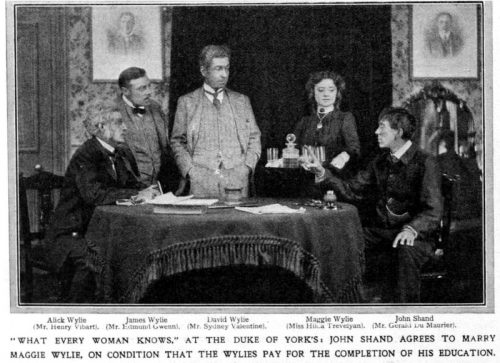
DAVID [sternly]. Woman. [But even this does not budge her.] Very well then, sit there, but don’t interfere, mind. Mr. Shand, we’re willing, the three of us, to lay out L300 on your education if—
JOHN. Take care.
DAVID [slowly, which is not his wont]. On condition that five years from now, Maggie Wylie, if still unmarried, can claim to marry you, should such be her wish; the thing to be perfectly open on her side, but you to be strictly tied down.
JAMES [enlightened]. So, so.
DAVID [resuming his smart manner]. Now, what have you to say? Decide.
JOHN [after a pause]. I regret to say—
MAGGIE. It doesn’t matter what he regrets to say, because I decide against it. And I think it was very ill-done of you to make any such proposal.
DAVID [without looking at her]. Quiet, Maggie.
JOHN [looking at her]. I must say, Miss Maggie, I don’t see what reasons YOU can have for being so set against it.
MAGGIE. If you would grow a beard, Mr. Shand, the reasons wouldn’t be quite so obvious.
JOHN. I’ll never grow a beard.
MAGGIE. Then you’re done for at the start.
ALICK. Come, come.
MAGGIE. Seeing I have refused the young man—
JOHN. Refused!
DAVID. That’s no reason why we shouldn’t have his friendly opinion. Your objections, Mr. Shand?
JOHN. Simply, it’s a one-sided bargain. I admit I’m no catch at present; but what could a man of my abilities not soar to with three hundred pounds? Something far above what she could aspire to.
MAGGIE. Oh, indeed!
DAVID. The position is that without the three hundred you can’t soar.
JOHN. You have me there.
MAGGIE. Yes, but—
ALICK. You see YOU’RE safeguarded, Maggie; you don’t need to take him unless you like, but he has to take you.
JOHN. That’s an unfair arrangement also.
MAGGIE. I wouldn’t dream of it without that condition.
JOHN. Then you ARE thinking of it?
MAGGIE. Poof!
DAVID. It’s a good arrangement for you, Mr. Shand. The chances are you’ll never have to go on with it, for in all probability she’ll marry soon.
JAMES. She’s tremendous run after.
JOHN. Even if that’s true, it’s just keeping me in reserve in case she misses doing better.
DAVID [relieved]. That’s the situation in a nutshell.
JOHN. Another thing. Supposing I was to get fond of her?
ALICK [wistfully]. It’s very likely.
JOHN. Yes, and then suppose she was to give me the go-by?
DAVID. You have to risk that.
JOHN. Or take it the other way. Supposing as I got to know her I COULD NOT endure her?
DAVID [suavely]. You have both to take risks.
JAMES [less suavely]. What you need, John Shand, is a clout on the head.
JOHN. Three hundred pounds is no great sum.
DAVID. You can take it or leave it.
ALICK. No great sum for a student studying for the ministry!
JOHN. Do you think that with that amount of money I would stop short at being a minister?
DAVID. That’s how I like to hear you speak. A young Scotsman of your ability let loose upon the world with L300, what could he not do? It’s almost appalling to think of; especially if he went among the English.
JOHN. What do you think, Miss Maggie?
MAGGIE [who is knitting]. I have no thoughts on the subject either way.
JOHN [after looking her over]. What’s her age? She looks young, but they say it’s the curls that does it.
DAVID [rather happily]. She’s one of those women who are eternally young.
JOHN. I can’t take that for an answer.
DAVID. She’s twenty-five.
JOHN. I’m just twenty-one.
JAMES. I read in a book that about four years’ difference in the ages is the ideal thing. [As usual he is disregarded.]
DAVID. Well, Mr. Shand?
JOHN [where is his mother?]. I’m willing if she’s willing.
DAVID. Maggie?
MAGGIE. There can be no ‘if’ about it. It must be an offer.
JOHN. A Shand give a Wylie such a chance to humiliate him? Never.
MAGGIE. Then all is off.
DAVID. Come, come, Mr. Shand, it’s just a form.
JOHN [reluctantly]. Miss Maggie, will you?
MAGGIE [doggedly]. Is it an offer?
JOHN [dourly]. Yes.
MAGGIE [rising]. Before I answer I want first to give you a chance of drawing back.
DAVID. Maggie.
MAGGIE [bravely]. When they said that I have been run after they were misleading you. I’m without charm; nobody has ever been after me.
JOHN. Oho!
ALICK. They will be yet.
JOHN [the innocent]. It shows at least that you haven’t been after them.
[His hosts exchange a self-conscious glance.]
MAGGIE. One thing more; David said I’m twenty-five, I’m twenty-six.
JOHN. Aha!
MAGGIE. Now be practical. Do you withdraw from the bargain, or do you not?
JOHN [on reflection]. It’s a bargain.
MAGGIE. Then so be it.
DAVID [hurriedly]. And that’s settled. Did you say you would take it hot, Mr. Shand?
JOHN. I think I’ll take it neat.
[The others decide to take it hot, and there is some careful business here with the toddy ladles.]
ALICK. Here’s to you, and your career.
JOHN. Thank you. To you, Miss Maggie. Had we not better draw up a legal document? Lawyer Crosbie could do it on the quiet.
DAVID. Should we do that, or should we just trust to one another’s honour?
ALICK [gallantly]. Let Maggie decide.
MAGGIE. I think we would better have a legal document.
DAVID. We’ll have it drawn up to-morrow. I was thinking the best way would be for to pay the money in five yearly instalments.
JOHN. I was thinking, better bank the whole sum in my name at once.
ALICK. I think David’s plan’s the best.
JOHN. I think not. Of course if it’s not convenient to you—
DAVID [touched to the quick]. It’s perfectly convenient. What do you say, Maggie?
MAGGIE. I agree with John.
DAVID [with an odd feeling that MAGGIE is now on the other side]. Very well.
JOHN. Then as that’s settled I think I’ll be stepping. [He is putting his papers back in the bag.]
ALICK [politely]. If you would like to sit on at your books—
JOHN. As I can come at any orra time now I think I’ll be stepping. [MAGGIE helps him into his topcoat.]
MAGGIE. Have you a muffler, John?
JOHN. I have. [He gets it from his pocket.]
MAGGIE. You had better put it twice round. [She does this for him.]
DAVID. Well, good-night to you, Mr. Shand.
ALICK. And good luck.
JOHN. Thank you. The same to you. And I’ll cry in at your office in the morning before the 6:20 is due.
DAVID. I’ll have the document ready for you. [There is the awkward pause that sometimes follows great events.] I think, Maggie, you might see Mr. Shand to the door.
MAGGIE. Certainly. [JOHN is going by the window.] This way, John.
[She takes him off by the more usual exit.]
DAVID. He’s a fine frank fellow; and you saw how cleverly he got the better of me about banking the money. [As the heads of the conspirators come gleefully together] I tell you, father, he has a grand business head.
ALICK. Lads, he’s canny. He’s cannier than any of us.
JAMES. Except maybe Maggie. He has no idea what a remarkable woman Maggie is.
ALICK. Best he shouldn’t know. Men are nervous of remarkable women.
JAMES. She’s a long time in coming back.
DAVID [not quite comfortable]. It’s a good sign. H’sh. What sort of a night is it, Maggie?
MAGGIE. It’s a little blowy.
[She gets a large dustcloth which is lying folded on a shelf, and proceeds to spread it over the fine chair. The men exchange self-conscious glances.]
DAVID [stretching himself]. Yes—well, well, oh yes. It’s getting late. What is it with you, father?
ALICK. I’m ten forty-two.
JAMES. I’m ten-forty.
DAVID. Ten forty-two.
[They wind up their watches.]
MAGGIE. It’s high time we were bedded. [She puts her hands on their shoulders lovingly, which is the very thing they have been trying to avoid.] You’re very kind to me.
DAVID. Havers.
ALICK. Havers.
JAMES [but this does not matter]. Havers.
MAGGIE [a little dolefully]. I’m a sort of sorry for the young man, David.
DAVID. Not at all. You’ll be the making of him. [She lifts the two volumes.] Are you taking the books to your bed, Maggie?
MAGGIE. Yes. I don’t want him to know things I don’t know myself.
[She departs with the books; and ALICK and DAVID, the villains, now want to get away from each other.]
ALICK. Yes—yes. Oh yes—ay, man—it is so—umpha. You’ll lift the big coals off, David.
[He wanders away to his spring mattress. DAVID removes the coals.]
JAMES [who would like to sit down and have an argy-bargy]. It’s a most romantical affair. [But he gets no answer.] I wonder how it’ll turn out? [No answer.] She’s queer, Maggie. I wonder how some clever writers has never noticed how queer women are. It’s my belief you could write a whole book about them. [DAVID remains obdurate.] It was very noble of her to tell him she’s twenty-six. [Muttering as he too wanders away.] But I thought she was twenty-seven.
[DAVID turns out the light.]