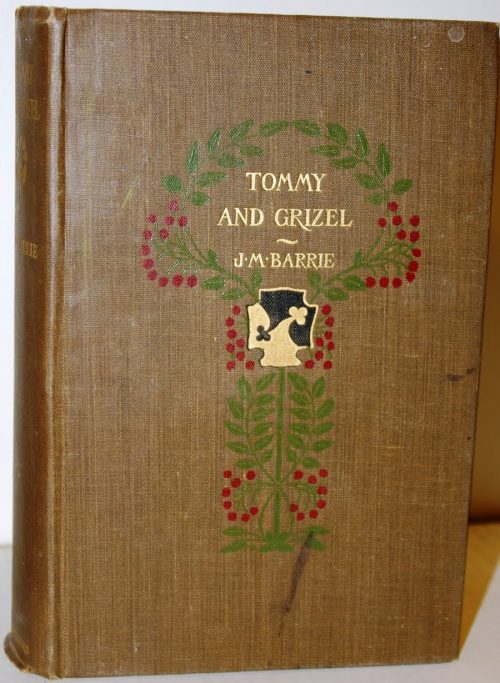
Tommy and Grizel by James Matthew Barrie
TOMMY AND GRIZEL
BY
J. M. BARRIE
ILLUSTRATED BY BERNARD PARTRIDGE
1900, 1912
TOMMY AND GRIZEL CONTENTS
TOMMY AND GRIZEL CHAPTER I. HOW TOMMY FOUND A WAY
TOMMY AND GRIZEL CHAPTER II. THE SEARCH FOR THE TREASURE
TOMMY AND GRIZEL CHAPTER III. SANDYS ON WOMAN
TOMMY AND GRIZEL CHAPTER IV. GRIZEL OF THE CROOKED SMILE
TOMMY AND GRIZEL CHAPTER V. THE TOMMY MYTH
TOMMY AND GRIZEL CHAPTER VI. GHOSTS THAT HAUNT THE DEN
TOMMY AND GRIZEL CHAPTER VII. THE BEGINNING OF THE DUEL
TOMMY AND GRIZEL CHAPTER VIII. WHAT GRIZEL’S EYES SAID
TOMMY AND GRIZEL CHAPTER IX. GALLANT BEHAVIOUR OF T. SANDYS
TOMMY AND GRIZEL CHAPTER X. GAVINIA ON THE TRACK
TOMMY AND GRIZEL CHAPTER XI. THE TEA-PARTY
TOMMY AND GRIZEL CHAPTER XII. IN WHICH A COMEDIAN CHALLENGES TRAGEDY TO BOWLS
TOMMY AND GRIZEL CHAPTER XIII. LITTLE WELLS OF GLADNESS
TOMMY AND GRIZEL CHAPTER XIV. ELSPETH
TOMMY AND GRIZEL CHAPTER XV. BY PROSEN WATER
TOMMY AND GRIZEL CHAPTER XVI. “HOW COULD YOU HURT YOUR GRIZEL SO!”
TOMMY AND GRIZEL CHAPTER XVII. HOW TOMMY SAVED THE FLAG
TOMMY AND GRIZEL CHAPTER XVIII. THE GIRL SHE HAD BEEN
TOMMY AND GRIZEL CHAPTER XIX. OF THE CHANGE IN THOMAS
TOMMY AND GRIZEL CHAPTER XX. A LOVE-LETTER
TOMMY AND GRIZEL CHAPTER XXI. THE ATTEMPT TO CARRY ELSPETH BY NUMBERS
TOMMY AND GRIZEL CHAPTER XXII. GRIZEL’S GLORIOUS HOUR
TOMMY AND GRIZEL CHAPTER XXIII. TOMMY LOSES GRIZEL
TOMMY AND GRIZEL CHAPTER XXIV. THE MONSTER
TOMMY AND GRIZEL CHAPTER XXV. MR. T. SANDYS HAS RETURNED TO TOWN
TOMMY AND GRIZEL CHAPTER XXVI. GRIZEL ALL ALONE
TOMMY AND GRIZEL CHAPTER XXVII. GRIZEL’S JOURNEY
TOMMY AND GRIZEL CHAPTER XXVIII. TWO OF THEM
TOMMY AND GRIZEL CHAPTER XXIX. THE RED LIGHT
TOMMY AND GRIZEL CHAPTER XXX. THE LITTLE GODS DESERT HIM
TOMMY AND GRIZEL CHAPTER XXXI. “THE MAN WITH THE GREETIN’ EYES”
TOMMY AND GRIZEL CHAPTER XXXII. TOMMY’S BEST WORK
TOMMY AND GRIZEL CHAPTER XXXIII. THE LITTLE GODS RETURN WITH A LADY
TOMMY AND GRIZEL CHAPTER XXXIV. A WAY IS FOUND FOR TOMMY
TOMMY AND GRIZEL CHAPTER XXXV. THE PERFECT LOVER
TOMMY AND GRIZEL
TOMMY AND GRIZEL CHAPTER I HOW TOMMY FOUND A WAY
O.P. Pym, the colossal Pym, that vast and rolling figure, who never knew what he was to write about until he dipped grandly, an author in such demand that on the foggy evening which starts our story his publishers have had his boots removed lest he slip thoughtlessly round the corner before his work is done, as was the great man’s way—shall we begin with him, or with Tommy, who has just arrived in London, carrying his little box and leading a lady by the hand? It was Pym, as we are about to see, who in the beginning held Tommy up to the public gaze, Pym who first noticed his remarkable indifference to female society, Pym who gave him——But alack! does no one remember Pym for himself? Is the king of the Penny Number already no more than a button that once upon a time kept Tommy’s person together? And we are at the night when they first met! Let us hasten into Marylebone before little Tommy arrives and Pym is swallowed like an oyster.
This is the house, 22 Little Owlet Street, Marylebone, but which were his rooms it is less easy to determine, for he was a lodger who flitted placidly from floor to floor according to the state of his finances, carrying his apparel and other belongings in one great armful, and spilling by the way. On this particular evening he was on the second floor front, which had a fireplace in the corner, furniture all his landlady’s and mostly horsehair, little to suggest his calling save a noble saucerful of ink, and nothing to draw attention from Pym, who lolled, gross and massive, on a sofa, one leg over the back of it, the other drooping, his arms extended, and his pipe, which he could find nowhere, thrust between the buttons of his waistcoat, an agreeable pipe-rack. He wore a yellow dressing-gown, or could scarcely be said to wear it, for such of it as was not round his neck he had converted into a cushion for his head, which is perhaps the part of him we should have turned to first It was a big round head, the plentiful gray hair in tangles, possibly because in Pym’s last flitting the comb had dropped over the banisters; the features were ugly and beyond life-size, yet the forehead had altered little except in colour since the day when he was near being made a fellow of his college; there was sensitiveness left in the thick nose, humour in the eyes, though they so often watered; the face had gone to flabbiness at last, but not without some lines and dents, as if the head had resisted the body for a space before the whole man rolled contentedly downhill.
He had no beard. “Young man, let your beard grow.” Those who have forgotten all else about Pym may recall him in these words. They were his one counsel to literary aspirants, who, according as they took it, are now bearded and prosperous or shaven and on the rates. To shave costs threepence, another threepence for loss of time—nearly ten pounds a year, three hundred pounds since Pym’s chin first bristled. With his beard he could have bought an annuity or a cottage in the country, he could have had a wife and children, and driven his dog-cart, and been made a church-warden. All gone, all shaved, and for what? When he asked this question he would move his hand across his chin with a sigh, and so, bravely to the barber’s.
Pym was at present suffering from an ailment that had spread him out on that sofa again and again—acute disinclination to work.
Meanwhile all the world was waiting for his new tale; so the publishers, two little round men, have told him. They have blustered, they have fawned, they have asked each other out to talk it over behind the door.
Has he any idea of what the story is to be about?
He has no idea.
Then at least, Pym—excellent Pym—sit down and dip, and let us see what will happen.
He declined to do even that. While all the world waited, this was Pym’s ultimatum:
“I shall begin the damned thing at eight o’clock.”
Outside, the fog kept changing at intervals from black to white, as lazily from white to black (the monster blinking); there was not a sound from the street save of pedestrians tapping with their sticks on the pavement as they moved forward warily, afraid of an embrace with the unknown; it might have been a city of blind beggars, one of them a boy.
At eight o’clock Pym rose with a groan and sat down in his stocking-soles to write his delicious tale. He was now alone. But though his legs were wound round his waste-paper basket, and he dipped often and loudly in the saucer, like one ringing at the door of Fancy, he could not get the idea that would set him going. He was still dipping for inspiration when T. Sandys, who had been told to find the second floor for himself, knocked at the door, and entered, quaking.
“I remember it vividly,” Pym used to say when questioned in the after years about this his first sight of Tommy, “and I hesitate to decide which impressed me more, the richness of his voice, so remarkable in a boy of sixteen, or his serene countenance, with its noble forehead, behind which nothing base could lurk.”
Pym, Pym! it is such as you that makes the writing of biography difficult. The richness of Tommy’s voice could not have struck you, for at that time it was a somewhat squeaky voice; and as for the noble forehead behind which nothing base could lurk, how could you say that, Pym, you who had a noble forehead yourself?
No; all that Pym saw was a pasty-faced boy sixteen years old, and of an appearance mysteriously plain; hair light brown, and waving defiance to the brush; nothing startling about him but the expression of his face, which was almost fearsomely solemn and apparently unchangeable. He wore his Sunday blacks, of which the trousers might with advantage have borrowed from the sleeves; and he was so nervous that he had to wet his lips before he could speak. He had left the door ajar for a private reason; but Pym, misunderstanding, thought he did it to fly the more readily if anything was flung at him, and so concluded that he must be a printer’s devil. Pym had a voice that shook his mantelpiece ornaments; he was all on the same scale as his ink-pot. “Your Christian name, boy?” he roared hopefully, for it was thus he sometimes got the idea that started him.
“Thomas,” replied the boy.
Pym gave him a look of disgust “You may go,” he said. But when he looked up presently, Thomas was still there. He was not only there, but whistling—a short, encouraging whistle that seemed to be directed at the door. He stopped quickly when Pym looked up, but during the remainder of the interview he emitted this whistle at intervals, always with that anxious glance at his friend the door; and its strained joviality was in odd contrast with his solemn face, like a cheery tune played on the church organ.
“Begone!” cried Pym.
“My full name,” explained Tommy, who was speaking the English correctly, but with a Scots accent, “is Thomas Sandys. And fine you know who that is,” he added, exasperated by Pym’s indifference. “I’m the T. Sandys that answered your advertisement.”
Pym knew who he was now. “You young ruffian,” he gasped, “I never dreamt that you would come!”
“I have your letter engaging me in my pocket,” said Tommy, boldly, and he laid it on the table. Pym surveyed it and him in comic dismay, then with a sudden thought produced nearly a dozen letters from a drawer, and dumped them down beside the other. It was now his turn to look triumphant and Tommy aghast.
Pym’s letters were all addressed from the Dubb of Prosen Farm, near Thrums, N.B., to different advertisers, care of a London agency, and were Tommy’s answers to the “wants” in a London newspaper which had found its way to the far North. “X Y Z” was in need of a chemist’s assistant, and from his earliest years, said one of the letters, chemistry had been the study of studies for T. Sandys. He was glad to read, was T. Sandys, that one who did not object to long hours would be preferred, for it seemed to him that those who objected to long hours did not really love their work, their heart was not in it, and only where the heart is can the treasure be found.
“123” had a vacancy for a page-boy, “Glasgow Man” for a photographer; page-boy must not be over fourteen, photographer must not be under twenty. “I am a little over fourteen, but I look less,” wrote T. Sandys to “123”; “I am a little under twenty,” he wrote to “Glasgow Man,” “but I look more.” His heart was in the work.
To be a political organizer! If “H and H,” who advertised for one, only knew how eagerly the undersigned desired to devote his life to political organizing!
In answer to “Scholastic’s” advertisement for janitor in a boys’ school, T. Sandys begged to submit his name for consideration.
Undoubtedly the noblest letter was the one applying for the secretaryship of a charitable society, salary to begin at once, but the candidate selected must deposit one hundred pounds. The application was noble in its offer to make the work a labour of love, and almost nobler in its argument that the hundred pounds was unnecessary.
“Rex” had a vacancy in his drapery department. T. Sandys had made a unique study of drapery.
Lastly, “Anon” wanted an amanuensis. “Salary,” said “Anon,” who seemed to be a humourist, “salary large but uncertain.” He added with equal candour: “Drudgery great, but to an intelligent man the pickings may be considerable.” Pickings! Is there a finer word in the language? T. Sandys had felt that he was particularly good at pickings. But amanuensis? The thing was unknown to him; no one on the farm could tell him what it was. But never mind; his heart was in it.
All this correspondence had produced one reply, the letter on which Tommy’s hand still rested. It was a brief note, signed “O.P. Pym,” and engaging Mr. Sandys on his own recommendation, “if he really felt quite certain that his heart (treasure included) was in the work.” So far good, Tommy had thought when he received this answer, but there was nothing in it to indicate the nature of the work, nothing to show whether O.P. Pym was “Scholastic,” or “123,” or “Rex,” or any other advertiser in particular. Stop, there was a postscript: “I need not go into details about your duties, as you assure me you are so well acquainted with them, but before you join me please send (in writing) a full statement of what you think they are.”
There were delicate reasons why Mr. Sandys could not do that, but oh, he was anxious to be done with farm labour, so he decided to pack and risk it. The letter said plainly that he was engaged; what for he must find out slyly when he came to London. So he had put his letter firmly on Pym’s table; but it was a staggerer to find that gentleman in possession of the others.
One of these was Pym’s by right; the remainder were a humourous gift from the agent who was accustomed to sift the correspondence of his clients. Pym had chuckled over them, and written a reply that he flattered himself would stump the boy; then he had unexpectedly come into funds (he found a forgotten check while searching his old pockets for tobacco-crumbs), and in that glory T. Sandys escaped his memory. Result, that they were now face to face.
A tiny red spot, not noticeable before, now appeared in Tommy’s eyes. It was never there except when he was determined to have his way. Pym, my friend, yes, and everyone of you who is destined to challenge Tommy, ‘ware that red light!
“Well, which am I?” demanded Pym, almost amused, Tommy was so obviously in a struggle with the problem.
The saucer and the blank pages told nothing. “Whichever you are,” the boy answered heavily, “it’s not herding nor foddering cattle, and so long as it’s not that, I’ll put my heart in it, and where the heart is, there the treasure—”
He suddenly remembered that his host must be acquainted with the sentiment.
Easy-going Pym laughed, then said irritably, “Of what use could a mere boy be to me?”
“Then it’s not the page-boy!” exclaimed Tommy, thankfully.
“Perhaps I am ‘Scholastic,'” suggested Pym.
“No,” said Tommy, after a long study of his face.
Pym followed this reasoning, and said touchily, “Many a schoolmaster has a red face.”
“Not that kind of redness,” explained Tommy, without delicacy.
“I am ‘H and H,'” said Pym.
“You forget you wrote to me as one person,” replied Tommy. “So I did. That was because I am the chemist; and I must ask you, Thomas, for your certificate.”
Tommy believed him this time, and Pym triumphantly poured himself a glass of whisky, spilling some of it on his dressing-gown.
“Not you,” said Tommy, quickly; “a chemist has a steady hand.”
“Confound you!” cried Pym, “what sort of a boy is this?”
“If you had been the draper you would have wiped the drink off your gown,” continued Tommy, thoughtfully, “and if you had been ‘Glasgow Man’ you would have sucked it off, and if you had been the charitable society you wouldn’t swear in company.” He flung out his hand. “I’ll tell you who you are,” he said sternly, “you’re ‘Anon.'”
Under this broadside Pym succumbed. He sat down feebly. “Right,” he said, with a humourous groan, “and I shall tell you who you are. I am afraid you are my amanuensis!”
Tommy immediately whistled, a louder and more glorious note than before.
“Don’t be so cocky,” cried Pym, in sudden rebellion. “You are only my amanuensis if you can tell me what that is. If you can’t—out you go!”
He had him at last! Not he!
“An amanuensis,” said Tommy, calmly, “is one who writes to dictation. Am I to bring in my box? It’s at the door.”
This made Pym sit down again. “You didn’t know what an amanuensis was when you answered my advertisement,” he said.
“As soon as I got to London,” Tommy answered, “I went into a bookseller’s shop, pretending I wanted to buy a dictionary, and I looked the word up.”
“Bring in your box,” Pym said, with a groan.
But it was now Tommy’s turn to hesitate. “Have you noticed,” he asked awkwardly, “that I sometimes whistle?”
“Don’t tell me,” said Pym, “that you have a dog out there.”
“It’s not a dog,” Tommy replied cautiously.
Pym had resumed his seat at the table and was once more toying with his pen. “Open the door,” he commanded, “and let me see what you have brought with you.”
Tommy obeyed gingerly, and then Pym gaped, for what the open door revealed to him was a tiny roped box with a girl of twelve sitting on it. She was dressed in some dull-coloured wincey, and looked cold and patient and lonely, and as she saw the big man staring at her she struggled in alarm to her feet, and could scarce stand on them. Tommy was looking apprehensively from her to Pym.
“Good God, boy!” roared Pym, “are you married?”
“No,” cried Tommy, in agony, “she’s my sister, and we’re orphans, and did you think I could have the heart to leave Elspeth behind?” He took her stoutly by the hand.
“And he never will marry,” said little Elspeth, almost fiercely; “will you, Tommy?”
“Never!” said Tommy, patting her and glaring at Pym.
But Pym would not have it. “Married!” he shouted. “Magnificent!” And he dipped exultantly, for he had got his idea at last. Forgetting even that he had an amanuensis, he wrote on and on and on.
“He smells o’ drink,” Elspeth whispered.
“All the better,” replied Tommy, cheerily. “Make yourself at home, Elspeth; he’s the kind I can manage. Was there ever a kind I couldna manage?” he whispered, top-heavy with conceit.
“There was Grizel,” Elspeth said, rather thoughtlessly; and then Tommy frowned.