Margaret Ogilvy by James Matthew Barrie
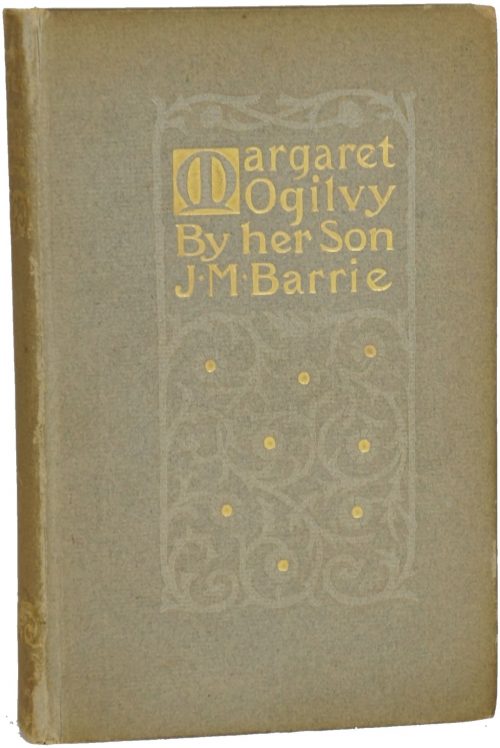
MARGARET OGILVY
by her son
J. M. BARRIE
Second Edition
Completing Twentieth Thousand
london
HODDER AND STOUGHTON
27 paternoster row
1897
to
the memory of
my sister
Jane Ann
MARGARET OGILVY CONTENTS
MARGARET OGILVY CHAPTER I HOW MY MOTHER GOT HER SOFT FACE
MARGARET OGILVY CHAPTER II WHAT SHE HAD BEEN
MARGARET OGILVY CHAPTER III WHAT I SHOULD BE
MARGARET OGILVY CHAPTER IV AN EDITOR
MARGARET OGILVY CHAPTER V A DAY OF HER LIFE
MARGARET OGILVY CHAPTER VI HER MAID OF ALL WORK
MARGARET OGILVY CHAPTER VII R. L. S.
MARGARET OGILVY CHAPTER VIII A PANIC IN THE HOUSE
MARGARET OGILVY CHAPTER IX MY HEROINE
MARGARET OGILVY CHAPTER X ART THOU AFRAID HIS POWER SHALL FAIL?
CHAPTER I—HOW MY MOTHER GOT HER SOFT FACE
On the day I was born we bought six hair-bottomed chairs, and in our little house it was an event, the first great victory in a woman’s long campaign; how they had been laboured for, the pound-note and the thirty threepenny-bits they cost, what anxiety there was about the purchase, the show they made in possession of the west room, my father’s unnatural coolness when he brought them in (but his face was white)—I so often heard the tale afterwards, and shared as boy and man in so many similar triumphs, that the coming of the chairs seems to be something I remember, as if I had jumped out of bed on that first day, and run ben to see how they looked. I am sure my mother’s feet were ettling to be ben long before they could be trusted, and that the moment after she was left alone with me she was discovered barefooted in the west room, doctoring a scar (which she had been the first to detect) on one of the chairs, or sitting on them regally, or withdrawing and re-opening the door suddenly to take the six by surprise. And then, I think, a shawl was flung over her (it is strange to me to think it was not I who ran after her with the shawl), and she was escorted sternly back to bed and reminded that she had promised not to budge, to which her reply was probably that she had been gone but an instant, and the implication that therefore she had not been gone at all. Thus was one little bit of her revealed to me at once: I wonder if I took note of it. Neighbours came in to see the boy and the chairs. I wonder if she deceived me when she affected to think that there were others like us, or whether I saw through her from the first, she was so easily seen through. When she seemed to agree with them that it would be impossible to give me a college education, was I so easily taken in, or did I know already what ambitions burned behind that dear face? when they spoke of the chairs as the goal quickly reached, was I such a newcomer that her timid lips must say ‘They are but a beginning’ before I heard the words? And when we were left together, did I laugh at the great things that were in her mind, or had she to whisper them to me first, and then did I put my arm round her and tell her that I would help? Thus it was for such a long time: it is strange to me to feel that it was not so from the beginning.
It is all guess-work for six years, and she whom I see in them is the woman who came suddenly into view when they were at an end. Her timid lips I have said, but they were not timid then, and when I knew her the timid lips had come. The soft face—they say the face was not so soft then. The shawl that was flung over her—we had not begun to hunt her with a shawl, nor to make our bodies a screen between her and the draughts, nor to creep into her room a score of times in the night to stand looking at her as she slept. We did not see her becoming little then, nor sharply turn our heads when she said wonderingly how small her arms had grown. In her happiest moments—and never was a happier woman—her mouth did not of a sudden begin to twitch, and tears to lie on the mute blue eyes in which I have read all I know and would ever care to write. For when you looked into my mother’s eyes you knew, as if He had told you, why God sent her into the world—it was to open the minds of all who looked to beautiful thoughts. And that is the beginning and end of literature. Those eyes that I cannot see until I was six years old have guided me through life, and I pray God they may remain my only earthly judge to the last. They were never more my guide than when I helped to put her to earth, not whimpering because my mother had been taken away after seventy-six glorious years of life, but exulting in her even at the grave.
She had a son who was far away at school. I remember very little about him, only that he was a merry-faced boy who ran like a squirrel up a tree and shook the cherries into my lap. When he was thirteen and I was half his age the terrible news came, and I have been told the face of my mother was awful in its calmness as she set off to get between Death and her boy. We trooped with her down the brae to the wooden station, and I think I was envying her the journey in the mysterious wagons; I know we played around her, proud of our right to be there, but I do not recall it, I only speak from hearsay. Her ticket was taken, she had bidden us good-bye with that fighting face which I cannot see, and then my father came out of the telegraph-office and said huskily, ‘He’s gone!’ Then we turned very quietly and went home again up the little brae. But I speak from hearsay no longer; I knew my mother for ever now.
That is how she got her soft face and her pathetic ways and her large charity, and why other mothers ran to her when they had lost a child. ‘Dinna greet, poor Janet,’ she would say to them; and they would answer, ‘Ah, Margaret, but you’re greeting yoursel.’ Margaret Ogilvy had been her maiden name, and after the Scotch custom she was still Margaret Ogilvy to her old friends. Margaret Ogilvy I loved to name her. Often when I was a boy, ‘Margaret Ogilvy, are you there?’ I would call up the stair.
She was always delicate from that hour, and for many months she was very ill. I have heard that the first thing she expressed a wish to see was the christening robe, and she looked long at it and then turned her face to the wall. That was what made me as a boy think of it always as the robe in which he was christened, but I knew later that we had all been christened in it, from the oldest of the family to the youngest, between whom stood twenty years. Hundreds of other children were christened in it also, such robes being then a rare possession, and the lending of ours among my mother’s glories. It was carried carefully from house to house, as if it were itself a child; my mother made much of it, smoothed it out, petted it, smiled to it before putting it into the arms of those to whom it was being lent; she was in our pew to see it borne magnificently (something inside it now) down the aisle to the pulpit-side, when a stir of expectancy went through the church and we kicked each other’s feet beneath the book-board but were reverent in the face; and however the child might behave, laughing brazenly or skirling to its mother’s shame, and whatever the father as he held it up might do, look doited probably and bow at the wrong time, the christening robe of long experience helped them through. And when it was brought back to her she took it in her arms as softly as if it might be asleep, and unconsciously pressed it to her breast: there was never anything in the house that spoke to her quite so eloquently as that little white robe; it was the one of her children that always remained a baby. And she had not made it herself, which was the most wonderful thing about it to me, for she seemed to have made all other things. All the clothes in the house were of her making, and you don’t know her in the least if you think they were out of the fashion; she turned them and made them new again, she beat them and made them new again, and then she coaxed them into being new again just for the last time, she let them out and took them in and put on new braid, and added a piece up the back, and thus they passed from one member of the family to another until they reached the youngest, and even when we were done with them they reappeared as something else. In the fashion! I must come back to this. Never was a woman with such an eye for it. She had no fashion-plates; she did not need them. The minister’s wife (a cloak), the banker’s daughters (the new sleeve)—they had but to pass our window once, and the scalp, so to speak, was in my mother’s hands. Observe her rushing, scissors in hand, thread in mouth, to the drawers where her daughters’ Sabbath clothes were kept. Or go to church next Sunday, and watch a certain family filing in, the boy lifting his legs high to show off his new boots, but all the others demure, especially the timid, unobservant-looking little woman in the rear of them. If you were the minister’s wife that day or the banker’s daughters you would have got a shock. But she bought the christening robe, and when I used to ask why, she would beam and look conscious, and say she wanted to be extravagant once. And she told me, still smiling, that the more a woman was given to stitching and making things for herself, the greater was her passionate desire now and again to rush to the shops and ‘be foolish.’ The christening robe with its pathetic frills is over half a century old now, and has begun to droop a little, like a daisy whose time is past; but it is as fondly kept together as ever: I saw it in use again only the other day.
My mother lay in bed with the christening robe beside her, and I peeped in many times at the door and then went to the stair and sat on it and sobbed. I know not if it was that first day, or many days afterwards, that there came to me, my sister, the daughter my mother loved the best; yes, more I am sure even than she loved me, whose great glory she has been since I was six years old. This sister, who was then passing out of her ‘teens, came to me with a very anxious face and wringing her hands, and she told me to go ben to my mother and say to her that she still had another boy. I went ben excitedly, but the room was dark, and when I heard the door shut and no sound come from the bed I was afraid, and I stood still. I suppose I was breathing hard, or perhaps I was crying, for after a time I heard a listless voice that had never been listless before say, ‘Is that you?’ I think the tone hurt me, for I made no answer, and then the voice said more anxiously ‘Is that you?’ again. I thought it was the dead boy she was speaking to, and I said in a little lonely voice, ‘No, it’s no him, it’s just me.’ Then I heard a cry, and my mother turned in bed, and though it was dark I knew that she was holding out her arms.
After that I sat a great deal in her bed trying to make her forget him, which was my crafty way of playing physician, and if I saw any one out of doors do something that made the others laugh I immediately hastened to that dark room and did it before her. I suppose I was an odd little figure; I have been told that my anxiety to brighten her gave my face a strained look and put a tremor into the joke (I would stand on my head in the bed, my feet against the wall, and then cry excitedly, ‘Are you laughing, mother?’)—and perhaps what made her laugh was something I was unconscious of, but she did laugh suddenly now and then, whereupon I screamed exultantly to that dear sister, who was ever in waiting, to come and see the sight, but by the time she came the soft face was wet again. Thus I was deprived of some of my glory, and I remember once only making her laugh before witnesses. I kept a record of her laughs on a piece of paper, a stroke for each, and it was my custom to show this proudly to the doctor every morning. There were five strokes the first time I slipped it into his hand, and when their meaning was explained to him he laughed so boisterously, that I cried, ‘I wish that was one of hers!’ Then he was sympathetic, and asked me if my mother had seen the paper yet, and when I shook my head he said that if I showed it to her now and told her that these were her five laughs he thought I might win another. I had less confidence, but he was the mysterious man whom you ran for in the dead of night (you flung sand at his window to waken him, and if it was only toothache he extracted the tooth through the open window, but when it was something sterner he was with you in the dark square at once, like a man who slept in his topcoat), so I did as he bade me, and not only did she laugh then but again when I put the laugh down, so that though it was really one laugh with a tear in the middle I counted it as two.
It was doubtless that same sister who told me not to sulk when my mother lay thinking of him, but to try instead to get her to talk about him. I did not see how this could make her the merry mother she used to be, but I was told that if I could not do it nobody could, and this made me eager to begin. At first, they say, I was often jealous, stopping her fond memories with the cry, ‘Do you mind nothing about me?’ but that did not last; its place was taken by an intense desire (again, I think, my sister must have breathed it into life) to become so like him that even my mother should not see the difference, and many and artful were the questions I put to that end. Then I practised in secret, but after a whole week had passed I was still rather like myself. He had such a cheery way of whistling, she had told me, it had always brightened her at her work to hear him whistling, and when he whistled he stood with his legs apart, and his hands in the pockets of his knickerbockers. I decided to trust to this, so one day after I had learned his whistle (every boy of enterprise invents a whistle of his own) from boys who had been his comrades, I secretly put on a suit of his clothes, dark grey they were, with little spots, and they fitted me many years afterwards, and thus disguised I slipped, unknown to the others, into my mother’s room. Quaking, I doubt not, yet so pleased, I stood still until she saw me, and then—how it must have hurt her! ‘Listen!’ I cried in a glow of triumph, and I stretched my legs wide apart and plunged my hands into the pockets of my knickerbockers, and began to whistle.
She lived twenty-nine years after his death, such active years until toward the end, that you never knew where she was unless you took hold of her, and though she was frail henceforth and ever growing frailer, her housekeeping again became famous, so that brides called as a matter of course to watch her ca’ming and sanding and stitching: there are old people still, one or two, to tell with wonder in their eyes how she could bake twenty-four bannocks in the hour, and not a chip in one of them. And how many she gave away, how much she gave away of all she had, and what pretty ways she had of giving it! Her face beamed and rippled with mirth as before, and her laugh that I had tried so hard to force came running home again. I have heard no such laugh as hers save from merry children; the laughter of most of us ages, and wears out with the body, but hers remained gleeful to the last, as if it were born afresh every morning. There was always something of the child in her, and her laugh was its voice, as eloquent of the past to me as was the christening robe to her. But I had not made her forget the bit of her that was dead; in those nine-and-twenty years he was not removed one day farther from her. Many a time she fell asleep speaking to him, and even while she slept her lips moved and she smiled as if he had come back to her, and when she woke he might vanish so suddenly that she started up bewildered and looked about her, and then said slowly, ‘My David’s dead!’ or perhaps he remained long enough to whisper why he must leave her now, and then she lay silent with filmy eyes. When I became a man and he was still a boy of thirteen, I wrote a little paper called ‘Dead this Twenty Years,’ which was about a similar tragedy in another woman’s life, and it is the only thing I have written that she never spoke about, not even to that daughter she loved the best. No one ever spoke of it to her, or asked her if she had read it: one does not ask a mother if she knows that there is a little coffin in the house. She read many times the book in which it is printed, but when she came to that chapter she would put her hands to her heart or even over her ears.