Customer Rating: 


Review Summary: Chivalric revival
Review: 'Sir Gawain and the Green Knight' (ca. 1400) is chivalric romance literature of the late Middle Ages. It is often thought of in conjunction with 'Beowulf' (ca. 800), but these works are nearly 600 years apart, as near to one another as 'Sir Gawain' is to our own time. It is a part of the "chivalric revival" of the Hundred Years' War period, when the old order of knights and chivalry was giving way to longbow armed peasants who could unceremoniously kill from a distance, when the three-orders of knight, peasant and priest was breaking down. In this period of rising violence, social turmoil, the Black Death, famine and other "Crisis of the 14th century", there was a nostalgia among the nobility for the old days, the romantic stories from the 11th and 12th centuries found new popularity. 'Sir Gawain' then is a continuation updated with contemporary aesthetics and sensibilities- a chivalric revival. It's this type of work that 'Don Quixote' would devastatingly satirize 200 years later, effectively putting the final nail in the coffin of the medieval romance and opening the way to a new form: the novel.
Armitage has done a great job with the translation, by keeping the alliteration intact it makes for excellent reading aloud, the tongue gets a real work-out but pretty soon the guttural Germanic accent takes over with a short, crisp, pounding rhythm. By the end you feel ready to become a good Medieval knight, or at least better understand the mindset.
Customer Rating: 


Review Summary: Sir Gawain and the Green Knight
Review: SIR GAWAIN AND THE GREEN KNIGHT: A NEW VERSE TRANSLATION TRANSLATED BY SIMON ARMITAGE: In February of 2000, renowned poet Seamus Heaney published a new verse translation of the classic anonymous epic poem "Beowulf." While not a complete literal translation, Heaney's version set out to emulate the poetic style and meter of the original writers of the poem. "Beowulf" was first committed to parchment around the year 1000, up to then it had only existed as a oral poem recited to friends, families and subjects over fires, in mead halls, and by bards to many people. Heaney's translation seeks to be this version, to be read aloud to people and appreciated in its original form. Heaney's Beowulf, in a bilingual edition with the original Old English verse on the left page and his translation on the right, has gone on to become the most popular translation; selected as the version for the Norton English Literature anthology; and has been made more accessible to ordinary readers who don't have a background in medieval literature.
"Sir Gawain and the Green Knight" is a poem much like "Beowulf." While not as epic in scale, it was likely first written down in the year 1400 and up to that point had been recited orally. It has survived in only one form, in the original early Middle English, and now resides at the British Library. Simon Armitage, like Heaney, has employed the use of the bilingual edition, with the original Middle English on the left page and his translation on the right, allowing the reader's eyes to wander from left to right and right to left, examining the translation and enjoying the story. If anything, the translation is more visible with this version, as Middle English is just a few steps away from our modern language and many words can be easily recognized, even if the spelling is barely decipherable. Armitage admits not going for a completely literal translation, but seeking to preserve the alliterative form of the original poem, even if it means using modern words and phrasing. The result is nevertheless a magnificent story which one reads, imagining what it was like being read or reading this poem aloud over six hundred years ago.
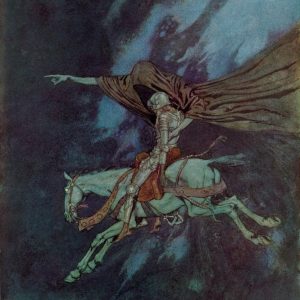
The story begins with King Arthur and his Knights of the Round Table, as they enjoy a marvelous feast in each other's company. Then the party is suddenly disturbed by the entrance of a giant man dressed in a full suit of green armor; by his side he carries a gigantic axe. He then challenges King Arthur with the offer for anyone to chop off his own head with the giant axe. If he survives, then the person will return to the Green Knight's abode to suffer the same fate in one year's time. Gawain being the just, proud and humble knight that he is offers to do this job for his king. Taking the axe he makes a mighty swing and easily separates the Green Knight's head from his shoulders. The Green Knight then picks up his head and makes the deal with Gawain to do the same to him on New Year's Day one year from now.
This essentially ends the first part of the poem, with the second part focusing on Gawain's journey across the lands to find the Green Knight's home. On the way he finds a great castle where a gracious king looks after him during the terrible weather. Yet, like the Green Knight, the king challenges him, offering to go hunting each morning, while his wife offers herself to Gawain, tempting him. The deal is that whatever Gawain does, shall be dealt to the king upon his return from the hunt. They do this for three days, but Gawain is pious and just, and does not give in to the king's wife, giving the king just kisses upon his cheek. The challenge certainly opens up an opportunity for some interesting interactions between Gawain and the king should Gawain have not been so just, but such was not the case. The last part of the story is of Gawain leaving the castle, finding the Green Knight and accepting the challenge visited on him a year ago.
Sir Gawain and the Green Knight, again much like Beowulf, has now been translated in this clear and alliterative version, making it accessible to any reader. Apart from being an entertaining tale, it asks many questions about what it is to be just and true to your king, how easy it is to be tempted. With a solid introduction from Armitage on the history of the poem, the book sets the scene well, letting the reader imagine what life was like in the fifteenth century, and more importantly, what the people were like back then.
For more reviews, please to go www.alexctelander.com.
Customer Rating: 


Review Summary: Falls on the ear with the percussion of hoof beats
Review: Every age produces its own version of Arthur and Camelot. The alliterative poem Sir Gawain and the Green Knight is separated from us by over 600 years but by even more from any putative historical Arthur. Its imagery belongs to the late medieval period rather than anything the post-Roman Dark Ages might have looked like. The juxtaposition of Christian and mythical elements is disconcerting and the real subject of the story (quite apart from the fantastic adventure elements) is far from obvious. It is actually about the conflict between Gawain's aspiration to impossible perfection and his recognition of his frail human reality. He feels that fear for his life has made him fail in his test. Yet Arthur's court and the Green Knight see him as an exemplar of chivalry and indeed the best of knights because protecting his life and knowing fear he manages to overcome it. What makes human success valuable is the possibility of shame. Sir Gawain and the Green Knight opens a window into a time when knighthood was a living institution and courtly love was the subject of much literature.
I first read Sir Gawain many years ago in the definitive JRR Tolkien translation, more out of an interest in Tolkien, than in Sir Gawain. The original text ranges from the somewhat comprehensible (Bot Arthure wolde not ete til al were served) to the completely unintelligible (Forthi, iwysse, bi yowre wylle, wende me bihoves). The translation is therefore everything. This new and remarkable alliterative verse translation by Simon Armitage is unexpected and amazing. The preface explains that in Germanic languages (like English) the accent is usually on the first syllable of a word, while in Romance languages (French, Italian, etc) the tonic syllable falls towards, or at the end, of words. Therefore, traditionally Germanic poets highlighted the beginning of words with alliteration whereas romance poets highlight the ends of words with rhyme. The alliterative style disappeared in the English language under the influence of French (Norman) poetry and so is alien to modern readers.
Gawain, however, was written in the alliterative style and Armitage's translation maintains this approach. The result is amazing. The poem falls on the ear like the percussive of hoof beats of Gawain's steed (Spiked with the spurs the steed sped away / with such force that the fire-stones sparked underfoot... lines 670-1). Good as the translation is one need only scan the original on the facing page to appreciate the achievement of the unknown author. The alliterative metrical pattern (a a/a x) is impeccable. It may be that over the centuries our language has grown less poetic.
Armitage displays his own particular genius, however. "...so the house and its hall were lit with happiness / and lords and ladies were luminous with joy (lines 48-9)", evokes images of merriment lit by torches and flickering firelight, without actually saying any such thing. Notice also the alliteration and read the words out loud. Contrast this scene with the imagery of Gawain's winter trek: "clouds shed their cargo of crystallized rain / which froze as it fell to the frost-glazed earth (lines 727-8)". We can feel the cold in our bones.
This is a wonderful and accessible translation of Sir Gawain and a must-read for those interested in medieval poetry. I wish I could hear it chanted by a bard.
Customer Rating: 


Review Summary: Good attempt
Review: The newest translation of Sir Gawain and the Green Knight by the poet Simon Armitage is an interesting and easy to read addition to the list of translations of the fascinating Middle English poem.
Armitage decided to keep the original's alliteration and metre by taking some liberties with vocabulary. In other words, there were a lot of anachronisms, too many for my taste. But, on the other hand, the result is very readable and accessible to non-medievalists. And, for the medievalists, you can look at the original text on the right page.
Armitage clearly loves the poem and worked for a long time on the translation. He explains in the introduction that he felt called to do this, so this is not a project driven solely by a publisher's desire to capitalize on the popularity of Seamus Heaney's Beowulf translation.
Customer Rating: 


Review Summary: Enjoyable to read
Review: I fully agree with reviewers lightman and leff... this is a wonderfully entertaining rendition of the poem. I read it through at one sitting and enjoyed it thoroughly.