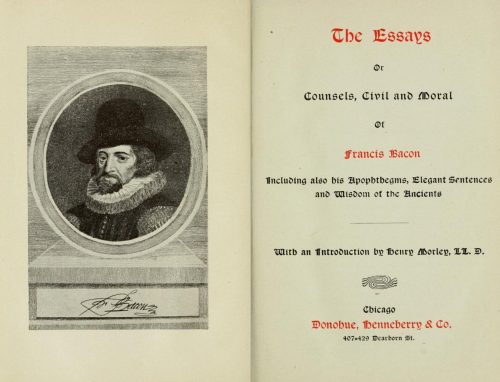
The Essays or Counsels, Civil and Moral by Francis Bacon
THE ESSAYS OR COUNSELS,
CIVIL AND MORAL,
OF FRANCIS Ld. VERULAM VISCOUNT ST. ALBANS
Francis Bacon
TO
THE RIGHT HONORABLE
MY VERY GOOD LORD
THE DUKE OF BUCKINGHAM
HIS GRACE, LORD
HIGH ADMIRAL OF ENGLAND
EXCELLENT LORD:
SALOMON saies; A good Name is as a precious oyntment; And I assure my selfe, such wil your Graces Name bee, with Posteritie. For your Fortune, and Merit both, have been Eminent. And you have planted Things, that are like to last. I doe now publish my Essayes; which, of all my other workes, have beene most Currant: For that, as it seemes, they come home, to Mens Businesse, and Bosomes. I have enlarged them, both in Number, and Weight; So that they are indeed a New Worke. I thought it therefore agreeable, to my Affection, and Obligation to your Grace, to prefix your Name before them, both in English, and in Latine. For I doe conceive, that the Latine Volume of them, (being in the Universall Language) may last, as long as Bookes last. My Instauration, I dedicated to the King: My Historie of Henry the Seventh, (which I have now also translated into Latine) and my Portions of Naturall History, to the Prince: And these I dedicate to your Grace; Being of the best Fruits, that by the good Encrease, which God gives to my Pen and Labours, I could yeeld. God leade your Grace by the Hand. Your Graces most Obliged and faithfull Servant,
FR. ST. ALBAN
THE ESSAYS
Essay Of Truth
Essay Of Death
Essay Of Unity In Religion
Essay Of Revenge
Essay Of Adversity
Essay Of Simulation And Dissimulation
Essay Of Parents And Children
Essay Of Marriage And Single Life
Essay Of Envy
Essay Of Love
Essay Of Great Place
Essay Of Boldness
Essay Of Goodness and Goodness Of Nature
Essay Of Nobility
Essay Of Seditions And Troubles
Essay Of Atheism
Essay Of Superstition
Essay Of Travel
Essay Of Empire
Essay Of Counsel
Essay Of Delays
Essay Of Cunning
Essay Of Wisdom For A Man’s Self
Essay Of Innovations
Essay Of Dispatch
Essay Of Seeming Wise
Essay Of Friendship
Essay Of Expense
Essay Of the True Greatness Of Kingdoms And Estates
Essay Of Regiment Of Health
Essay Of Suspicion
Essay Of Discourse
Essay Of Plantations
Essay Of Riches
Essay Of Prophecies
Essay Of Ambition
Essay Of Masques And Triumphs
Essay Of Nature In Men
Essay Of Custom And Education
Essay Of Fortune
Essay Of Usury
Essay Of Youth And Age
Essay Of Beauty
Essay Of Deformity
Essay Of Building
Essay Of Gardens
Essay Of Negotiating
Essay Of Followers And Friends
Essay Of Suitors
Essay Of Studies
Essay Of Faction
Essay Of Ceremonies, And Respects
Essay Of Praise
Essay Of Vain-glory
Essay Of Honor And Reputation
Essay Of Judicature
Essay Of Anger
Essay Of Vicissitude Of Things
Essay Of Fame
A Glossary Of Archaic Words And Phrases
Abridgment: miniature
Absurd: stupid, unpolished
Abuse: cheat, deceive
Aculeate: stinging
Adamant: loadstone
Adust: scorched
Advoutress: adulteress
Affect: like, desire
Antic: clown
Appose: question
Arietation: battering-ram
Audit: revenue
Avoidance: secret outlet
Battle: battalion
Bestow: settle in life
Blanch: flatter, evade
Brave: boastful
Bravery: boast, ostentation
Broke: deal in brokerage
Broken: shine by comparison
Broken music: part music
Cabinet: secret
Calendar: weather forecast
Card: chart, map
Care not to: are reckless
Cast: plan
Cat: cate, cake
Charge and adventure: cost and
risk
Check with: interfere
Chop: bandy words
Civil: peaceful
Close: secret, secretive
Collect: infer
Compound: compromise
Consent: agreement
Curious: elaborate
Custom: import duties
Deceive: rob
Derive: divert
Difficileness: moroseness
Discover: reveal
Donative: money gift
Doubt: fear
Equipollent: equally powerful
Espial: spy
Estate: state
Facility: of easy persuasion
Fair: rather
Fame: rumor
Favor: feature
Flashy: insipid
Foot-pace: lobby
Foreseen: guarded against
Froward: stubborn
Futile: babbling
Globe: complete body
Glorious: showy, boastful
Humorous: capricious
Hundred poll: hundredth head
Impertinent: irrelevant
Implicit: entangled
In a mean: in moderation
In smother: suppressed
Indifferent: impartial
Intend: attend to
Knap: knoll
Leese: lose
Let: hinder
Loose: shot
Lot: spell
Lurch: intercept
Make: profit, get
Manage: train
Mate: conquer
Material: business-like
Mere-stone: boundary stone
Muniting: fortifying
Nerve: sinew
Obnoxious: subservient, liable
Oes: round spangles
Pair: impair
Pardon: allowance
Passable: mediocre
Pine-apple-tree: pine
Plantation: colony
Platform: plan
Plausible: praiseworthy
Point device: excessively precise
Politic: politician
Poll: extort
Poser: examiner
Practice: plotting
Preoccupate: anticipate
Prest: prepared
Prick: plant
Proper: personal
Prospective: stereoscope
Proyne: prune
Purprise: enclosure
Push: pimple
Quarrel: pretext
Quech: flinch
Reason: principle
Recamera: retiring-room
Return: reaction
Return: wing running back
Rise: dignity
Round: straight
Save: account for
Scantling: measure
Seel: blind
Shrewd: mischievous
Sort: associate
Spial: spy
Staddle: sapling
Steal: do secretly
Stirp: family
Stond: stop, stand
Stoved: hot-housed
Style: title
Success: outcome
Sumptuary law: law against
extravagance
Superior globe: the heavens
Temper: proportion
Tendering: nursing
Tract: line, trait
Travel: travail, labor
Treaties: treatises
Trench to: touch
Trivial: common
Turquet: Turkish dwarf
Under foot: below value
Unready: untrained
Usury: interest
Value: certify
Virtuous: able
Votary: vowed
Wanton: spoiled
Wood: maze
Work: manage, utilize