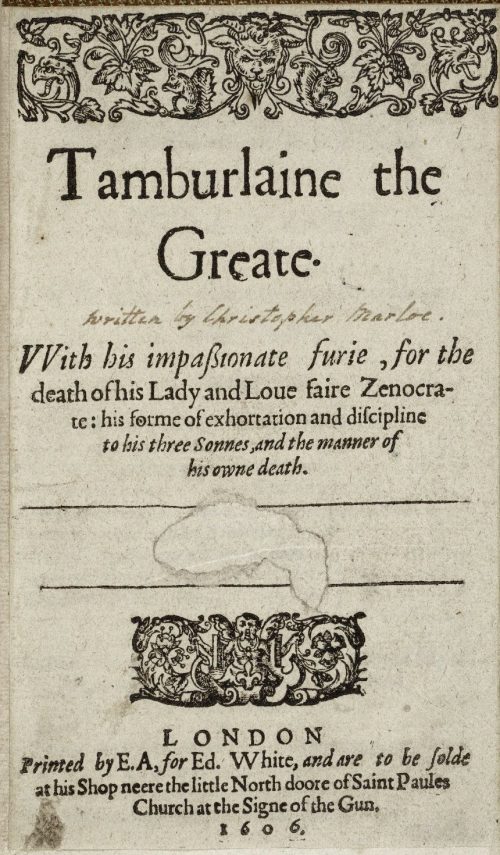
Tamburlaine the Great, Part 2 by Christopher Marlowe
TAMBURLAINE THE GREAT—THE SECOND PART
Edited By The Rev. Alexander Dyce
This is Part II.
Go to Tamburlaine the Great Part I.
TAMBURLAINE THE GREAT PART 2 THE PROLOGUE.
The general welcomes Tamburlaine receiv’d,
When he arrived last upon the 1 stage,
Have made our poet pen his Second Part,
Where Death cuts off the progress of his pomp,
And murderous Fates throw all his triumphs 2 down.
But what became of fair Zenocrate,
And with how many cities’ sacrifice
He celebrated her sad 3 funeral,
Himself in presence shall unfold at large.
TAMBURLAINE THE GREAT PART 2 CONTENTS
TAMBURLAINE DRAMATIS PERSONAE.
THE SECOND PART OF TAMBURLAINE THE GREAT.
TAMBURLAINE ACT I.
TAMBURLAINE ACT I SCENE I.
TAMBURLAINE ACT I SCENE II.
TAMBURLAINE ACT I SCENE III.TAMBURLAINE ACT II.
TAMBURLAINE ACT II SCENE I.
TAMBURLAINE ACT II SCENE II.
TAMBURLAINE ACT II SCENE III.
TAMBURLAINE ACT II SCENE IV.TAMBURLAINE ACT III.
TAMBURLAINE ACT III SCENE I.
TAMBURLAINE ACT III SCENE II.
TAMBURLAINE ACT III SCENE III.
TAMBURLAINE ACT III SCENE IV.
TAMBURLAINE ACT III SCENE V.TAMBURLAINE ACT IV.
TAMBURLAINE ACT IV SCENE I.
TAMBURLAINE ACT IV SCENE II.
TAMBURLAINE ACT IV SCENE III.TAMBURLAINE ACT V.
TAMBURLAINE ACT V SCENE I.
TAMBURLAINE ACT V SCENE II.
TAMBURLAINE ACT V SCENE III.
DRAMATIS PERSONAE.
TAMBURLAINE, king of Persia.
CALYPHAS, ]
AMYRAS, ] his sons.
CELEBINUS, ]
THERIDAMAS, king of Argier.
TECHELLES, king of Fez.
USUMCASANE, king of Morocco.
ORCANES, king of Natolia.
KING OF TREBIZON.
KING OF SORIA.
KING OF JERUSALEM.
KING OF AMASIA.
GAZELLUS, viceroy of Byron.
URIBASSA.
SIGISMUND, King of Hungary.
FREDERICK, ]
BALDWIN, ] Lords of Buda and Bohemia.
CALLAPINE, son to BAJAZETH, and prisoner to TAMBURLAINE.
ALMEDA, his keeper.
GOVERNOR OF BABYLON.
CAPTAIN OF BALSERA.
HIS SON.
ANOTHER CAPTAIN.
MAXIMUS, PERDICAS, Physicians, Lords, Citizens, Messengers,
Soldiers, and Attendants.ZENOCRATE, wife to TAMBURLAINE.
OLYMPIA, wife to the CAPTAIN OF BALSERA.
Turkish Concubines.
THE SECOND PART OF TAMBURLAINE THE GREAT.
ACT I.
SCENE I.
Enter ORCANES king of Natolia, GAZELLUS viceroy of Byron,
URIBASSA, 4 and their train, with drums and trumpets.ORCANES. Egregious viceroys of these eastern parts,
Plac’d by the issue of great Bajazeth,
And sacred lord, the mighty Callapine,
Who lives in Egypt prisoner to that slave
Which kept his father in an iron cage,—
Now have we march’d from fair Natolia
Two hundred leagues, and on Danubius’ banks
Our warlike host, in complete armour, rest,
Where Sigismund, the king of Hungary,
Should meet our person to conclude a truce:
What! shall we parle with the Christian?
Or cross the stream, and meet him in the field?GAZELLUS. King of Natolia, let us treat of peace:
We all are glutted with the Christians’ blood,
And have a greater foe to fight against,—
Proud Tamburlaine, that now in Asia,
Near Guyron’s head, doth set his conquering feet,
And means to fire Turkey as he goes:
‘Gainst him, my lord, you must address your power.URIBASSA. Besides, King Sigismund hath brought from Christendom
More than his camp of stout Hungarians,—
Sclavonians, Almains, Rutters, 5 Muffs, and Danes,
That with the halberd, lance, and murdering axe,
Will hazard that we might with surety hold.ORCANES. 6 Though from the shortest northern parallel,
Vast Grantland, compass’d with the Frozen Sea,
(Inhabited with tall and sturdy men,
Giants as big as hugy 7 Polypheme,)
Millions of soldiers cut the 8 arctic line,
Bringing the strength of Europe to these arms,
Our Turkey blades shall glide through all their throats,
And make this champion 9 mead a bloody fen:
Danubius’ stream, that runs to Trebizon,
Shall carry, wrapt within his scarlet waves,
As martial presents to our friends at home,
The slaughter’d bodies of these Christians:
The Terrene 10 main, wherein Danubius falls,
Shall by this battle be the bloody sea:
The wandering sailors of proud Italy
Shall meet those Christians, fleeting with the tide,
Beating in heaps against their argosies,
And make fair Europe, mounted on her bull,
Trapp’d with the wealth and riches of the world,
Alight, and wear a woful mourning weed.GAZELLUS. Yet, stout Orcanes, pro-rex of the world,
Since Tamburlaine hath muster’d all his men,
Marching from Cairo 11 northward, with his camp,
To Alexandria and the frontier towns,
Meaning to make a conquest of our land,
‘Tis requisite to parle for a peace
With Sigismund, the king of Hungary,
And save our forces for the hot assaults
Proud Tamburlaine intends Natolia.ORCANES. Viceroy of Byron, wisely hast thou said.
My realm, the centre of our empery,
Once lost, all Turkey would be overthrown;
And for that cause the Christians shall have peace.
Sclavonians, Almains, Rutters, Muffs, and Danes,
Fear 12 not Orcanes, but great Tamburlaine;
Nor he, but Fortune that hath made him great.
We have revolted Grecians, Albanese,
Sicilians, Jews, Arabians, Turks, and Moors,
Natolians, Sorians, 13 black 14 Egyptians,
Illyrians, Thracians, and Bithynians, 15
Enough to swallow forceless Sigismund,
Yet scarce enough t’ encounter Tamburlaine.
He brings a world of people to the field,
]From Scythia to the oriental plage 16
Of India, where raging Lantchidol
Beats on the regions with his boisterous blows,
That never seaman yet discovered.
All Asia is in arms with Tamburlaine,
Even from the midst of fiery Cancer’s tropic
To Amazonia under Capricorn;
And thence, as far as Archipelago,
All Afric is in arms with Tamburlaine:
Therefore, viceroy, 17 the Christians must have peace.Enter SIGISMUND, FREDERICK, BALDWIN, and their
train, with drums and trumpets.SIGISMUND. Orcanes, (as our legates promis’d thee,)
We, with our peers, have cross’d Danubius’ stream,
To treat of friendly peace or deadly war.
Take which thou wilt; for, as the Romans us’d,
I here present thee with a naked sword:
Wilt thou have war, then shake this blade at me;
If peace, restore it to my hands again,
And I will sheathe it, to confirm the same.ORCANES. Stay, Sigismund: forgett’st thou I am he
That with the cannon shook Vienna-walls,
And made it dance upon the continent,
As when the massy substance of the earth
Quiver[s] about the axle-tree of heaven?
Forgett’st thou that I sent a shower of darts,
Mingled with powder’d shot and feather’d steel,
So thick upon the blink-ey’d burghers’ heads,
That thou thyself, then County Palatine,
The King of Boheme, 18 and the Austric Duke,
Sent heralds out, which basely on their knees,
In all your names, desir’d a truce of me?
Forgett’st thou that, to have me raise my siege,
Waggons of gold were set before my tent,
Stampt with the princely fowl that in her wings
Carries the fearful thunderbolts of Jove?
How canst thou think of this, and offer war?SIGISMUND. Vienna was besieg’d, and I was there,
Then County Palatine, but now a king,
And what we did was in extremity
But now, Orcanes, view my royal host,
That hides these plains, and seems as vast and wide
As doth the desert of Arabia
To those that stand on Bagdet’s 19 lofty tower,
Or as the ocean to the traveller
That rests upon the snowy Appenines;
And tell me whether I should stoop so low,
Or treat of peace with the Natolian king.GAZELLUS. Kings of Natolia and of Hungary,
We came from Turkey to confirm a league,
And not to dare each other to the field.
A friendly parle 20 might become you both.FREDERICK. And we from Europe, to the same intent; 21
Which if your general refuse or scorn,
Our tents are pitch’d, our men stand 22 in array,
Ready to charge you ere you stir your feet.ORCANES. So prest 23 are we: but yet, if Sigismund
Speak as a friend, and stand not upon terms,
Here is his sword; let peace be ratified
On these conditions specified before,
Drawn with advice of our ambassadors.SIGISMUND. Then here I sheathe it, and give thee my hand,
Never to draw it out, or 24 manage arms
Against thyself or thy confederates,
But, whilst I live, will be at truce with thee.ORCANES. But, Sigismund, confirm it with an oath,
And swear in sight of heaven and by thy Christ.SIGISMUND. By Him that made the world and sav’d my soul,
The Son of God and issue of a maid,
Sweet Jesus Christ, I solemnly protest
And vow to keep this peace inviolable!ORCANES. By sacred Mahomet, the friend of God,
Whose holy Alcoran remains with us,
Whose glorious body, when he left the world,
Clos’d in a coffin mounted up the air,
And hung on stately Mecca’s temple-roof,
I swear to keep this truce inviolable!
Of whose conditions 25 and our solemn oaths,
Sign’d with our hands, each shall retain a scroll,
As memorable witness of our league.
Now, Sigismund, if any Christian king
Encroach upon the confines of thy realm,
Send word, Orcanes of Natolia
Confirm’d 26 this league beyond Danubius’ stream,
And they will, trembling, sound a quick retreat;
So am I fear’d among all nations.SIGISMUND. If any heathen potentate or king
Invade Natolia, Sigismund will send
A hundred thousand horse train’d to the war,
And back’d by 27 stout lanciers of Germany,
The strength and sinews of the imperial seat.ORCANES. I thank thee, Sigismund; but, when I war,
All Asia Minor, Africa, and Greece,
Follow my standard and my thundering drums.
Come, let us go and banquet in our tents:
I will despatch chief of my army hence
To fair Natolia and to Trebizon,
To stay my coming ‘gainst proud Tamburlaine:
Friend Sigismund, and peers of Hungary,
Come, banquet and carouse with us a while,
And then depart we to our territories.
[Exeunt.]
SCENE II.
Enter CALLAPINE, and ALMEDA his keeper.
CALLAPINE. Sweet Almeda, pity the ruthful plight
Of Callapine, the son of Bajazeth,
Born to be monarch of the western world,
Yet here detain’d by cruel Tamburlaine.ALMEDA. My lord, I pity it, and with my heart
Wish your release; but he whose wrath is death,
My sovereign lord, renowmed 28 Tamburlaine,
Forbids you further liberty than this.CALLAPINE. Ah, were I now but half so eloquent
To paint in words what I’ll perform in deeds,
I know thou wouldst depart from hence with me!ALMEDA. Not for all Afric: therefore move me not.
CALLAPINE. Yet hear me speak, my gentle Almeda.
ALMEDA. No speech to that end, by your favour, sir.
CALLAPINE. By Cairo 29 runs—
ALMEDA. No talk of running, I tell you, sir.
CALLAPINE. A little further, gentle Almeda.
ALMEDA. Well, sir, what of this?
CALLAPINE. By Cairo runs to Alexandria-bay
Darotes’ stream, 30 wherein at 31 anchor lies
A Turkish galley of my royal fleet,
Waiting my coming to the river-side,
Hoping by some means I shall be releas’d;
Which, when I come aboard, will hoist up sail,
And soon put forth into the Terrene 32 sea,
Where, 33 ‘twixt the isles of Cyprus and of Crete,
We quickly may in Turkish seas arrive.
Then shalt thou see a hundred kings and more,
Upon their knees, all bid me welcome home.
Amongst so many crowns of burnish’d gold,
Choose which thou wilt, all are at thy command:
A thousand galleys, mann’d with Christian slaves,
I freely give thee, which shall cut the Straits,
And bring armadoes, from 34 the coasts of Spain,
Fraughted with gold of rich America:
The Grecian virgins shall attend on thee,
Skilful in music and in amorous lays,
As fair as was Pygmalion’s ivory girl
Or lovely Io metamorphosed:
With naked negroes shall thy coach be drawn,
And, as thou rid’st in triumph through the streets,
The pavement underneath thy chariot-wheels
With Turkey-carpets shall be covered,
And cloth of arras hung about the walls,
Fit objects for thy princely eye to pierce:
A hundred bassoes, cloth’d in crimson silk,
Shall ride before thee on Barbarian steeds;
And, when thou goest, a golden canopy
Enchas’d with precious stones, which shine as bright
As that fair veil that covers all the world,
When Phoebus, leaping from his hemisphere,
Descendeth downward to th’ Antipodes:—
And more than this, for all I cannot tell.ALMEDA. How far hence lies the galley, say you?
CALLAPINE. Sweet Almeda, scarce half a league from hence.
ALMEDA. But need 35 we not be spied going aboard?
CALLAPINE. Betwixt the hollow hanging of a hill,
And crooked bending of a craggy rock,
The sails wrapt up, the mast and tacklings down,
She lies so close that none can find her out.ALMEDA. I like that well: but, tell me, my lord,
if I should let you go, would you be as good as
your word? shall I be made a king for my labour?CALLAPINE. As I am Callapine the emperor,
And by the hand of Mahomet I swear,
Thou shalt be crown’d a king, and be my mate!ALMEDA. Then here I swear, as I am Almeda,
Your keeper under Tamburlaine the Great,
(For that’s the style and title I have yet,)
Although he sent a thousand armed men
To intercept this haughty enterprize,
Yet would I venture to conduct your grace,
And die before I brought you back again!CALLAPINE. Thanks, gentle Almeda: then let us haste,
Lest time be past, and lingering let 36 us both.ALMEDA. When you will, my lord: I am ready.
CALLAPINE. Even straight:—and farewell, cursed Tamburlaine!
Now go I to revenge my father’s death.
[Exeunt.]
SCENE III.
Enter TAMBURLAINE, ZENOCRATE, and their three sons,
CALYPHAS, AMYRAS, and CELEBINUS, with drums and trumpets.TAMBURLAINE. Now, bright Zenocrate, the world’s fair eye,
Whose beams illuminate the lamps of heaven,
Whose cheerful looks do clear the cloudy air,
And clothe it in a crystal livery,
Now rest thee here on fair Larissa-plains,
Where Egypt and the Turkish empire part
Between thy sons, that shall be emperors,
And every one commander of a world.ZENOCRATE. Sweet Tamburlaine, when wilt thou leave these arms,
And save thy sacred person free from scathe,
And dangerous chances of the wrathful war?TAMBURLAINE. When heaven shall cease to move on both the poles,
And when the ground, whereon my soldiers march,
Shall rise aloft and touch the horned moon;
And not before, my sweet Zenocrate.
Sit up, and rest thee like a lovely queen.
So; now she sits in pomp and majesty,
When these, my sons, more precious in mine eyes
Than all the wealthy kingdoms I subdu’d,
Plac’d by her side, look on their mother’s face.
But yet methinks their looks are amorous,
Not martial as the sons of Tamburlaine:
Water and air, being symboliz’d in one,
Argue their want of courage and of wit;
Their hair as white as milk, and soft as down,
(Which should be like the quills of porcupines,
As black as jet, and hard as iron or steel,)
Bewrays they are too dainty for the wars;
Their fingers made to quaver on a lute,
Their arms to hang about a lady’s neck,
Their legs to dance and caper in the air,
Would make me think them bastards, not my sons,
But that I know they issu’d from thy womb,
That never look’d on man but Tamburlaine.ZENOCRATE. My gracious lord, they have their mother’s looks,
But, when they list, their conquering father’s heart.
This lovely boy, the youngest of the three,
Not long ago bestrid a Scythian steed,
Trotting the ring, and tilting at a glove,
Which when he tainted 37 with his slender rod,
He rein’d him straight, and made him so curvet
As I cried out for fear he should have faln.TAMBURLAINE.
Well done, my boy! thou shalt have shield and lance,
Armour of proof, horse, helm, and curtle-axe,
And I will teach thee how to charge thy foe,
And harmless run among the deadly pikes.
If thou wilt love the wars and follow me,
Thou shalt be made a king and reign with me,
Keeping in iron cages emperors.
If thou exceed thy elder brothers’ worth,
And shine in complete virtue more than they,
Thou shalt be king before them, and thy seed
Shall issue crowned from their mother’s womb.CELEBINUS. Yes, father; you shall see me, if I live,
Have under me as many kings as you,
And march with such a multitude of men
As all the world shall 38 tremble at their view.TAMBURLAINE. These words assure me, boy, thou art my son.
When I am old and cannot manage arms,
Be thou the scourge and terror of the world.AMYRAS. Why may not I, my lord, as well as he,
Be term’d the scourge and terror of 39 the world?TAMBURLAINE. Be all a scourge and terror to 40 the world,
Or else you are not sons of Tamburlaine.CALYPHAS. But, while my brothers follow arms, my lord,
Let me accompany my gracious mother:
They are enough to conquer all the world,
And you have won enough for me to keep.TAMBURLAINE. Bastardly boy, sprung 41 from some coward’s loins,
And not the issue of great Tamburlaine!
Of all the provinces I have subdu’d
Thou shalt not have a foot, unless thou bear
A mind courageous and invincible;
For he shall wear the crown of Persia
Whose head hath deepest scars, whose breast most wounds,
Which, being wroth, sends lightning from his eyes,
And in the furrows of his frowning brows
Harbours revenge, war, death, and cruelty;
For in a field, whose superficies 42
Is cover’d with a liquid purple veil,
And sprinkled with the brains of slaughter’d men,
My royal chair of state shall be advanc’d;
And he that means to place himself therein,
Must armed wade up to the chin in blood.ZENOCRATE. My lord, such speeches to our princely sons
Dismay their minds before they come to prove
The wounding troubles angry war affords.CELEBINUS. No, madam, these are speeches fit for us;
For, if his chair were in a sea of blood,
I would prepare a ship and sail to it,
Ere I would lose the title of a king.AMYRAS. And I would strive to swim through 43 pools of blood,
Or make a bridge of murder’d carcasses, 44
Whose arches should be fram’d with bones of Turks,
Ere I would lose the title of a king.TAMBURLAINE. Well, lovely boys, ye shall be emperors both,
Stretching your conquering arms from east to west:—
And, sirrah, if you mean to wear a crown,
When we 45 shall meet the Turkish deputy
And all his viceroys, snatch it from his head,
And cleave his pericranion with thy sword.CALYPHAS. If any man will hold him, I will strike,
And cleave him to the channel 46 with my sword.TAMBURLAINE. Hold him, and cleave him too, or I’ll cleave thee;
For we will march against them presently.
Theridamas, Techelles, and Casane
Promis’d to meet me on Larissa-plains,
With hosts a-piece against this Turkish crew;
For I have sworn by sacred Mahomet
To make it parcel of my empery.
The trumpets sound; Zenocrate, they come.
Enter THERIDAMAS, and his train, with drums and trumpets.
Welcome, Theridamas, king of Argier.THERIDAMAS. My lord, the great and mighty Tamburlaine,
Arch-monarch of the world, I offer here
My crown, myself, and all the power I have,
In all affection at thy kingly feet.TAMBURLAINE. Thanks, good Theridamas.
THERIDAMAS. Under my colours march ten thousand Greeks,
And of Argier and Afric’s frontier towns
Twice twenty thousand valiant men-at-arms;
All which have sworn to sack Natolia.
Five hundred brigandines are under sail,
Meet for your service on the sea, my lord,
That, launching from Argier to Tripoly,
Will quickly ride before Natolia,
And batter down the castles on the shore.TAMBURLAINE. Well said, Argier! receive thy crown again.
Enter USUMCASANE and TECHELLES.
Kings of Morocco 47 and of Fez, welcome.USUMCASANE. Magnificent and peerless Tamburlaine,
I and my neighbour king of Fez have brought,
To aid thee in this Turkish expedition,
A hundred thousand expert soldiers;
]From Azamor to Tunis near the sea
Is Barbary unpeopled for thy sake,
And all the men in armour under me,
Which with my crown I gladly offer thee.TAMBURLAINE. Thanks, king of Morocco: take your crown again.
TECHELLES. And, mighty Tamburlaine, our earthly god,
Whose looks make this inferior world to quake,
I here present thee with the crown of Fez,
And with an host of Moors train’d to the war, 48
Whose coal-black faces make their foes retire,
And quake for fear, as if infernal 49 Jove,
Meaning to aid thee 50 in these 51 Turkish arms,
Should pierce the black circumference of hell,
With ugly Furies bearing fiery flags,
And millions of his strong 52 tormenting spirits:
]From strong Tesella unto Biledull
All Barbary is unpeopled for thy sake.TAMBURLAINE. Thanks, king of Fez: take here thy crown again.
Your presence, loving friends and fellow-kings,
Makes me to surfeit in conceiving joy:
If all the crystal gates of Jove’s high court
Were open’d wide, and I might enter in
To see the state and majesty of heaven,
It could not more delight me than your sight.
Now will we banquet on these plains a while,
And after march to Turkey with our camp,
In number more than are the drops that fall
When Boreas rents a thousand swelling clouds;
And proud Orcanes of Natolia
With all his viceroys shall be so afraid,
That, though the stones, as at Deucalion’s flood,
Were turn’d to men, he should be overcome.
Such lavish will I make of Turkish blood,
That Jove shall send his winged messenger
To bid me sheathe my sword and leave the field;
The sun, unable to sustain the sight,
Shall hide his head in Thetis’ watery lap,
And leave his steeds to fair Bootes’ 53 charge;
For half the world shall perish in this fight.
But now, my friends, let me examine ye;
How have ye spent your absent time from me?USUMCASANE. My lord, our men of Barbary have march’d
Four hundred miles with armour on their backs,
And lain in leaguer 54 fifteen months and more;
For, since we left you at the Soldan’s court,
We have subdu’d the southern Guallatia,
And all the land unto the coast of Spain;
We kept the narrow Strait of Jubalter, 55
And made Canaria call us kings and lords:
Yet never did they recreate themselves,
Or cease one day from war and hot alarms;
And therefore let them rest a while, my lord.TAMBURLAINE. They shall, Casane, and ’tis time, i’faith.
TECHELLES. And I have march’d along the river Nile
To Machda, where the mighty Christian priest,
Call’d John the Great, 56 sits in a milk-white robe,
Whose triple mitre I did take by force,
And made him swear obedience to my crown.
]From thence unto Cazates did I march,
Where Amazonians met me in the field,
With whom, being women, I vouchsaf’d a league,
And with my power did march to Zanzibar,
The western part of Afric, where I view’d
The Ethiopian sea, rivers and lakes,
But neither man nor child in all the land:
Therefore I took my course to Manico,
Where, 57 unresisted, I remov’d my camp;
And, by the coast of Byather, 58 at last
I came to Cubar, where the negroes dwell,
And, conquering that, made haste to Nubia.
There, having sack’d Borno, the kingly seat,
I took the king and led him bound in chains
Unto Damascus, 59 where I stay’d before.TAMBURLAINE. Well done, Techelles!—What saith Theridamas?
THERIDAMAS. I left the confines and the bounds of Afric,
And made 60 a voyage into Europe,
Where, by the river Tyras, I subdu’d
Stoka, Podolia, and Codemia;
Then cross’d the sea and came to Oblia,
And Nigra Silva, where the devils dance,
Which, in despite of them, I set on fire.
]From thence I cross’d the gulf call’d by the name
Mare Majore of the inhabitants.
Yet shall my soldiers make no period
Until Natolia kneel before your feet.TAMBURLAINE. Then will we triumph, banquet and carouse;
Cooks shall have pensions to provide us cates,
And glut us with the dainties of the world;
Lachryma Christi and Calabrian wines
Shall common soldiers drink in quaffing bowls,
Ay, liquid gold, when we have conquer’d him, 61
Mingled with coral and with orient 62 pearl.
Come, let us banquet and carouse the whiles.
[Exeunt.]
ACT II.
SCENE I.
Enter SIGISMUND, FREDERICK, and BALDWIN, with their train.
SIGISMUND. Now say, my lords of Buda and Bohemia,
What motion is it that inflames your thoughts,
And stirs your valours to such sudden arms?FREDERICK. Your majesty remembers, I am sure,
What cruel slaughter of our Christian bloods
These heathenish Turks and pagans lately made
Betwixt the city Zula and Danubius;
How through the midst of Varna and Bulgaria,
And almost to the very walls of Rome,
They have, not long since, massacred our camp.
It resteth now, then, that your majesty
Take all advantages of time and power,
And work revenge upon these infidels.
Your highness knows, for Tamburlaine’s repair,
That strikes a terror to all Turkish hearts,
Natolia hath dismiss’d the greatest part
Of all his army, pitch’d against our power
Betwixt Cutheia and Orminius’ mount,
And sent them marching up to Belgasar,
Acantha, Antioch, and Caesarea,
To aid the kings of Soria 63 and Jerusalem.
Now, then, my lord, advantage take thereof, 64
And issue suddenly upon the rest;
That, in the fortune of their overthrow,
We may discourage all the pagan troop
That dare attempt to war with Christians.SIGISMUND. But calls not, then, your grace to memory
The league we lately made with King Orcanes,
Confirm’d by oath and articles of peace,
And calling Christ for record of our truths?
This should be treachery and violence
Against the grace of our profession.BALDWIN. No whit, my lord; for with such infidels,
In whom no faith nor true religion rests,
We are not bound to those accomplishments
The holy laws of Christendom enjoin;
But, as the faith which they profanely plight
Is not by necessary policy
To be esteem’d assurance for ourselves,
So that we vow 65 to them should not infringe
Our liberty of arms and victory.SIGISMUND. Though I confess the oaths they undertake
Breed little strength to our security,
Yet those infirmities that thus defame
Their faiths, 66 their honours, and religion, 67
Should not give us presumption to the like.
Our faiths are sound, and must be consummate, 68
Religious, righteous, and inviolate.FREDERICK. Assure your grace, ’tis superstition
To stand so strictly on dispensive faith;
And, should we lose the opportunity
That God hath given to venge our Christians’ death,
And scourge their foul blasphemous paganism,
As fell to Saul, to Balaam, and the rest,
That would not kill and curse at God’s command,
So surely will the vengeance of the Highest,
And jealous anger of his fearful arm,
Be pour’d with rigour on our sinful heads,
If we neglect this 69 offer’d victory.SIGISMUND. Then arm, my lords, and issue suddenly,
Giving commandment to our general host,
With expedition to assail the pagan,
And take the victory our God hath given.
[Exeunt.]
SCENE II.
Enter ORCANES, GAZELLUS, and URIBASSA, with their train.
ORCANES. Gazellus, Uribassa, and the rest,
Now will we march from proud Orminius’ mount
To fair Natolia, where our neighbour kings
Expect our power and our royal presence,
T’ encounter with the cruel Tamburlaine,
That nigh Larissa sways a mighty host,
And with the thunder of his martial 70 tools
Makes earthquakes in the hearts of men and heaven.GAZELLUS. And now come we to make his sinews shake
With greater power than erst his pride hath felt.
An hundred kings, by scores, will bid him arms,
And hundred thousands subjects to each score:
Which, if a shower of wounding thunderbolts
Should break out of the bowels of the clouds,
And fall as thick as hail upon our heads,
In partial aid of that proud Scythian,
Yet should our courages and steeled crests,
And numbers, more than infinite, of men,
Be able to withstand and conquer him.URIBASSA. Methinks I see how glad the Christian king
Is made for joy of our 71 admitted truce,
That could not but before be terrified
With 72 unacquainted power of our host.Enter a Messenger.
MESSENGER. Arm, dread sovereign, and my noble lords!
The treacherous army of the Christians,
Taking advantage of your slender power,
Comes marching on us, and determines straight
To bid us battle for our dearest lives.ORCANES. Traitors, villains, damned Christians!
Have I not here the articles of peace
And solemn covenants we have both confirm’d,
He by his Christ, and I by Mahomet?GAZELLUS. Hell and confusion light upon their heads,
That with such treason seek our overthrow,
And care so little for their prophet Christ!ORCANES. Can there be such deceit in Christians,
Or treason in the fleshly heart of man,
Whose shape is figure of the highest God?
Then, if there be a Christ, as Christians say,
But in their deeds deny him for their Christ,
If he be son to everliving Jove,
And hath the power of his outstretched arm,
If he be jealous of his name and honour
As is our holy prophet Mahomet,
Take here these papers as our sacrifice
And witness of thy servant’s 73 perjury!
[He tears to pieces the articles of peace.]
Open, thou shining veil of Cynthia,
And make a passage from th’ empyreal heaven,
That he that sits on high and never sleeps,
Nor in one place is circumscriptible,
But every where fills every continent
With strange infusion of his sacred vigour,
May, in his endless power and purity,
Behold and venge this traitor’s perjury!
Thou, Christ, that art esteem’d omnipotent,
If thou wilt prove thyself a perfect God,
Worthy the worship of all faithful hearts,
Be now reveng’d upon this traitor’s soul,
And make the power I have left behind
(Too little to defend our guiltless lives)
Sufficient to discomfit 74 and confound
The trustless force of those false Christians!—
To arms, my lords! 75 on Christ still let us cry:
If there be Christ, we shall have victory.
[Exeunt.]
SCENE III.
Alarms of battle within. Enter SIGISMUND wounded.
SIGISMUND. Discomfited is all the Christian 76 host,
And God hath thunder’d vengeance from on high,
For my accurs’d and hateful perjury.
O just and dreadful punisher of sin,
Let the dishonour of the pains I feel
In this my mortal well-deserved wound
End all my penance in my sudden death!
And let this death, wherein to sin I die,
Conceive a second life in endless mercy!
[Dies.]Enter ORCANES, GAZELLUS, URIBASSA, with others.
ORCANES. Now lie the Christians bathing in their bloods,
And Christ or Mahomet hath been my friend.GAZELLUS. See, here the perjur’d traitor Hungary,
Bloody and breathless for his villany!ORCANES. Now shall his barbarous body be a prey
To beasts and fowls, and all the winds shall breathe,
Through shady leaves of every senseless tree,
Murmurs and hisses for his heinous sin.
Now scalds his soul in the Tartarian streams,
And feeds upon the baneful tree of hell,
That Zoacum, 77 that fruit of bitterness,
That in the midst of fire is ingraff’d,
Yet flourisheth, as Flora in her pride,
With apples like the heads of damned fiends.
The devils there, in chains of quenchless flame,
Shall lead his soul, through Orcus’ burning gulf,
]From pain to pain, whose change shall never end.
What say’st thou yet, Gazellus, to his foil,
Which we referr’d to justice of his Christ
And to his power, which here appears as full
As rays of Cynthia to the clearest sight?GAZELLUS. ‘Tis but the fortune of the wars, my lord,
Whose power is often prov’d a miracle.ORCANES. Yet in my thoughts shall Christ be honoured,
Not doing Mahomet an 78 injury,
Whose power had share in this our victory;
And, since this miscreant hath disgrac’d his faith,
And died a traitor both to heaven and earth,
We will both watch and ward shall keep his trunk 79
Amidst these plains for fowls to prey upon.
Go, Uribassa, give 80 it straight in charge.URIBASSA. I will, my lord.
[Exit.]ORCANES. And now, Gazellus, let us haste and meet
Our army, and our brother[s] of Jerusalem,
Of Soria, 81 Trebizon, and Amasia,
And happily, with full Natolian bowls
Of Greekish wine, now let us celebrate
Our happy conquest and his angry fate.
[Exeunt.]
SCENE IV.
The arras is drawn, and ZENOCRATE is discovered lying
in her bed of state; TAMBURLAINE sitting by her; three
PHYSICIANS about her bed, tempering potions; her three
sons, CALYPHAS, AMYRAS, and CELEBINUS; THERIDAMAS,
TECHELLES, and USUMCASANE.TAMBURLAINE. Black is the beauty of the brightest day;
The golden ball of heaven’s eternal fire,
That danc’d with glory on the silver waves,
Now wants the fuel that inflam’d his beams;
And all with faintness, and for foul disgrace,
He binds his temples with a frowning cloud,
Ready to darken earth with endless night.
Zenocrate, that gave him light and life,
Whose eyes shot fire from their 82 ivory brows, 83
And temper’d every soul with lively heat,
Now by the malice of the angry skies,
Whose jealousy admits no second mate,
Draws in the comfort of her latest breath,
All dazzled with the hellish mists of death.
Now walk the angels on the walls of heaven,
As sentinels to warn th’ immortal souls
To entertain divine Zenocrate:
Apollo, Cynthia, and the ceaseless lamps
That gently look’d upon this 84 loathsome earth,
Shine downwards now no more, but deck the heavens
To entertain divine Zenocrate:
The crystal springs, whose taste illuminates
Refined eyes with an eternal sight,
Like tried silver run through Paradise
To entertain divine Zenocrate:
The cherubins and holy seraphins,
That sing and play before the King of Kings,
Use all their voices and their instruments
To entertain divine Zenocrate;
And, in this sweet and curious harmony,
The god that tunes this music to our souls
Holds out his hand in highest majesty
To entertain divine Zenocrate.
Then let some holy trance convey my thoughts
Up to the palace of th’ empyreal heaven,
That this my life may be as short to me
As are the days of sweet Zenocrate.—
Physicians, will no 85 physic do her good?FIRST PHYSICIAN. My lord, your majesty shall soon perceive,
An if she pass this fit, the worst is past.TAMBURLAINE. Tell me, how fares my fair Zenocrate?
ZENOCRATE. I fare, my lord, as other empresses,
That, when this frail and 86 transitory flesh
Hath suck’d the measure of that vital air
That feeds the body with his dated health,
Wane with enforc’d and necessary change.TAMBURLAINE. May never such a change transform my love,
In whose sweet being I repose my life!
Whose heavenly presence, beautified with health,
Gives light to Phoebus and the fixed stars;
Whose absence makes 87 the sun and moon as dark
As when, oppos’d in one diameter,
Their spheres are mounted on the serpent’s head,
Or else descended to his winding train.
Live still, my love, and so conserve my life,
Or, dying, be the author 88 of my death.ZENOCRATE. Live still, my lord; O, let my sovereign live!
And sooner let the fiery element
Dissolve, and make your kingdom in the sky,
Than this base earth should shroud your majesty;
For, should I but suspect your death by mine,
The comfort of my future happiness,
And hope to meet your highness in the heavens,
Turn’d to despair, would break my wretched breast,
And fury would confound my present rest.
But let me die, my love; yes, 89 let me die;
With love and patience let your true love die:
Your grief and fury hurts my second life.
Yet let me kiss my lord before I die,
And let me die with kissing of my lord.
But, since my life is lengthen’d yet a while,
Let me take leave of these my loving sons,
And of my lords, whose true nobility
Have merited my latest memory.
Sweet sons, farewell! in death resemble me,
And in your lives your father’s excellence. 90
Some music, and my fit will cease, my lord.
[They call for music.]TAMBURLAINE. Proud fury, and intolerable fit,
That dares torment the body of my love,
And scourge the scourge of the immortal God!
Now are those spheres, where Cupid us’d to sit,
Wounding the world with wonder and with love,
Sadly supplied with pale and ghastly death,
Whose darts do pierce the centre of my soul.
Her sacred beauty hath enchanted heaven;
And, had she liv’d before the siege of Troy,
Helen, whose beauty summon’d Greece to arms,
And drew a thousand ships to Tenedos,
Had not been nam’d in Homer’s Iliads,—
Her name had been in every line he wrote;
Or, had those wanton poets, for whose birth
Old Rome was proud, but gaz’d a while on her,
Nor Lesbia nor Corinna had been nam’d,—
Zenocrate had been the argument
Of every epigram or elegy.
[The music sounds—ZENOCRATE dies.]
What, is she dead? Techelles, draw thy sword,
And wound the earth, that it may cleave in twain,
And we descend into th’ infernal vaults,
To hale the Fatal Sisters by the hair,
And throw them in the triple moat of hell,
For taking hence my fair Zenocrate.
Casane and Theridamas, to arms!
Raise cavalieros 91 higher than the clouds,
And with the cannon break the frame of heaven;
Batter the shining palace of the sun,
And shiver all the starry firmament,
For amorous Jove hath snatch’d my love from hence,
Meaning to make her stately queen of heaven.
What god soever holds thee in his arms,
Giving thee nectar and ambrosia,
Behold me here, divine Zenocrate,
Raving, impatient, desperate, and mad,
Breaking my steeled lance, with which I burst
The rusty beams of Janus’ temple-doors,
Letting out Death and tyrannizing War,
To march with me under this bloody flag!
And, if thou pitiest Tamburlaine the Great,
Come down from heaven, and live with me again!THERIDAMAS. Ah, good my lord, be patient! she is dead,
And all this raging cannot make her live.
If words might serve, our voice hath rent the air;
If tears, our eyes have water’d all the earth;
If grief, our murder’d hearts have strain’d forth blood:
Nothing prevails, 92 for she is dead, my lord.TAMBURLAINE. FOR SHE IS DEAD! thy words do pierce my soul:
Ah, sweet Theridamas, say so no more!
Though she be dead, yet let me think she lives,
And feed my mind that dies for want of her.
Where’er her soul be, thou [To the body] shalt stay with me,
Embalm’d with cassia, ambergris, and myrrh,
Not lapt in lead, but in a sheet of gold,
And, till I die, thou shalt not be interr’d.
Then in as rich a tomb as Mausolus’ 93
We both will rest, and have one 94 epitaph
Writ in as many several languages
As I have conquer’d kingdoms with my sword.
This cursed town will I consume with fire,
Because this place bereft me of my love;
The houses, burnt, will look as if they mourn’d;
And here will I set up her stature, 95
And march about it with my mourning camp,
Drooping and pining for Zenocrate.
[The arras is drawn.]
ACT III.
SCENE I.
Enter the KINGS OF TREBIZON and SORIA, 96 one bringing a
sword and the other a sceptre; next, ORCANES king of
Natolia, and the KING OF JERUSALEM with the imperial crown,
after, CALLAPINE; and, after him, other LORDS and ALMEDA.
ORCANES and the KING OF JERUSALEM crown CALLAPINE, and the
others give him the sceptre.ORCANES. Callapinus Cyricelibes, otherwise Cybelius, son and
successive heir to the late mighty emperor Bajazeth, by the aid
of God and his friend Mahomet, Emperor of Natolia, Jerusalem,
Trebizon, Soria, Amasia, Thracia, Ilyria, Carmania, and all the
hundred and thirty kingdoms late contributory to his mighty
father,—long live Callapinus, Emperor of Turkey!CALLAPINE. Thrice-worthy kings, of Natolia and the rest,
I will requite your royal gratitudes
With all the benefits my empire yields;
And, were the sinews of th’ imperial seat
So knit and strengthen’d as when Bajazeth,
My royal lord and father, fill’d the throne,
Whose cursed fate 97 hath so dismember’d it,
Then should you see this thief of Scythia,
This proud usurping king of Persia,
Do us such honour and supremacy,
Bearing the vengeance of our father’s wrongs,
As all the world should blot his 98 dignities
Out of the book of base-born infamies.
And now I doubt not but your royal cares
Have so provided for this cursed foe,
That, since the heir of mighty Bajazeth
(An emperor so honour’d for his virtues)
Revives the spirits of all 99 true Turkish hearts,
In grievous memory of his father’s shame,
We shall not need to nourish any doubt,
But that proud Fortune, who hath follow’d long
The martial sword of mighty Tamburlaine,
Will now retain her old inconstancy,
And raise our honours 100 to as high a pitch,
In this our strong and fortunate encounter;
For so hath heaven provided my escape
]From all the cruelty my soul sustain’d,
By this my friendly keeper’s happy means,
That Jove, surcharg’d with pity of our wrongs,
Will pour it down in showers on our heads,
Scourging the pride of cursed Tamburlaine.ORCANES. I have a hundred thousand men in arms;
Some that, in conquest 101 of the perjur’d Christian,
Being a handful to a mighty host,
Think them in number yet sufficient
To drink the river Nile or Euphrates,
And for their power enow to win the world.KING OF JERUSALEM. And I as many from Jerusalem,
Judaea, 102 Gaza, and Sclavonia’s 103 bounds,
That on mount Sinai, with their ensigns spread,
Look like the parti-colour’d clouds of heaven
That shew fair weather to the neighbour morn.KING OF TREBIZON. And I as many bring from Trebizon,
Chio, Famastro, and Amasia,
All bordering on the Mare-Major-sea,
Riso, Sancina, and the bordering towns
That touch the end of famous Euphrates,
Whose courages are kindled with the flames
The cursed Scythian sets on all their towns,
And vow to burn the villain’s cruel heart.KING OF SORIA. From Soria 104 with seventy thousand strong,
Ta’en from Aleppo, Soldino, Tripoly,
And so unto my city of Damascus, 105
I march to meet and aid my neighbour kings;
All which will join against this Tamburlaine,
And bring him captive to your highness’ feet.ORCANES. Our battle, then, in martial manner pitch’d,
According to our ancient use, shall bear
The figure of the semicircled moon,
Whose horns shell sprinkle through the tainted air
The poison’d brains of this proud Scythian.CALLAPINE. Well, then, my noble lords, for this my friend
That freed me from the bondage of my foe,
I think it requisite and honourable
To keep my promise and to make him king,
That is a gentleman, I know, at least.ALMEDA. That’s no matter, 106 sir, for being a king;
or Tamburlaine came up of nothing.KING OF JERUSALEM. Your majesty may choose some ‘pointed time,
Performing all your promise to the full;
‘Tis naught for your majesty to give a kingdom.CALLAPINE. Then will I shortly keep my promise, Almeda.
ALMEDA. Why, I thank your majesty.
[Exeunt.]
SCENE II.
Enter TAMBURLAINE and his three sons, CALYPHAS, AMYRAS, and
CELEBINUS; USUMCASANE; four ATTENDANTS bearing the hearse of
ZENOCRATE, and the drums sounding a doleful march; the town
burning.TAMBURLAINE. So burn the turrets of this cursed town,
Flame to the highest region of the air,
And kindle heaps of exhalations,
That, being fiery meteors, may presage
Death and destruction to the inhabitants!
Over my zenith hang a blazing star,
That may endure till heaven be dissolv’d,
Fed with the fresh supply of earthly dregs,
Threatening a dearth 107 and famine to this land!
Flying dragons, lightning, fearful thunder-claps,
Singe these fair plains, and make them seem as black
As is the island where the Furies mask,
Compass’d with Lethe, Styx, and Phlegethon,
Because my dear Zenocrate is dead!CALYPHAS. This pillar, plac’d in memory of her,
Where in Arabian, Hebrew, Greek, is writ,
THIS TOWN, BEING BURNT BY TAMBURLAINE THE GREAT,
FORBIDS THE WORLD TO BUILD IT UP AGAIN.AMYRAS. And here this mournful streamer shall be plac’d,
Wrought with the Persian and th’ 108 Egyptian arms,
To signify she was a princess born,
And wife unto the monarch of the East.CELEBINUS. And here this table as a register
Of all her virtues and perfections.TAMBURLAINE. And here the picture of Zenocrate,
To shew her beauty which the world admir’d;
Sweet picture of divine Zenocrate,
That, hanging here, will draw the gods from heaven,
And cause the stars fix’d in the southern arc,
(Whose lovely faces never any view’d
That have not pass’d the centre’s latitude,)
As pilgrims travel to our hemisphere,
Only to gaze upon Zenocrate.
Thou shalt not beautify Larissa-plains,
But keep within the circle of mine arms:
At every town and castle I besiege,
Thou shalt be set upon my royal tent;
And, when I meet an army in the field,
Those 109 looks will shed such influence in my camp,
As if Bellona, goddess of the war,
Threw naked swords and sulphur-balls of fire
Upon the heads of all our enemies.—
And now, my lords, advance your spears again;
Sorrow no more, my sweet Casane, now:
Boys, leave to mourn; this town shall ever mourn,
Being burnt to cinders for your mother’s death.CALYPHAS. If I had wept a sea of tears for her,
would not ease the sorrows 110 I sustain.AMYRAS. As is that town, so is my heart consum’d
With grief and sorrow for my mother’s death.CELEBINUS. My mother’s death hath mortified my mind,
And sorrow stops the passage of my speech.TAMBURLAINE. But now, my boys, leave off, and list to me,
That mean to teach you rudiments of war.
I’ll have you learn to sleep upon the ground,
March in your armour thorough watery fens,
Sustain the scorching heat and freezing cold,
Hunger and thirst, 111 right adjuncts of the war;
And, after this, to scale a castle-wall,
Besiege a fort, to undermine a town,
And make whole cities caper in the air:
Then next, the way to fortify your men;
In champion 112 grounds what figure serves you best,
For which 113 the quinque-angle form is meet,
Because the corners there may fall more flat
Whereas 114 the fort may fittest be assail’d,
And sharpest where th’ assault is desperate:
The ditches must be deep; the 115 counterscarps
Narrow and steep; the walls made high and broad;
The bulwarks and the rampires large and strong,
With cavalieros 116 and thick counterforts,
And room within to lodge six thousand men;
It must have privy ditches, countermines,
And secret issuings to defend the ditch;
It must have high argins 117 and cover’d ways
To keep the bulwark-fronts from battery,
And parapets to hide the musketeers,
Casemates to place the great 118 artillery,
And store of ordnance, that from every flank
May scour the outward curtains of the fort,
Dismount the cannon of the adverse part,
Murder the foe, and save the 119 walls from breach.
When this is learn’d for service on the land,
By plain and easy demonstration
I’ll teach you how to make the water mount,
That you may dry-foot march through lakes and pools,
Deep rivers, havens, creeks, and little seas,
And make a fortress in the raging waves,
Fenc’d with the concave of a monstrous rock,
Invincible by nature 120 of the place.
When this is done, then are ye soldiers,
And worthy sons of Tamburlaine the Great.CALYPHAS. My lord, but this is dangerous to be done;
We may be slain or wounded ere we learn.TAMBURLAINE. Villain, art thou the son of Tamburlaine,
And fear’st to die, or with a 121 curtle-axe
To hew thy flesh, and make a gaping wound?
Hast thou beheld a peal of ordnance strike
A ring of pikes, mingled with shot and horse, 122
Whose shatter’d limbs, being toss’d as high as heaven,
Hang in the air as thick as sunny motes,
And canst thou, coward, stand in fear of death?
Hast thou not seen my horsemen charge the foe,
Shot through the arms, cut overthwart the hands,
Dying their lances with their streaming blood,
And yet at night carouse within my tent,
Filling their empty veins with airy wine,
That, being concocted, turns to crimson blood,
And wilt thou shun the field for fear of wounds?
View me, thy father, that hath conquer’d kings,
And, with his 123 host, march’d 124 round about the earth,
Quite void of scars and clear from any wound,
That by the wars lost not a drop 125 of blood,
And see him lance 126 his flesh to teach you all.
[He cuts his arm.]
A wound is nothing, be it ne’er so deep;
Blood is the god of war’s rich livery.
Now look I like a soldier, and this wound
As great a grace and majesty to me,
As if a chair of gold enamelled,
Enchas’d with diamonds, sapphires, rubies,
And fairest pearl of wealthy India,
Were mounted here under a canopy,
And I sat down, cloth’d with a massy robe
That late adorn’d the Afric potentate,
Whom I brought bound unto Damascus’ walls.
Come, boys, and with your fingers search my wound,
And in my blood wash all your hands at once,
While I sit smiling to behold the sight.
Now, my boys, what think ye of a wound?CALYPHAS. I know not 127 what I should think of it;
methinks ’tis a pitiful sight.CELEBINUS. ‘Tis 128 nothing.—Give me a wound, father.
AMYRAS. And me another, my lord.
TAMBURLAINE. Come, sirrah, give me your arm.
CELEBINUS. Here, father, cut it bravely, as you did your own.
TAMBURLAINE. It shall suffice thou dar’st abide a wound;
My boy, thou shalt not lose a drop of blood
Before we meet the army of the Turk;
But then run desperate through the thickest throngs,
Dreadless of blows, of bloody wounds, and death;
And let the burning of Larissa-walls,
My speech of war, and this my wound you see,
Teach you, my boys, to bear courageous minds,
Fit for the followers of great Tamburlaine.—
Usumcasane, now come, let us march
Towards Techelles and Theridamas,
That we have sent before to fire the towns,
The towers and cities of these hateful Turks,
And hunt that coward faint-heart runaway,
With that accursed 129 traitor Almeda,
Till fire and sword have found them at a bay.USUMCASANE. I long to pierce his 130 bowels with my sword,
That hath betray’d my gracious sovereign,—
That curs’d and damned traitor Almeda.TAMBURLAINE. Then let us see if coward Callapine
Dare levy arms against our puissance,
That we may tread upon his captive neck,
And treble all his father’s slaveries.
[Exeunt.]
SCENE III.
Enter TECHELLES, THERIDAMAS, and their train.
THERIDAMAS. Thus have we march’d northward from Tamburlaine,
Unto the frontier point 131 of Soria; 132
And this is Balsera, their chiefest hold,
Wherein is all the treasure of the land.TECHELLES. Then let us bring our light artillery,
Minions, falc’nets, and sakers, 133 to the trench,
Filling the ditches with the walls’ wide breach,
And enter in to seize upon the hold.— 134
How say you, soldiers, shall we not?SOLDIERS. Yes, my lord, yes; come, let’s about it.
THERIDAMAS. But stay a while; summon a parle, drum.
It may be they will yield it quietly, 135
Knowing two kings, the friends 136 to Tamburlaine,
Stand at the walls with such a mighty power.
[A parley sounded.—CAPTAIN appears on the walls,
with OLYMPIA his wife, and his SON.]CAPTAIN. What require you, my masters?
THERIDAMAS. Captain, that thou yield up thy hold to us.
CAPTAIN. To you! why, do you 137 think me weary of it?
TECHELLES. Nay, captain, thou art weary of thy life,
If thou withstand the friends of Tamburlaine.THERIDAMAS. These pioners 138 of Argier in Africa,
Even in 139 the cannon’s face, shall raise a hill
Of earth and faggots higher than thy fort,
And, over thy argins 140 and cover’d ways,
Shall play upon the bulwarks of thy hold
Volleys of ordnance, till the breach be made
That with his ruin fills up all the trench;
And, when we enter in, not heaven itself
Shall ransom thee, thy wife, and family.TECHELLES. Captain, these Moors shall cut the leaden pipes
That bring fresh water to thy men and thee,
And lie in trench before thy castle-walls,
That no supply of victual shall come in,
Nor [any] issue forth but they shall die;
And, therefore, captain, yield it quietly. 141CAPTAIN. Were you, that are the friends of Tamburlaine, 142
Brothers of 143 holy Mahomet himself,
I would not yield it; therefore do your worst:
Raise mounts, batter, intrench, and undermine,
Cut off the water, all convoys that can, 144
Yet I am 145 resolute: and so, farewell.
[CAPTAIN, OLYMPIA, and SON, retire from the walls.]THERIDAMAS. Pioners, away! and where I stuck the stake,
Intrench with those dimensions I prescrib’d;
Cast up the earth towards the castle-wall,
Which, till it may defend you, labour low,
And few or none shall perish by their shot.PIONERS. We will, my lord.
[Exeunt PIONERS.]TECHELLES. A hundred horse shall scout about the plains,
To spy what force comes to relieve the hold.
Both we, Theridamas, will intrench our men,
And with the Jacob’s staff measure the height
And distance of the castle from the trench,
That we may know if our artillery
Will carry full point-blank unto their walls.THERIDAMAS. Then see the bringing of our ordnance
Along the trench into 146 the battery,
Where we will have gallions of six foot broad,
To save our cannoneers from musket-shot;
Betwixt which shall our ordnance thunder forth,
And with the breach’s fall, smoke, fire, and dust,
The crack, the echo, and the soldiers’ cry,
Make deaf the air and dim the crystal sky.TECHELLES. Trumpets and drums, alarum presently!
And, soldiers, play the men; the hold 147 is yours!
[Exeunt.]
SCENE IV.
Alarms within. Enter the CAPTAIN, with OLYMPIA, and his
SON.OLYMPIA. Come, good my lord, and let us haste from hence,
Along the cave that leads beyond the foe:
No hope is left to save this conquer’d hold.CAPTAIN. A deadly bullet, gliding through my side,
Lies heavy on my heart; I cannot live:
I feel my liver pierc’d, and all my veins,
That there begin and nourish every part,
Mangled and torn, and all my entrails bath’d
In blood that straineth 148 from their orifex.
Farewell, sweet wife! sweet son, farewell! I die.
[Dies.]OLYMPIA. Death, whither art thou gone, that both we live?
Come back again, sweet Death, and strike us both!
One minute and our days, and one sepulchre
Contain our bodies! Death, why com’st thou not
Well, this must be the messenger for thee:
[Drawing a dagger.]
Now, ugly Death, stretch out thy sable wings,
And carry both our souls where his remains.—
Tell me, sweet boy, art thou content to die?
These barbarous Scythians, full of cruelty,
And Moors, in whom was never pity found,
Will hew us piecemeal, put us to the wheel,
Or else invent some torture worse than that;
Therefore die by thy loving mother’s hand,
Who gently now will lance thy ivory throat,
And quickly rid thee both of pain and life.SON. Mother, despatch me, or I’ll kill myself;
For think you I can live and see him dead?
Give me your knife, good mother, or strike home: 149
The Scythians shall not tyrannize on me:
Sweet mother, strike, that I may meet my father.
[She stabs him, and he dies.]OLYMPIA. Ah, sacred Mahomet, if this be sin,
Entreat a pardon of the God of heaven,
And purge my soul before it come to thee!
[She burns the bodies of her HUSBAND and SON,
and then attempts to kill herself.]Enter THERIDAMAS, TECHELLES, and all their train.
THERIDAMAS. How now, madam! what are you doing?
OLYMPIA. Killing myself, as I have done my son,
Whose body, with his father’s, I have burnt,
Lest cruel Scythians should dismember him.TECHELLES. ‘Twas bravely done, and like a soldier’s wife.
Thou shalt with us to Tamburlaine the Great,
Who, when he hears how resolute thou wert, 150
Will match thee with a viceroy or a king.OLYMPIA. My lord deceas’d was dearer unto me
Than any viceroy, king, or emperor;
And for his sake here will I end my days.THERIDAMAS. But, lady, go with us to Tamburlaine,
And thou shalt see a man greater than Mahomet,
In whose high looks is much more majesty,
Than from the concave superficies
Of Jove’s vast palace, the empyreal orb,
Unto the shining bower where Cynthia sits,
Like lovely Thetis, in a crystal robe;
That treadeth Fortune underneath his feet,
And makes the mighty god of arms his slave;
On whom Death and the Fatal Sisters wait
With naked swords and scarlet liveries;
Before whom, mounted on a lion’s back,
Rhamnusia bears a helmet full of blood,
And strows the way with brains of slaughter’d men;
By whose proud side the ugly Furies run,
Hearkening when he shall bid them plague the world;
Over whose zenith, cloth’d in windy air,
And eagle’s wings join’d 151 to her feather’d breast,
Fame hovereth, sounding of 152 her golden trump,
That to the adverse poles of that straight line
Which measureth the glorious frame of heaven
The name of mighty Tamburlaine is spread;
And him, fair lady, shall thy eyes behold.
Come.OLYMPIA. Take pity of a lady’s ruthful tears,
That humbly craves upon her knees to stay,
And cast her body in the burning flame
That feeds upon her son’s and husband’s flesh.TECHELLES. Madam, sooner shall fire consume us both
Than scorch a face so beautiful as this,
In frame of which Nature hath shew’d more skill
Than when she gave eternal chaos form,
Drawing from it the shining lamps of heaven.THERIDAMAS. Madam, I am so far in love with you,
That you must go with us: no remedy.OLYMPIA. Then carry me, I care not, where you will,
And let the end of this my fatal journey
Be likewise end to my accursed life.TECHELLES. No, madam, but the 153 beginning of your joy:
Come willingly therefore.THERIDAMAS. Soldiers, now let us meet the general,
Who by this time is at Natolia,
Ready to charge the army of the Turk.
The gold and 154 silver, and the pearl, ye got,
Rifling this fort, divide in equal shares:
This lady shall have twice so much again
Out of the coffers of our treasury.
[Exeunt.]
SCENE V.
Enter CALLAPINE, ORCANES, the KINGS OF JERUSALEM, TREBIZON,
and SORIA, with their train, ALMEDA, and a MESSENGER.MESSENGER. Renowmed 155 emperor, mighty 156 Callapine,
God’s great lieutenant over all the world,
Here at Aleppo, with an host of men,
Lies Tamburlaine, this king of Persia,
(In number more than are the 157 quivering leaves
Of Ida’s forest, where your highness’ hounds
With open cry pursue the wounded stag,)
Who means to girt Natolia’s walls with siege,
Fire the town, and over-run the land.CALLAPINE. My royal army is as great as his,
That, from the bounds of Phrygia to the sea
Which washeth Cyprus with his brinish waves,
Covers the hills, the valleys, and the plains.
Viceroys and peers of Turkey, play the men;
Whet all your 158 swords to mangle Tamburlaine,
His sons, his captains, and his followers:
By Mahomet, not one of them shall live!
The field wherein this battle shall be fought
For ever term’d 159 the Persians’ sepulchre,
In memory of this our victory.ORCANES. Now he that calls himself the 160 scourge of Jove,
The emperor of the world, and earthly god,
Shall end the warlike progress he intends,
And travel headlong to the lake of hell,
Where legions of devils (knowing he must die
Here in Natolia by your 161 highness’ hands),
All brandishing their 162 brands of quenchless fire,
Stretching their monstrous paws, grin with 163 their teeth,
And guard the gates to entertain his soul.CALLAPINE. Tell me, viceroys, the number of your men,
And what our army royal is esteem’d.KING OF JERUSALEM. From Palestina and Jerusalem,
Of Hebrews three score thousand fighting men
Are come, since last we shew’d your 164 majesty.ORCANES. So from Arabia Desert, and the bounds
Of that sweet land whose brave metropolis
Re-edified the fair Semiramis,
Came forty thousand warlike foot and horse,
Since last we number’d to your majesty.KING OF TREBIZON. From Trebizon in Asia the Less,
Naturaliz’d Turks and stout Bithynians
Came to my bands, full fifty thousand more,
(That, fighting, know not what retreat doth mean,
Nor e’er return but with the victory,)
Since last we number’d to your majesty.KING OF SORIA. Of Sorians 165 from Halla is repair’d, 166
And neighbour cities of your highness’ land, 167
Ten thousand horse, and thirty thousand foot,
Since last we number’d to your majesty;
So that the army royal is esteem’d
Six hundred thousand valiant fighting men.CALLAPINE. Then welcome, Tamburlaine, unto thy death!—
Come, puissant viceroys, let us to the field
(The Persians’ sepulchre), and sacrifice
Mountains of breathless men to Mahomet,
Who now, with Jove, opens the firmament
To see the slaughter of our enemies.Enter TAMBURLAINE with his three SONS, CALYPHAS, AMYRAS,
and CELEBINUS; USUMCASANE, and others.TAMBURLAINE. How now, Casane! see, a knot of kings,
Sitting as if they were a-telling riddles!USUMCASANE. My lord, your presence makes them pale and wan:
Poor souls, they look as if their deaths were near.TAMBURLAINE. Why, so he 168 is, Casane; I am here:
But yet I’ll save their lives, and make them slaves.—
Ye petty kings of Turkey, I am come,
As Hector did into the Grecian camp,
To overdare the pride of Graecia,
And set his warlike person to the view
Of fierce Achilles, rival of his fame:
I do you honour in the simile;
For, if I should, as Hector did Achilles,
(The worthiest knight that ever brandish’d sword,)
Challenge in combat any of you all,
I see how fearfully ye would refuse,
And fly my glove as from a scorpion.ORCANES. Now, thou art fearful of thy army’s strength,
Thou wouldst with overmatch of person fight:
But, shepherd’s issue, base-born Tamburlaine,
Think of thy end; this sword shall lance thy throat.TAMBURLAINE. Villain, the shepherd’s issue (at whose birth
Heaven did afford a gracious aspect,
And join’d those stars that shall be opposite
Even till the dissolution of the world,
And never meant to make a conqueror
So famous as is 169 mighty Tamburlaine)
Shall so torment thee, and that Callapine,
That, like a roguish runaway, suborn’d
That villain there, that slave, that Turkish dog,
To false his service to his sovereign,
As ye shall curse the birth of Tamburlaine.CALLAPINE. Rail not, proud Scythian: I shall now revenge
My father’s vile abuses and mine own.KING OF JERUSALEM. By Mahomet, he shall be tied in chains,
Rowing with Christians in a brigandine
About the Grecian isles to rob and spoil,
And turn him to his ancient trade again:
Methinks the slave should make a lusty thief.CALLAPINE. Nay, when the battle ends, all we will meet,
And sit in council to invent some pain
That most may vex his body and his soul.TAMBURLAINE. Sirrah Callapine, I’ll hang a clog about
your neck for running away again: you shall not
trouble me thus to come and fetch you.—
But as for you, viceroy[s], you shall have bits,
And, harness’d 170 like my horses, draw my coach;
And, when ye stay, be lash’d with whips of wire:
I’ll have you learn to feed on 171 provender,
And in a stable lie upon the planks.ORCANES. But, Tamburlaine, first thou shalt 172 kneel to us,
And humbly crave a pardon for thy life.KING OF TREBIZON. The common soldiers of our mighty host
Shall bring thee bound unto the 173 general’s tent [.]KING OF SORIA. And all have jointly sworn thy cruel death,
Or bind thee in eternal torments’ wrath.TAMBURLAINE. Well, sirs, diet yourselves; you know I
shall have occasion shortly to journey you.CELEBINUS. See, father, how Almeda the jailor looks upon us!
TAMBURLAINE. Villain, traitor, damned fugitive,
I’ll make thee wish the earth had swallow’d thee!
See’st thou not death within my wrathful looks?
Go, villain, cast thee headlong from a rock,
Or rip thy bowels, and rent 174 out thy heart,
T’ appease my wrath; or else I’ll torture thee,
Searing thy hateful flesh with burning irons
And drops of scalding lead, while all thy joints
Be rack’d and beat asunder with the wheel;
For, if thou liv’st, not any element
Shall shroud thee from the wrath of Tamburlaine.CALLAPINE. Well, in despite of thee, he shall be king.—
Come, Almeda; receive this crown of me:
I here invest thee king of Ariadan,
Bordering on Mare Roso, near to Mecca.ORCANES. What! take it, man.
ALMEDA. [to Tamb.] Good my lord, let me take it.
CALLAPINE. Dost thou ask him leave? here; take it.
TAMBURLAINE. Go to, sirrah! 175 take your crown, and make up
the half dozen. So, sirrah, now you are a king, you must give
arms. 176ORCANES. So he shall, and wear thy head in his scutcheon.
TAMBURLAINE. No; 177 let him hang a bunch of keys on his
standard, to put him in remembrance he was a jailor, that,
when I take him, I may knock out his brains with them,
and lock you in the stable, when you shall come sweating
from my chariot.KING OF TREBIZON. Away! let us to the field, that the villain
may be slain.TAMBURLAINE. Sirrah, prepare whips, and bring my chariot
to my tent; for, as soon as the battle is done, I’ll ride
in triumph through the camp.
Enter THERIDAMAS, TECHELLES, and their train.
How now, ye petty kings? lo, here are bugs 178
Will make the hair stand upright on your heads,
And cast your crowns in slavery at their feet!—
Welcome, Theridamas and Techelles, both:
See ye this rout, 179 and know ye this same king?THERIDAMAS. Ay, my lord; he was Callapine’s keeper.
TAMBURLAINE. Well, now ye see he is a king. Look to him,
Theridamas, when we are fighting, lest he hide his crown
as the foolish king of Persia did. 180KING OF SORIA. No, Tamburlaine; he shall not be put
to that exigent, I warrant thee.TAMBURLAINE. You know not, sir.—
But now, my followers and my loving friends,
Fight as you ever did, like conquerors,
The glory of this happy day is yours.
My stern aspect 181 shall make fair Victory,
Hovering betwixt our armies, light on me,
Loaden with laurel-wreaths to crown us all.TECHELLES. I smile to think how, when this field is fought
And rich Natolia ours, our men shall sweat
With carrying pearl and treasure on their backs.TAMBURLAINE. You shall be princes all, immediately.—
Come, fight, ye Turks, or yield us victory.ORCANES. No; we will meet thee, slavish Tamburlaine.
[Exeunt severally.]
ACT IV.
SCENE I.
Alarms within. AMYRAS and CELEBINUS issue from the tent
where CALYPHAS sits asleep. 182AMYRAS. Now in their glories shine the golden crowns
Of these proud Turks, much like so many suns
That half dismay the majesty of heaven.
Now, brother, follow we our father’s sword,
That flies with fury swifter than our thoughts,
And cuts down armies with his conquering wings.CELEBINUS. Call forth our lazy brother from the tent,
For, if my father miss him in the field,
Wrath, kindled in the furnace of his breast,
Will send a deadly lightning to his heart.AMYRAS. Brother, ho! what, given so much to sleep,
You cannot 183 leave it, when our enemies’ drums
And rattling cannons thunder in our ears
Our proper ruin and our father’s foil?CALYPHAS. Away, ye fools! my father needs not me,
Nor you, in faith, but that you will be thought
More childish-valourous than manly-wise.
If half our camp should sit and sleep with me,
My father were enough to scare 184 the foe:
You do dishonour to his majesty,
To think our helps will do him any good.AMYRAS. What, dar’st thou, then, be absent from the fight,
Knowing my father hates thy cowardice,
And oft hath warn’d thee to be still in field,
When he himself amidst the thickest troops
Beats down our foes, to flesh our taintless swords?CALYPHAS. I know, sir, what it is to kill a man;
It works remorse of conscience in me.
I take no pleasure to be murderous,
Nor care for blood when wine will quench my thirst.CELEBINUS. O cowardly boy! fie, for shame, come forth!
Thou dost dishonour manhood and thy house.CALYPHAS. Go, go, tall 185 stripling, fight you for us both,
And take my other toward brother here,
For person like to prove a second Mars.
‘Twill please my mind as well to hear, both you 186
Have won a heap of honour in the field,
And left your slender carcasses behind,
As if I lay with you for company.AMYRAS. You will not go, then?
CALYPHAS. You say true.
AMYRAS. Were all the lofty mounts of Zona Mundi
That fill the midst of farthest Tartary
Turn’d into pearl and proffer’d for my stay,
I would not bide the fury of my father,
When, made a victor in these haughty arms,
He comes and finds his sons have had no shares
In all the honours he propos’d for us.CALYPHAS. Take you the honour, I will take my ease;
My wisdom shall excuse my cowardice:
I go into the field before I need!
[Alarms within. AMYRAS and CELEBINUS run out.]
The bullets fly at random where they list;
And, should I 187 go, and kill a thousand men,
I were as soon rewarded with a shot,
And sooner far than he that never fights;
And, should I go, and do no harm nor good,
I might have harm, which all the good I have,
Join’d with my father’s crown, would never cure.
I’ll to cards.—Perdicas!Enter PERDICAS.
PERDICAS. Here, my lord.
CALYPHAS.
Come, thou and I will go to cards to drive away the time.PERDICAS. Content, my lord: but what shall we play for?
CALYPHAS. Who shall kiss the fairest of the Turks’ concubines
first, when my father hath conquered them.PERDICAS. Agreed, i’faith.
[They play.]CALYPHAS. They say I am a coward, Perdicas, and I fear
as little their taratantaras, their swords, or their cannons
as I do a naked lady in a net of gold, and, for fear I should be
afraid, would put it off and come to bed with me.PERDICAS. Such a fear, my lord, would never make ye retire.
CALYPHAS. I would my father would let me be put in the front
of such a battle once, to try my valour! [Alarms within.]
What a coil they keep! I believe there will be some hurt done
anon amongst them.Enter TAMBURLAINE, THERIDAMAS, TECHELLES, USUMCASANE;
AMYRAS and CELEBINUS leading in ORCANES, and the KINGS
OF JERUSALEM, TREBIZON, and SORIA; and SOLDIERS.TAMBURLAINE.
See now, ye 188 slaves, my children stoop your pride, 189
And lead your bodies 190 sheep-like to the sword!—
Bring them, my boys, and tell me if the wars
Be not a life that may illustrate gods,
And tickle not your spirits with desire
Still to be train’d in arms and chivalry?AMYRAS. Shall we let go these kings again, my lord,
To gather greater numbers ‘gainst our power,
That they may say, it is not chance doth this,
But matchless strength and magnanimity?TAMBURLAINE. No, no, Amyras; tempt not Fortune so:
Cherish thy valour still with fresh supplies,
And glut it not with stale and daunted foes.
But where’s this coward villain, not my son,
But traitor to my name and majesty?
[He goes in and brings CALYPHAS out.]
Image of sloth, and picture of a slave,
The obloquy and scorn of my renown!
How may my heart, thus fired with mine 191 eyes,
Wounded with shame and kill’d with discontent,
Shroud any thought may 192 hold my striving hands
]From martial justice on thy wretched soul?THERIDAMAS. Yet pardon him, I pray your majesty.
TECHELLES and USUMCASANE.
Let all of us entreat your highness’ pardon.TAMBURLAINE. Stand up, 193 ye base, unworthy soldiers!
Know ye not yet the argument of arms?AMYRAS. Good my lord, let him be forgiven for once, 194
And we will force him to the field hereafter.TAMBURLAINE. Stand up, my boys, and I will teach ye arms,
And what the jealousy of wars must do.—
O Samarcanda, where I breathed first,
And joy’d the fire of this martial 195 flesh,
Blush, blush, fair city, at thine 196 honour’s foil,
And shame of nature, which 197 Jaertis’ 198 stream,
Embracing thee with deepest of his love,
Can never wash from thy distained brows!—
Here, Jove, receive his fainting soul again;
A form not meet to give that subject essence
Whose matter is the flesh of Tamburlaine,
Wherein an incorporeal 199 spirit moves,
Made of the mould whereof thyself consists,
Which makes me valiant, proud, ambitious,
Ready to levy power against thy throne,
That I might move the turning spheres of heaven;
For earth and all this airy region
Cannot contain the state of Tamburlaine.
[Stabs CALYPHAS.]
By Mahomet, thy mighty friend, I swear,
In sending to my issue such a soul,
Created of the massy dregs of earth,
The scum and tartar of the elements,
Wherein was neither courage, strength, or wit,
But folly, sloth, and damned idleness,
Thou hast procur’d a greater enemy
Than he that darted mountains at thy head,
Shaking the burden mighty Atlas bears,
Whereat thou trembling hidd’st thee in the air,
Cloth’d with a pitchy cloud for being seen.— 200
And now, ye canker’d curs of Asia,
That will not see the strength of Tamburlaine,
Although it shine as brightly as the sun,
Now you shall 201 feel the strength of Tamburlaine,
And, by the state of his supremacy,
Approve 202 the difference ‘twixt himself and you.ORCANES. Thou shew’st the difference ‘twixt ourselves and thee,
In this thy barbarous damned tyranny.KING OF JERUSALEM. Thy victories are grown so violent,
That shortly heaven, fill’d with the meteors
Of blood and fire thy tyrannies have made,
Will pour down blood and fire on thy head,
Whose scalding drops will pierce thy seething brains,
And, with our bloods, revenge our bloods 203 on thee.TAMBURLAINE. Villains, these terrors, and these tyrannies
(If tyrannies war’s justice ye repute),
I execute, enjoin’d me from above,
To scourge the pride of such as Heaven abhors;
Nor am I made arch-monarch of the world,
Crown’d and invested by the hand of Jove,
For deeds of bounty or nobility;
But, since I exercise a greater name,
The scourge of God and terror of the world,
I must apply myself to fit those terms,
In war, in blood, in death, in cruelty,
And plague such peasants 204 as resist in 205 me
The power of Heaven’s eternal majesty.—
Theridamas, Techelles, and Casane, 206
Ransack the tents and the pavilions
Of these proud Turks, and take their concubines,
Making them bury this effeminate brat;
For not a common soldier shall defile
His manly fingers with so faint a boy:
Then bring those Turkish harlots to my tent,
And I’ll dispose them as it likes me best.—
Meanwhile, take him in.SOLDIERS. We will, my lord.
[Exeunt with the body of CALYPHAS.]KING OF JERUSALEM. O damned monster! nay, a fiend of hell,
Whose cruelties are not so harsh as thine,
Nor yet impos’d with such a bitter hate!ORCANES. Revenge it, 207 Rhadamanth and Aeacus,
And let your hates, extended in his pains,
Excel 208 the hate wherewith he pains our souls!KING OF TREBIZON. May never day give virtue to his eyes,
Whose sight, compos’d of fury and of fire,
Doth send such stern affections to his heart!KING OF SORIA. May never spirit, vein, or artier, 209 feed
The cursed substance of that cruel heart;
But, wanting moisture and remorseful 210 blood,
Dry up with anger, and consume with heat!TAMBURLAINE. Well, bark, ye dogs: I’ll bridle all your tongues,
And bind them close with bits of burnish’d steel,
Down to the channels of your hateful throats;
And, with the pains my rigour shall inflict,
I’ll make ye roar, that earth may echo forth
The far-resounding torments ye sustain;
As when an herd of lusty Cimbrian bulls
Run mourning round about the females’ miss, 211
And, stung with fury of their following,
Fill all the air with troublous bellowing.
I will, with engines never exercis’d,
Conquer, sack, and utterly consume
Your cities and your golden palaces,
And, with the flames that beat against the clouds,
Incense the heavens, and make the stars to melt,
As if they were the tears of Mahomet
For hot consumption of his country’s pride;
And, till by vision or by speech I hear
Immortal Jove say “Cease, my Tamburlaine,”
I will persist a terror to the world,
Making the meteors (that, like armed men,
Are seen to march upon the towers of heaven)
Run tilting round about the firmament,
And break their burning lances in the air,
For honour of my wondrous victories.—
Come, bring them in to our pavilion.
[Exeunt.]
SCENE II.
Enter OLYMPIA.
OLYMPIA. Distress’d Olympia, whose weeping eyes,
Since thy arrival here, behold 212 no sun,
But, clos’d within the compass of a 213 tent,
Have 214 stain’d thy cheeks, and made thee look like death,
Devise some means to rid thee of thy life,
Rather than yield to his detested suit,
Whose drift is only to dishonour thee;
And, since this earth, dew’d with thy brinish tears,
Affords no herbs whose taste may poison thee,
Nor yet this air, beat often with thy sighs,
Contagious smells and vapours to infect thee,
Nor thy close cave a sword to murder thee,
Let this invention be the instrument.Enter THERIDAMAS.
THERIDAMAS. Well met, Olympia: I sought thee in my tent,
But, when I saw the place obscure and dark,
Which with thy beauty thou wast wont to light,
Enrag’d, I ran about the fields for thee,
Supposing amorous Jove had sent his son,
The winged Hermes, to convey thee hence;
But now I find thee, and that fear is past,
Tell me, Olympia, wilt thou grant my suit?OLYMPIA. My lord and husband’s death, with my sweet son’s,
(With whom I buried all affections
Save grief and sorrow, which torment my heart,)
Forbids my mind to entertain a thought
That tends to love, but meditate on death,
A fitter subject for a pensive soul.THERIDAMAS. Olympia, pity him in whom thy looks
Have greater operation and more force
Than Cynthia’s in the watery wilderness;
For with thy view my joys are at the full,
And ebb again as thou depart’st from me.OLYMPIA. Ah, pity me, my lord, and draw your sword,
Making a passage for my troubled soul,
Which beats against this prison to get out,
And meet my husband and my loving son!THERIDAMAS. Nothing but still thy husband and thy son?
Leave this, my love, and listen more to me:
Thou shalt be stately queen of fair Argier;
And, cloth’d in costly cloth of massy gold,
Upon the marble turrets of my court
Sit like to Venus in her chair of state,
Commanding all thy princely eye desires;
And I will cast off arms to 215 sit with thee,
Spending my life in sweet discourse of love.OLYMPIA. No such discourse is pleasant in 216 mine ears,
But that where every period ends with death,
And every line begins with death again:
I cannot love, to be an emperess.THERIDAMAS. Nay, lady, then, if nothing will prevail,
I’ll use some other means to make you yield:
Such is the sudden fury of my love,
I must and will be pleas’d, and you shall yield:
Come to the tent again.OLYMPIA. Stay now, my lord; and, will you 217 save my honour,
I’ll give your grace a present of such price
As all the world can not afford the like.THERIDAMAS. What is it?
OLYMPIA. An ointment which a cunning alchymist
Distilled from the purest balsamum
And simplest extracts of all minerals,
In which the essential form of marble stone,
Temper’d by science metaphysical,
And spells of magic from the mouths 218 of spirits,
With which if you but ‘noint your tender skin,
Nor pistol, sword, nor lance, can pierce your flesh.THERIDAMAS. Why, madam, think you to mock me thus palpably?
OLYMPIA. To prove it, I will ‘noint my naked throat,
Which when you stab, look on your weapon’s point,
And you shall see’t rebated 219 with the blow.THERIDAMAS. Why gave you not your husband some of it,
If you lov’d him, and it so precious?OLYMPIA. My purpose was, my lord, to spend it so,
But was prevented by his sudden end;
And for a present easy proof thereof, 220
That I dissemble not, try it on me.THERIDAMAS. I will, Olympia, and will 221 keep it for
The richest present of this eastern world.
[She anoints her throat. 222]OLYMPIA. Now stab, my lord, and mark your weapon’s point,
That will be blunted if the blow be great.THERIDAMAS. Here, then, Olympia.—
[Stabs her.]
What, have I slain her? Villain, stab thyself!
Cut off this arm that at murdered my 223 love,
In whom the learned Rabbis of this age
Might find as many wondrous miracles
As in the theoria of the world!
Now hell is fairer than Elysium; 224
A greater lamp than that bright eye of heaven,
]From whence the stars do borrow 225 all their light,
Wanders about the black circumference;
And now the damned souls are free from pain,
For every Fury gazeth on her looks;
Infernal Dis is courting of my love,
Inventing masks and stately shows for her,
Opening the doors of his rich treasury
To entertain this queen of chastity;
Whose body shall be tomb’d with all the pomp
The treasure of my 226 kingdom may afford.
[Exit with the body.]
SCENE III.
Enter TAMBURLAINE, drawn in his chariot by the KINGS OF
TREBIZON and SORIA, 227 with bits in their mouths,
reins in his 228 left hand, and in his right hand a whip
with which he scourgeth them; AMYRAS, CELEBINUS, TECHELLES,
THERIDAMAS, USUMCASANE; ORCANES king of Natolia, and the
KING OF JERUSALEM, led by five 229 or six common SOLDIERS;
and other SOLDIERS.TAMBURLAINE. Holla, ye pamper’d jades of Asia! 230
What, can ye draw but twenty miles a-day,
And have so proud a chariot at your heels,
And such a coachman as great Tamburlaine,
But from Asphaltis, where I conquer’d you,
To Byron here, where thus I honour you?
The horse that guide the golden eye of heaven,
And blow the morning from their nostrils, 231
Making their fiery gait above the clouds,
Are not so honour’d in 232 their governor
As you, ye slaves, in mighty Tamburlaine.
The headstrong jades of Thrace Alcides tam’d,
That King Aegeus fed with human flesh,
And made so wanton that they knew their strengths,
Were not subdu’d with valour more divine
Than you by this unconquer’d arm of mine.
To make you fierce, and fit my appetite,
You shall be fed with flesh as raw as blood,
And drink in pails the strongest muscadel:
If you can live with it, then live, and draw
My chariot swifter than the racking 233 clouds;
If not, then die like beasts, and fit for naught
But perches for the black and fatal ravens.
Thus am I right the scourge of highest Jove;
And see the figure of my dignity,
By which I hold my name and majesty!AMYRAS. Let me have coach, 234 my lord, that I may ride,
And thus be drawn by 235 these two idle kings.TAMBURLAINE. Thy youth forbids such ease, my kingly boy:
They shall to-morrow draw my chariot,
While these their fellow-kings may be refresh’d.ORCANES. O thou that sway’st the region under earth,
And art a king as absolute as Jove,
Come as thou didst in fruitful Sicily,
Surveying all the glories of the land,
And as thou took’st the fair Proserpina,
Joying the fruit of Ceres’ garden-plot, 236
For love, for honour, and to make her queen,
So, for just hate, for shame, and to subdue
This proud contemner of thy dreadful power,
Come once in fury, and survey his pride,
Haling him headlong to the lowest hell!THERIDAMAS. Your majesty must get some bits for these,
To bridle their contemptuous cursing tongues,
That, like unruly never-broken jades,
Break through the hedges of their hateful mouths,
And pass their fixed bounds exceedingly.TECHELLES. Nay, we will break the hedges of their mouths,
And pull their kicking colts 237 out of their pastures.USUMCASANE. Your majesty already hath devis’d
A mean, as fit as may be, to restrain
These coltish coach-horse tongues from blasphemy.CELEBINUS. How like you that, sir king? why speak you not?
KING OF JERUSALEM. Ah, cruel brat, sprung from a tyrant’s loins!
How like his cursed father he begins
To practice taunts and bitter tyrannies!TAMBURLAINE. Ay, Turk, I tell thee, this same 238 boy is he
That must (advanc’d in higher pomp than this)
Rifle the kingdoms I shall leave unsack’d,
If Jove, esteeming me too good for earth,
Raise me, to match 239 the fair Aldeboran,
Above 240 the threefold astracism of heaven,
Before I conquer all the triple world.—
Now fetch me out the Turkish concubines:
I will prefer them for the funeral
They have bestow’d on my abortive son.
[The CONCUBINES are brought in.]
Where are my common soldiers now, that fought
So lion-like upon Asphaltis’ plains?SOLDIERS. Here, my lord.
TAMBURLAINE.
Hold ye, tall 241 soldiers, take ye queens a-piece,—
I mean such queens as were kings’ concubines;
Take them; divide them, and their 242 jewels too,
And let them equally serve all your turns.SOLDIERS. We thank your majesty.
TAMBURLAINE. Brawl not, I warn you, for your lechery;
For every man that so offends shall die.ORCANES. Injurious tyrant, wilt thou so defame
The hateful fortunes of thy victory,
To exercise upon such guiltless dames
The violence of thy common soldiers’ lust?TAMBURLAINE.
Live continent, 243 then, ye slaves, and meet not me
With troops of harlots at your slothful heels.CONCUBINES. O, pity us, my lord, and save our honours!
TAMBURLAINE. Are ye not gone, ye villains, with your spoils?
[The SOLDIERS run away with the CONCUBINES.]KING OF JERUSALEM. O, merciless, infernal cruelty!
TAMBURLAINE. Save your honours! ’twere but time indeed,
Lost long before ye knew what honour meant.THERIDAMAS. It seems they meant to conquer us, my lord,
And make us jesting pageants for their trulls.TAMBURLAINE. And now themselves shall make our pageant,
And common soldiers jest 244 with all their trulls.
Let them take pleasure soundly in their spoils,
Till we prepare our march to Babylon,
Whither we next make expedition.TECHELLES. Let us not be idle, then, my lord,
But presently be prest 245 to conquer it.TAMBURLAINE. We will, Techelles.—Forward, then, ye jades!
Now crouch, ye kings of greatest Asia,
And tremble, when ye hear this scourge will come
That whips down cities and controlleth crowns,
Adding their wealth and treasure to my store.
The Euxine sea, north to Natolia;
The Terrene, 246 west; the Caspian, north northeast;
And on the south, Sinus Arabicus;
Shall all 247 be loaden with the martial spoils
We will convey with us to Persia.
Then shall my native city Samarcanda,
And crystal waves of fresh Jaertis’ 248 stream,
The pride and beauty of her princely seat,
Be famous through the furthest 249 continents;
For there my palace royal shall be plac’d,
Whose shining turrets shall dismay the heavens,
And cast the fame of Ilion’s tower to hell:
Thorough 250 the streets, with troops of conquer’d kings,
I’ll ride in golden armour like the sun;
And in my helm a triple plume shall spring,
Spangled with diamonds, dancing in the air,
To note me emperor of the three-fold world;
Like to an almond-tree 251 y-mounted 252 high
Upon the lofty and celestial mount
Of ever-green Selinus, 253 quaintly deck’d
With blooms more white than Erycina’s 254 brows, 255
Whose tender blossoms tremble every one
At every little breath that thorough heaven 256 is blown.
Then in my coach, like Saturn’s royal son
Mounted his shining chariot 257 gilt with fire,
And drawn with princely eagles through the path
Pav’d with bright crystal and enchas’d with stars,
When all the gods stand gazing at his pomp,
So will I ride through Samarcanda-streets,
Until my soul, dissever’d from this flesh,
Shall mount the milk-white way, and meet him there.
To Babylon, my lords, to Babylon!
[Exeunt.]
ACT V.
SCENE I.
Enter the GOVERNOR OF BABYLON, MAXIMUS, and others, upon
the walls.GOVERNOR. What saith Maximus?
MAXIMUS. My lord, the breach the enemy hath made
Gives such assurance of our overthrow,
That little hope is left to save our lives,
Or hold our city from the conqueror’s hands.
Then hang out 258 flags, my lord, of humble truce,
And satisfy the people’s general prayers,
That Tamburlaine’s intolerable wrath
May be suppress’d by our submission.GOVERNOR. Villain, respect’st thou 259 more thy slavish life
Than honour of thy country or thy name?
Is not my life and state as dear to me,
The city and my native country’s weal,
As any thing of 260 price with thy conceit?
Have we not hope, for all our batter’d walls,
To live secure and keep his forces out,
When this our famous lake of Limnasphaltis
Makes walls a-fresh with every thing that falls
Into the liquid substance of his stream,
More strong than are the gates of death or hell?
What faintness should dismay our courages,
When we are thus defenc’d against our foe,
And have no terror but his threatening looks?Enter, above, a CITIZEN, who kneels to the GOVERNOR.
CITIZEN. My lord, if ever you did deed of ruth,
And now will work a refuge to our lives,
Offer submission, hang up flags of truce,
That Tamburlaine may pity our distress,
And use us like a loving conqueror.
Though this be held his last day’s dreadful siege,
Wherein he spareth neither man nor child,
Yet are there Christians of Georgia here,
Whose state he 261 ever pitied and reliev’d,
Will get his pardon, if your grace would send.GOVERNOR. How 262 is my soul environed!
And this eterniz’d 263 city Babylon
Fill’d with a pack of faint-heart fugitives
That thus entreat their shame and servitude!Enter, above, a SECOND CITIZEN.
SECOND CITIZEN. My lord, if ever you will win our hearts,
Yield up the town, and 264 save our wives and children;
For I will cast myself from off these walls,
Or die some death of quickest violence,
Before I bide the wrath of Tamburlaine.GOVERNOR. Villains, cowards, traitors to our state!
Fall to the earth, and pierce the pit of hell,
That legions of tormenting spirits may vex
Your slavish bosoms with continual pains!
I care not, nor the town will never yield
As long as any life is in my breast.Enter THERIDAMAS and TECHELLES, with SOLDIERS.
THERIDAMAS. Thou desperate governor of Babylon,
To save thy life, and us a little labour,
Yield speedily the city to our hands,
Or else be sure thou shalt be forc’d with pains
More exquisite than ever traitor felt.GOVERNOR. Tyrant, I turn the traitor in thy throat,
And will defend it in despite of thee.—
Call up the soldiers to defend these walls.TECHELLES. Yield, foolish governor; we offer more
Than ever yet we did to such proud slaves
As durst resist us till our third day’s siege.
Thou seest us prest 265 to give the last assault,
And that shall bide no more regard of parle. 266GOVERNOR. Assault and spare not; we will never yield.
[Alarms: and they scale the walls.]Enter TAMBURLAINE, drawn in his chariot (as before) by the
KINGS OF TREBIZON and SORIA; AMYRAS, CELEBINUS, USUMCASANE;
ORCANES king of Natolia, and the KING OF JERUSALEM, led by
SOLDIERS; 267 and others.TAMBURLAINE. The stately buildings of fair Babylon,
Whose lofty pillars, higher than the clouds,
Were wont to guide the seaman in the deep,
Being carried thither by the cannon’s force,
Now fill the mouth of Limnasphaltis’ lake,
And make a bridge unto the batter’d walls.
Where Belus, Ninus, and great Alexander
Have rode in triumph, triumphs Tamburlaine,
Whose chariot-wheels have burst 268 th’ Assyrians’ bones,
Drawn with these kings on heaps of carcasses.
Now in the place, where fair Semiramis,
Courted by kings and peers of Asia,
Hath trod the measures, 269 do my soldiers march;
And in the streets, where brave Assyrian dames
Have rid in pomp like rich Saturnia,
With furious words and frowning visages
My horsemen brandish their unruly blades.
Re-enter THERIDAMAS and TECHELLES, bringing in the
GOVERNOR OF BABYLON.
Who have ye there, my lords?THERIDAMAS. The sturdy governor of Babylon,
That made us all the labour for the town,
And us’d such slender reckoning of 270 your majesty.TAMBURLAINE. Go, bind the villain; he shall hang in chains
Upon the ruins of this conquer’d town.—
Sirrah, the view of our vermilion tents
(Which threaten’d more than if the region
Next underneath the element of fire
Were full of comets and of blazing stars,
Whose flaming trains should reach down to the earth)
Could not affright you; no, nor I myself,
The wrathful messenger of mighty Jove,
That with his sword hath quail’d all earthly kings,
Could not persuade you to submission,
But still the ports 271 were shut: villain, I say,
Should I but touch the rusty gates of hell,
The triple-headed Cerberus would howl,
And make 272 black Jove to crouch and kneel to me;
But I have sent volleys of shot to you,
Yet could not enter till the breach was made.GOVERNOR. Nor, if my body could have stopt the breach,
Shouldst thou have enter’d, cruel Tamburlaine.
‘Tis not thy bloody tents can make me yield,
Nor yet thyself, the anger of the Highest;
For, though thy cannon shook the city-walls, 273
My heart did never quake, or courage faint.TAMBURLAINE. Well, now I’ll make it quake.—Go draw him 274 up,
Hang him in 275 chains upon the city-walls,
And let my soldiers shoot the slave to death.GOVERNOR. Vile monster, born of some infernal hag,
And sent from hell to tyrannize on earth,
Do all thy worst; nor death, nor Tamburlaine,
Torture, or pain, can daunt my dreadless mind.TAMBURLAINE. Up with him, then! his body shall be scar’d. 276
GOVERNOR. But, Tamburlaine, in Limnasphaltis’ lake
There lies more gold than Babylon is worth,
Which, when the city was besieg’d, I hid:
Save but my life, and I will give it thee.TAMBURLAINE.
Then, for all your valour, you would save your life?
Whereabout lies it?GOVERNOR. Under a hollow bank, right opposite
Against the western gate of Babylon.TAMBURLAINE. Go thither, some of you, and take his gold:—
[Exeunt some ATTENDANTS.]
The rest forward with execution.
Away with him hence, let him speak no more.—
I think I make your courage something quail.—
[Exeunt ATTENDANTS with the GOVERNOR or BABYLON.]
When this is done, we’ll march from Babylon,
And make our greatest haste to Persia.
These jades are broken-winded and half-tir’d;
Unharness them, and let me have fresh horse.
[ATTENDANTS unharness the KINGS or TREBIZON and SORIA]
So; now their best is done to honour me,
Take them and hang them both up presently.KING OF TREBIZON.
Vile 277 tyrant! barbarous bloody Tamburlaine!TAMBURLAINE. Take them away, Theridamas; see them despatch’d.
THERIDAMAS. I will, my lord.
[Exit with the KINGS or TREBIZON and SORIA.]TAMBURLAINE. Come, Asian viceroys; to your tasks a while,
And take such fortune as your fellows felt.ORCANES. First let thy Scythian horse tear both our limbs,
Rather than we should draw thy chariot,
And, like base slaves, abject our princely minds
To vile and ignominious servitude.KING OF JERUSALEM. Rather lend me thy weapon, Tamburlaine,
That I may sheathe it in this breast of mine.
A thousand deaths could not torment our hearts
More than the thought of this doth vex our souls.AMYRAS.
They will talk still, my lord, if you do not bridle them.TAMBURLAINE. Bridle them, and let me to my coach.
[ATTENDANTS bridle ORCANES king of Natolia, and the
KING OF JERUSALEM, and harness them to the chariot.—
The GOVERNOR OF BABYLON appears hanging in chains
on the walls.—Re-enter THERIDAMAS.]AMYRAS. See, now, my lord, how brave the captain hangs!
TAMBURLAINE. ‘Tis brave indeed, my boy:—well done!—
Shoot first, my lord, and then the rest shall follow.THERIDAMAS. Then have at him, to begin withal.
[THERIDAMAS shoots at the GOVERNOR.]GOVERNOR. Yet save my life, and let this wound appease
The mortal fury of great Tamburlaine!TAMBURLAINE. No, though Asphaltis’ lake were liquid gold,
And offer’d me as ransom for thy life,
Yet shouldst thou die.—Shoot at him all at once.
[They shoot.]
So, now he hangs like Bagdet’s 278 governor,
Having as many bullets in his flesh
As there be breaches in her batter’d wall.
Go now, and bind the burghers hand and foot,
And cast them headlong in the city’s lake.
Tartars and Persians shall inhabit there;
And, to command the city, I will build
A citadel, 279 that all Africa,
Which hath been subject to the Persian king,
Shall pay me tribute for in Babylon.TECHELLES.
What shall be done with their wives and children, my lord?TAMBURLAINE. Techelles, drown them all, man, woman, and child;
Leave not a Babylonian in the town.TECHELLES. I will about it straight.—Come, soldiers.
[Exit with SOLDIERS.]TAMBURLAINE. Now, Casane, where’s the Turkish Alcoran,
And all the heaps of superstitious books
Found in the temples of that Mahomet
Whom I have thought a god? they shall be burnt.USUMCASANE. Here they are, my lord.
TAMBURLAINE. Well said! 280 let there be a fire presently.
[They light a fire.]
In vain, I see, men worship Mahomet:
My sword hath sent millions of Turks to hell,
Slew all his priests, his kinsmen, and his friends,
And yet I live untouch’d by Mahomet.
There is a God, full of revenging wrath,
]From whom the thunder and the lightning breaks,
Whose scourge I am, and him will I 281 obey.
So, Casane; fling them in the fire.—
[They burn the books.]
Now, Mahomet, if thou have any power,
Come down thyself and work a miracle:
Thou art not worthy to be worshipped
That suffer’st 282 flames of fire to burn the writ
Wherein the sum of thy religion rests:
Why send’st 283 thou not a furious whirlwind down,
To blow thy Alcoran up to thy throne,
Where men report thou sitt’st 284 by God himself?
Or vengeance on the head 285 of Tamburlaine
That shakes his sword against thy majesty,
And spurns the abstracts of thy foolish laws?—
Well, soldiers, Mahomet remains in hell;
He cannot hear the voice of Tamburlaine:
Seek out another godhead to adore;
The God that sits in heaven, if any god,
For he is God alone, and none but he.Re-enter TECHELLES.
TECHELLES. I have fulfill’d your highness’ will, my lord:
Thousands of men, drown’d in Asphaltis’ lake,
Have made the water swell above the banks,
And fishes, fed 286 by human carcasses,
Amaz’d, swim up and down upon 287 the waves,
As when they swallow assafoetida,
Which makes them fleet 288 aloft and gape 289 for air.TAMBURLAINE. Well, then, my friendly lords, what now remains,
But that we leave sufficient garrison,
And presently depart to Persia,
To triumph after all our victories?THERIDAMAS. Ay, good my lord, let us in 290 haste to Persia;
And let this captain be remov’d the walls
To some high hill about the city here.TAMBURLAINE. Let it be so;—about it, soldiers;—
But stay; I feel myself distemper’d suddenly.TECHELLES. What is it dares distemper Tamburlaine?
TAMBURLAINE. Something, Techelles; but I know not what.—
But, forth, ye vassals! 291 whatsoe’er 292 it be,
Sickness or death can never conquer me.
[Exeunt.]
SCENE II.
Enter CALLAPINE, KING OF AMASIA, a CAPTAIN, and train,
with drums and trumpets.CALLAPINE. King of Amasia, now our mighty host
Marcheth in Asia Major, where the streams
Of Euphrates 293 and Tigris swiftly run;
And here may we 294 behold great Babylon,
Circled about with Limnasphaltis’ lake,
Where Tamburlaine with all his army lies,
Which being faint and weary with the siege,
We may lie ready to encounter him
Before his host be full from Babylon,
And so revenge our latest grievous loss,
If God or Mahomet send any aid.KING OF AMASIA. Doubt not, my lord, but we shall conquer him:
The monster that hath drunk a sea of blood,
And yet gapes still for more to quench his thirst,
Our Turkish swords shall headlong send to hell;
And that vile carcass, drawn by warlike kings,
The fowls shall eat; for never sepulchre
Shall grace this 295 base-born tyrant Tamburlaine.CALLAPINE. When I record 296 my parents’ slavish life,
Their cruel death, mine own captivity,
My viceroys’ bondage under Tamburlaine,
Methinks I could sustain a thousand deaths,
To be reveng’d of all his villany.—
Ah, sacred Mahomet, thou that hast seen
Millions of Turks perish by Tamburlaine,
Kingdoms made waste, brave cities sack’d and burnt,
And but one host is left to honour thee,
Aid 297 thy obedient servant Callapine,
And make him, after all these overthrows,
To triumph over cursed Tamburlaine!KING OF AMASIA. Fear not, my lord: I see great Mahomet,
Clothed in purple clouds, and on his head
A chaplet brighter than Apollo’s crown,
Marching about the air with armed men,
To join with you against this Tamburlaine.CAPTAIN. Renowmed 298 general, mighty Callapine,
Though God himself and holy Mahomet
Should come in person to resist your power,
Yet might your mighty host encounter all,
And pull proud Tamburlaine upon his knees
To sue for mercy at your highness’ feet.CALLAPINE. Captain, the force of Tamburlaine is great,
His fortune greater, and the victories
Wherewith he hath so sore dismay’d the world
Are greatest to discourage all our drifts;
Yet, when the pride of Cynthia is at full,
She wanes again; and so shall his, I hope;
For we have here the chief selected men
Of twenty several kingdoms at the least;
Nor ploughman, priest, nor merchant, stays at home;
All Turkey is in arms with Callapine;
And never will we sunder camps and arms
Before himself or his be conquered:
This is the time that must eternize me
For conquering the tyrant of the world.
Come, soldiers, let us lie in wait for him,
And, if we find him absent from his camp,
Or that it be rejoin’d again at full,
Assail it, and be sure of victory.
[Exeunt.]
SCENE III.
Enter THERIDAMAS, TECHELLES, and USUMCASANE.
THERIDAMAS. Weep, heavens, and vanish into liquid tears!
Fall, stars that govern his nativity,
And summon all the shining lamps of heaven
To cast their bootless fires to the earth,
And shed their feeble influence in the air;
Muffle your beauties with eternal clouds;
For Hell and Darkness pitch their pitchy tents,
And Death, with armies of Cimmerian spirits,
Gives battle ‘gainst the heart of Tamburlaine!
Now, in defiance of that wonted love
Your sacred virtues pour’d upon his throne,
And made his state an honour to the heavens,
These cowards invisibly 299 assail his soul,
And threaten conquest on our sovereign;
But, if he die, your glories are disgrac’d,
Earth droops, and says that hell in heaven is plac’d!TECHELLES. O, then, ye powers that sway eternal seats,
And guide this massy substance of the earth,
If you retain desert of holiness,
As your supreme estates instruct our thoughts,
Be not inconstant, careless of your fame,
Bear not the burden of your enemies’ joys,
Triumphing in his fall whom you advanc’d;
But, as his birth, life, health, and majesty
Were strangely blest and governed by heaven,
So honour, heaven, (till heaven dissolved be,)
His birth, his life, his health, and majesty!USUMCASANE. Blush, heaven, to lose the honour of thy name,
To see thy footstool set upon thy head;
And let no baseness in thy haughty breast
Sustain a shame of such inexcellence, 300
To see the devils mount in angels’ thrones,
And angels dive into the pools of hell!
And, though they think their painful date is out,
And that their power is puissant as Jove’s,
Which makes them manage arms against thy state,
Yet make them feel the strength of Tamburlaine
(Thy instrument and note of majesty)
Is greater far than they can thus subdue;
For, if he die, thy glory is disgrac’d,
Earth droops, and says that hell in heaven is plac’d!Enter TAMBURLAINE, 301 drawn in his chariot (as before)
by ORCANES king of Natolia, and the KING OF JERUSALEM,
AMYRAS, CELEBINUS, and Physicians.TAMBURLAINE. What daring god torments my body thus,
And seeks to conquer mighty Tamburlaine?
Shall sickness prove me now to be a man,
That have been term’d the terror of the world?
Techelles and the rest, come, take your swords,
And threaten him whose hand afflicts my soul:
Come, let us march against the powers of heaven,
And set black streamers in the firmament,
To signify the slaughter of the gods.
Ah, friends, what shall I do? I cannot stand.
Come, carry me to war against the gods,
That thus envy the health of Tamburlaine.THERIDAMAS. Ah, good my lord, leave these impatient words,
Which add much danger to your malady!TAMBURLAINE. Why, shall I sit and languish in this pain?
No, strike the drums, and, in revenge of this,
Come, let us charge our spears, and pierce his breast
Whose shoulders bear the axis of the world,
That, if I perish, heaven and earth may fade.
Theridamas, haste to the court of Jove;
Will him to send Apollo hither straight,
To cure me, or I’ll fetch him down myself.TECHELLES.
Sit still, my gracious lord; this grief will cease, 302
And cannot last, it is so violent.TAMBURLAINE. Not last, Techelles! no, for I shall die.
See, where my slave, the ugly monster Death,
Shaking and quivering, pale and wan for fear,
Stands aiming at me with his murdering dart,
Who flies away at every glance I give,
And, when I look away, comes stealing on!—
Villain, away, and hie thee to the field!
I and mine army come to load thy back
With souls of thousand mangled carcasses.—
Look, where he goes! but, see, he comes again,
Because I stay! Techelles, let us march,
And weary Death with bearing souls to hell.FIRST PHYSICIAN. Pleaseth your majesty to drink this potion,
Which will abate the fury of your fit,
And cause some milder spirits govern you.TAMBURLAINE. Tell me what think you of my sickness now?
FIRST PHYSICIAN. I view’d your urine, and the hypostasis, 303
Thick and obscure, doth make your danger great:
Your veins are full of accidental heat,
Whereby the moisture of your blood is dried:
The humidum and calor, which some hold
Is not a parcel of the elements,
But of a substance more divine and pure,
Is almost clean extinguished and spent;
Which, being the cause of life, imports your death:
Besides, my lord, this day is critical,
Dangerous to those whose crisis is as yours:
Your artiers, 304 which alongst the veins convey
The lively spirits which the heart engenders,
Are parch’d and void of spirit, that the soul,
Wanting those organons by which it moves,
Cannot endure, by argument of art.
Yet, if your majesty may escape this day,
No doubt but you shall soon recover all.TAMBURLAINE. Then will I comfort all my vital parts,
And live, in spite of death, above a day.
[Alarms within.]Enter a Messenger.
MESSENGER. My lord, young Callapine, that lately fled
from your majesty, hath now gathered a fresh army, and,
hearing your absence in the field, offers to set upon 305 us
presently.TAMBURLAINE. See, my physicians, now, how Jove hath sent
A present medicine to recure my pain!
My looks shall make them fly; and, might I follow,
There should not one of all the villain’s power
Live to give offer of another fight.USUMCASANE. I joy, my lord, your highness is so strong,
That can endure so well your royal presence,
Which only will dismay the enemy.TAMBURLAINE. I know it will, Casane.—Draw, you slaves!
In spite of death, I will go shew my face.
[Alarms. Exit TAMBURLAINE with all the rest (except the
PHYSICIANS), and re-enter presently.]TAMBURLAINE. Thus are the villain cowards 306 fled for fear,
Like summer’s vapours vanish’d by the sun;
And, could I but a while pursue the field,
That Callapine should be my slave again.
But I perceive my martial strength is spent:
In vain I strive and rail against those powers
That mean t’ invest me in a higher throne,
As much too high for this disdainful earth.
Give me a map; then let me see how much
Is left for me to conquer all the world,
That these, my boys, may finish all my wants.
[One brings a map.]
Here I began to march towards Persia,
Along Armenia and the Caspian Sea,
And thence unto 307 Bithynia, where I took
The Turk and his great empress prisoners.
Then march’d I into Egypt and Arabia;
And here, not far from Alexandria,
Whereas 308 the Terrene 309 and the Red Sea meet,
Being distant less than full a hundred leagues,
I meant to cut a channel to them both,
That men might quickly sail to India.
]From thence to Nubia near Borno-lake,
And so along the Aethiopian sea,
Cutting the tropic line of Capricorn,
I conquer’d all as far as Zanzibar.
Then, by the northern part of Africa,
I came at last to Graecia, and from thence
To Asia, where I stay against my will;
Which is from Scythia, where I first began, 310
Backward[s] and forwards near five thousand leagues.
Look here, my boys; see, what a world of ground
Lies westward from the midst of Cancer’s line
Unto the rising of this 311 earthly globe,
Whereas the sun, declining from our sight,
Begins the day with our Antipodes!
And shall I die, and this unconquered?
Lo, here, my sons, are all the golden mines,
Inestimable drugs and precious stones,
More worth than Asia and the world beside;
And from th’ Antarctic Pole eastward behold
As much more land, which never was descried,
Wherein are rocks of pearl that shine as bright
As all the lamps that beautify the sky!
And shall I die, and this unconquered?
Here, lovely boys; what death forbids my life,
That let your lives command in spite of death.AMYRAS. Alas, my lord, how should our bleeding hearts,
Wounded and broken with your highness’ grief,
Retain a thought of joy or spark of life?
Your soul gives essence to our wretched subjects, 312
Whose matter is incorporate in your flesh.CELEBINUS. Your pains do pierce our souls; no hope survives,
For by your life we entertain our lives.TAMBURLAINE. But, sons, this subject, not of force enough
To hold the fiery spirit it contains,
Must part, imparting his impressions
By equal portions into 313 both your breasts;
My flesh, divided in your precious shapes,
Shall still retain my spirit, though I die,
And live in all your seeds 314 immortally.—
Then now remove me, that I may resign
My place and proper title to my son.—
First, take my scourge and my imperial crown,
And mount my royal chariot of estate,
That I may see thee crown’d before I die.—
Help me, my lords, to make my last remove.
[They assist TAMBURLAINE to descend from the chariot.]THERIDAMAS. A woful change, my lord, that daunts our thoughts
More than the ruin of our proper souls!TAMBURLAINE. Sit up, my son, [and] let me see how well
Thou wilt become thy father’s majesty.AMYRAS. With what a flinty bosom should I joy
The breath of life and burden of my soul,
If not resolv’d into resolved pains,
My body’s mortified lineaments 315
Should exercise the motions of my heart,
Pierc’d with the joy of any dignity!
O father, if the unrelenting ears
Of Death and Hell be shut against my prayers,
And that the spiteful influence of Heaven
Deny my soul fruition of her joy,
How should I step, or stir my hateful feet
Against the inward powers of my heart,
Leading a life that only strives to die,
And plead in vain unpleasing sovereignty!TAMBURLAINE. Let not thy love exceed thine honour, son,
Nor bar thy mind that magnanimity
That nobly must admit necessity.
Sit up, my boy, and with these 316 silken reins
Bridle the steeled stomachs of these 317 jades.THERIDAMAS. My lord, you must obey his majesty,
Since fate commands and proud necessity.AMYRAS. Heavens witness me with what a broken heart
[Mounting the chariot.]
And damned 318 spirit I ascend this seat,
And send my soul, before my father die,
His anguish and his burning agony!
[They crown AMYRAS.]TAMBURLAINE. Now fetch the hearse of fair Zenocrate;
Let it be plac’d by this my fatal chair,
And serve as parcel of my funeral.USUMCASANE. Then feels your majesty no sovereign ease,
Nor may our hearts, all drown’d in tears of blood,
Joy any hope of your recovery?TAMBURLAINE. Casane, no; the monarch of the earth,
And eyeless monster that torments my soul,
Cannot behold the tears ye shed for me,
And therefore still augments his cruelty.TECHELLES. Then let some god oppose his holy power
Against the wrath and tyranny of Death,
That his tear-thirsty and unquenched hate
May be upon himself reverberate!
[They bring in the hearse of ZENOCRATE.]TAMBURLAINE. Now, eyes, enjoy your latest benefit,
And, when my soul hath virtue of your sight,
Pierce through the coffin and the sheet of gold,
And glut your longings with a heaven of joy.
So, reign, my son; scourge and control those slaves,
Guiding thy chariot with thy father’s hand.
As precious is the charge thou undertak’st
As that which Clymene’s 319 brain-sick son did guide,
When wandering Phoebe’s 320 ivory cheeks were scorch’d,
And all the earth, like Aetna, breathing fire:
Be warn’d by him, then; learn with awful eye
To sway a throne as dangerous as his;
For, if thy body thrive not full of thoughts
As pure and fiery as Phyteus’ 321 beams,
The nature of these proud rebelling jades
Will take occasion by the slenderest hair,
And draw thee 322 piecemeal, like Hippolytus,
Through rocks more steep and sharp than Caspian cliffs: 323
The nature of thy chariot will not bear
A guide of baser temper than myself,
More than heaven’s coach the pride of Phaeton.
Farewell, my boys! my dearest friends, farewell!
My body feels, my soul doth weep to see
Your sweet desires depriv’d my company,
For Tamburlaine, the scourge of God, must die.
[Dies.]AMYRAS. Meet heaven and earth, and here let all things end,
For earth hath spent the pride of all her fruit,
And heaven consum’d his choicest living fire!
Let earth and heaven his timeless death deplore,
For both their worths will equal him no more!
[Exeunt.]
NOTES:
[a] [From THE FIRST PART OF TAMBURLAINE THE GREAT]
Tamburlaine the Great. Who, from a Scythian Shephearde
by his rare and woonderfull Conquests, became a most
puissant and mightye Monarque. And (for his tyranny,
and terrour in Warre) was tearmed, The Scourge of God.
Deuided into two Tragicall Discourses, as they were
sundrie times shewed vpon Stages in the Citie of London.
By the right honorable the Lord Admyrall, his seruauntes.
Now first, and newlie published. London. Printed by
Richard Ihones: at the signe of the Rose and Crowne
neere Holborne Bridge. 1590. 4to.
The above title-page is pasted into a copy of the FIRST PART OF TAMBURLAINE in the Library at Bridge-water House; which copy, excepting that title-page and the Address to the Readers, is the impression of 1605. I once supposed that the title-pages which bear the dates 1605 and 1606 (see below) had been added to the 4tos of the TWO PARTS of the play originally printed in 1590; but I am now convinced that both PARTS were really reprinted, THE FIRST PART in 1605, and THE SECOND PART in 1606, and that nothing remains of the earlier 4tos, except the title-page and the Address to the Readers, which are preserved in the Bridgewater collection.
In the Bodleian Library, Oxford, is an 8vo edition of both PARTS OF TAMBURLAINE, dated 1590: the title-page of THE FIRST PART agrees verbatim with that given above; the half-title-page of THE SECOND PART is as follows;
The Second Part of The bloody Conquests of mighty
Tamburlaine. With his impassionate fury, for the death
of his Lady and loue faire Zenocrate; his fourme of
exhortacion and discipline to his three sons, and the
maner of his own death.
In the Garrick Collection, British Museum, is an 8vo edition of both PARTS dated 1592: the title-page of THE FIRST PART runs thus;
Tamburlaine the Great. Who, from a Scythian Shepheard,
by his rare and wonderfull Conquestes, became a most
puissant and mightie Mornarch [sic]: And (for his
tyrannie, and terrour in warre) was tearmed, The Scourge
of God. The first part of the two Tragicall discourses,
as they were sundrie times most stately shewed vpon
Stages in the Citie of London. By the right honorable
the Lord Admirall, his seruauntes. Now newly published.
Printed by Richard Iones, dwelling at the signe of the
Rose and Crowne neere Holborne Bridge.
The half-title-page of THE SECOND PART agrees exactly with that already given. Perhaps the 8vo at Oxford and that in the British Museum (for I have not had an opportunity of comparing them) are the same impression, differing only in the title-pages.
Langbaine (ACCOUNT OF ENGL. DRAM. POETS, p. 344) mentions an 8vo dated 1593.
The title-pages of the latest impressions of THE TWO PARTS are as follows;
Tamburlaine the Greate. Who, from the state of a
Shepheard in Scythia, by his rare and wonderfull
Conquests, became a most puissant and mighty Monarque.
London Printed for Edward White, and are to be solde
at the little North doore of Saint Paules-Church, at
the signe of the Gunne, 1605. 4to.Tamburlaine the Greate. With his impassionate furie,
for the death of his Lady and Loue fair Zenocrate: his
forme of exhortation and discipline to his three Sonnes,
and the manner of his owne death. The second part.
London Printed by E. A. for Ed. White, and are to be
solde at his Shop neere the little North doore of Saint
Paules Church at the Signe of the Gun. 1606. 4to.
The text of the present edition is given from the 8vo of 1592, collated with the 4tos of 1605-6.]
FOOTNOTES:
1 (return)
[ the] So the 4to.—The 8vo “our.”]
2 (return)
[ triumphs] So the 8vo.—The 4to “triumph.”]
3 (return)
[ sad] Old eds. “said.”]
4 (return)
[ Uribassa] In this scene, but only here, the old eds. have “Upibassa.”]
5 (return)
[ Almains, Rutters] RUTTERS are properly—German troopers, (REITER, REUTER). In the third speech after the present one this line is repeated VERBATIM: but in the first scene of our author’s FAUSTUS we have,—
“Like ALMAIN RUTTERS with their horsemen’s staves.”]
6 (return)
[ ORCANES.] Omitted in the old eds.]
7 (return)
[ hugy] i.e. huge.]
8 (return)
[ cut the] So the 8vo.—The 4to “out of.”]
9 (return)
[ champion] i.e. champaign.]
10 (return)
[ Terrene] i.e. Mediterranean (but the Danube falls into the Black Sea.)]
11 (return)
[ Cairo] Old eds. “Cairon:” but they are not consistent in the spelling of this name; afterwards (p. 45, sec. col.) [See note 29.] they have “Cario.”]
12 (return)
[ Fear] i.e. frighten.]
13 (return)
[ Sorians] So the 4to.—Here the 8vo has “Syrians”; but elsewhere in this SEC. PART of the play it agrees with the 4to in having “Sorians,” and “Soria” (which occurs repeatedly,—the King of SORIA being one of the characters).—Compare Jonson’s FOX, act iv. sc. 1;
“whether a ship,
Newly arriv’d from SORIA, or from
Any suspected part of all the Levant,
Be guilty of the plague,” &c.
On which passage Whalley remarks; “The city Tyre, from whence the whole country had its name, was anciently called ZUR or ZOR; since the Arabs erected their empire in the East, it has been again called SOR, and is at this day known by no other name in those parts. Hence the Italians formed their SORIA.”]
14 (return)
[ black] So the 8vo.—The 4to “AND black.”]
15 (return)
[ Egyptians, Illyrians, Thracians, and Bithynians] So the 8vo (except that by a misprint it gives “Illicians”).— The 4to has,—
“Egyptians,
FREDERICK. And we from Europe to the same intent
Illirians, Thracians, and Bithynians”;
a line which belongs to a later part of the scene (see next col.) being unaccountably inserted here. (See note 21.)]
16 (return)
[ plage] i.e. region. So the 8vo.—The 4to “Place.”]
17 (return)
[ viceroy] So the 8vo.—The 4to “Vice-royes.”]
18 (return)
[ Boheme] i.e. Bohemia.]
19 (return)
[ Bagdet’s] So the 8vo in act v. sc. 1. Here it has “Badgeths”: the 4to “Baieths.”]
20 (return)
[ parle] So the 8vo.—Here the 4to “parley,” but before, repeatedly, “parle.”]
21 (return)
[ FREDERICK. And we from Europe, to the same intent] So the 8vo.—The 4to, which gives this line in an earlier part of the scene (see note §, preceding col.), [i.e. note 15] omits it here.]
22 (return)
[ stand] So the 8vo.—The 4to “are.”]
23 (return)
[ prest] i.e. ready.]
24 (return)
[ or] So the 8vo.—The 4to “and.”]
25 (return)
[ conditions] So the 4to.—The 8vo “condition.”]
26 (return)
[ Confirm’d] So the 4to.—The 8vo “Confirme.”]
27 (return)
[ by] So the 8vo.—The 4to “with.”]
28 (return)
[ renowmed] See note ||, p. 11. (Here the old eds. agree.)
[Note ||, from p. 11. (The First Part of Tamburlaine the
Great):“renowmed] i.e. renowned.—So the 8vo.—The 4to
“renowned.”—The form “RENOWMED” (Fr. renomme) occurs
repeatedly afterwards in this play, according to the 8vo.
It is occasionally found in writers posterior to Marlowe’s
time. e.g.“Of Constantines great towne RENOUM’D in vaine.”
Verses to King James, prefixed to Lord Stirling’s
MONARCHICKE TRAGEDIES, ed. 1607.]
29 (return)
[ Cairo] Old eds. “Cario.” See note ¶, p. 43. (i.e. note 11.)]
30 (return)
[ stream] Old eds. “streames.”]
31 (return)
[ at] So the 4to.—The 8vo “an.”]
32 (return)
[ Terrene] i.e. Mediterranean.]
33 (return)
[ Where] Altered by the modern editors to “Whence,”—an alteration made by one of them also in a speech at p. 48, sec. col., [see note 57: which may be compared with the present one,—
“Therefore I took my course to Manico,
WHERE, unresisted, I remov’d my camp;
And, by the coast,” &c.]
34 (return)
[ from] So the 4to.—The 8vo “to.”]
35 (return)
[ need] i.e. must.]
36 (return)
[ let] i.e. hinder.]
37 (return)
[ tainted] i.e. touched, struck lightly; see Richardson’s DICT. in v.]
38 (return)
[ shall] So the 8vo.—The 4to “should.”]
39 (return)
[ of] So the 8vo.—The 4to “to.”]
40 (return)
[ to] So the 8vo.—The 4to “of.”]
41 (return)
[ sprung] So the 8vo.—The 4to “sprong”.—See note ?, d. [p.] 14.
[Note ?, from p. 14. (The First Part of Tamburlaine the
Great):“Sprung] Here, and in the next speech, both the old eds.
“SPRONG”: but in p. 18, l. 3, first col., the 4to has
“SPRUNG”, and in the SEC. PART of the play, act iv. sc. 4,
they both give “SPRUNG from a tyrants loynes.”[Page 18, First Column, Line 3, The First Part of
Tamburlaine the Great,
“For he was never sprung of human race,”]
42 (return)
[ superficies] Old eds. “superfluities.”—(In act iii. sc. 4, we have,
“the concave SUPERFICIES
Of Jove’s vast palace.”)]
43 (return)
[ through] So the 4to.—The 8vo “thorow.”]
44 (return)
[ carcasses] So the 8vo.—The 4to “carkasse.”]
45 (return)
[ we] So the 8vo.—The 4to “yon (you).”]
46 (return)
[ channel] i.e. collar, neck,—collar-bone.]
47 (return)
[ Morocco] The old eds. here, and in the next speech, “Morocus”; but see note ?, p. 22.
[note ?, from p. 22. (The First Part of Tamburlaine the
Great):“Morocco] Here the old eds. “Moroccus,”—a barbarism which
I have not retained, because previously, in the stage-
direction at the commencement of this act, p. 19, they
agree in reading “Morocco.”]
48 (return)
[ war] So the 8vo.—The 4to “warres.”]
49 (return)
[ if infernal] So the 8vo.—The 4to “if THE infernall.”]
50 (return)
[ thee] Old eds. “them.”]
51 (return)
[ these] So the 4to.—The 8vo “this.”]
52 (return)
[ strong] A mistake,—occasioned by the word “strong” in the next line.]
53 (return)
[ Bootes’] So the 4to.—The 8vo “Boetes.”]
54 (return)
[ leaguer] i.e. camp.]
55 (return)
[ Jubalter] Here the old eds. have “Gibralter”; but in the First Part of this play they have “JUBALTER”: see p. 25, first col.
[p. 25, first col. (The First Part of Tamburlaine the
Great):“And thence unto the Straits of Jubalter;”]
56 (return)
[ The mighty Christian Priest,
Call’d John the Great] Concerning the fabulous personage,
PRESTER JOHN, see Nares’s GLOSS. in v.]
57 (return)
[ Where] See note ¶, p. 45. (i.e. note 33.)]
58 (return)
[ Byather] The editor of 1826 printed “Biafar”: but it is very doubtful if Marlowe wrote the names of places correctly.]
59 (return)
[ Damascus] Here the old eds. “Damasco.” See note *, p. 31.
note *, from p. 31. (The First Part of Tamburlaine the
Great):“Damascus] Both the old eds. here “Damasco:” but in many
other places they agree in reading “Damascus.”]
60 (return)
[ And made, &c.] A word dropt out from this line.]
61 (return)
[ him] i.e. the king of Natolia.]
62 (return)
[ orient] Old eds. “orientall” and “oriental.”—Both in our author’s FAUSTUS and in his JEW OF MALTA we have “ORIENT pearl.”]
63 (return)
[ Soria] See note ?, p. 44. [i.e. note 13.]]
64 (return)
[ thereof] So the 8vo.—The 4to “heereof.”]
65 (return)
[ that we vow] i.e. that which we vow. So the 8vo.—The 4to “WHAT we vow.” Neither of the modern editors understanding the passage, they printed “WE THAT vow.”]
66 (return)
[ faiths] So the 8vo.—The 4to “fame.”]
67 (return)
[ and religion] Old eds. “and THEIR religion.”]
68 (return)
[ consummate] Old eds. “consinuate.” The modern editors print “continuate,” a word which occurs in Shakespeare’s TIMON OF ATHENS, act i. sc. 1., but which the metre determines to be inadmissible in the present passage.—The Revd. J. Mitford proposes “continent,” in the sense of—restraining from violence.]
69 (return)
[ this] So the 8vo.—The 4to “the.”]
70 (return)
[ martial] So the 4to.—The 8vo “materiall.”]
71 (return)
[ our] So the 4to.—The 8vo “your.”]
72 (return)
[ With] So the 4to.—The 8vo “Which.”]
73 (return)
[ thy servant’s] He means Sigismund. So a few lines after, “this traitor’s perjury.”]
74 (return)
[ discomfit] Old eds. “discomfort.” (Compare the first line of the next scene.)]
75 (return)
[ lords] So the 8vo.—The 4to “lord.”]
76 (return)
[ Christian] So the 8vo.—The 4to “Christians.”]
77 (return)
[ Zoacum] “Or ZAKKUM.—The description of this tree is taken from a fable in the Koran, chap. 37.” Ed. 1826.]
78 (return)
[ an] So the 8vo.—The 4to “any.”]
79 (return)
[ We will both watch and ward shall keep his trunk] i.e. We will that both watch, &c. So the 4to.—The 8vo has “AND keepe.”]
80 (return)
[ Uribassa, give] So the 8vo.—The 4to “Vribassa, AND giue.”]
81 (return)
[ Soria] See note ?, p. 44. [i.e. note 13.]]
82 (return)
[ their] So the 4to.—Not in the 8vo.]
83 (return)
[ brows] Old eds. “bowers.”]
84 (return)
[ this] So the 8vo.—The 4to “the.”]
85 (return)
[ no] So the 4to.—The 8vo “not.”]
86 (return)
[ and] So the 4to.—The 8vo “a.”]
87 (return)
[ makes] So the 4to.—The 8vo “make.”]
88 (return)
[ author] So the 4to.—The 8vo “anchor.”]
89 (return)
[ yes] Old eds. “yet.”]
90 (return)
[ excellence] So the 4to.—The 8vo “excellency.”]
91 (return)
[ cavalieros] i.e. mounds, or elevations of earth, to lodge cannon.]
92 (return)
[ prevails] i.e. avails.]
93 (return)
[ Mausolus’] Wrong quantity.]
94 (return)
[ one] So the 8vo (“on”).—The 4to “our.”]
95 (return)
[ stature] See note |||, p. 27.—So the 8vo.—The 4to “statue.” Here the metre would be assisted by reading “statua,” which is frequently found in our early writers: see my REMARKS ON MR. COLLIER’S AND MR. KNIGHT’S EDITIONS OF SHAKESPEARE, p. 186.
[note |||, from p. 27. (The First Part of Tamburlaine the
Great):“stature] So the 8vo.—The 4to “statue:” but again, in the
SECOND PART of this play, act ii. sc. 4, we have, according
to the 8vo—“And here will I set up her STATURE.”
and, among many passages that might be cited from our
early authors, compare the following;“The STATURES huge, of Porphyrie and costlier matters
made.”
Warner’s ALBIONS ENGLAND, p. 303. ed. 1596.“By them shal Isis STATURE gently stand.”
Chapman’s BLIND BEGGER OF ALEXANDRIA, 1598, sig. A 3.“Was not Anubis with his long nose of gold preferred
before Neptune, whose STATURE was but brasse?”
Lyly’s MIDAS, sig. A 2. ed. 1592.”]
96 (return)
[ Soria] See note ?, p. 44. [i.e. note 13.]]
97 (return)
[ fate] So the 8vo.—The 4to “fates.”]
98 (return)
[ his] Old eds. “our.”]
99 (return)
[ all] So the 8vo.—Omitted in the 4to.]
100 (return)
[ honours] So the 8vo.—The 4to “honour.”]
101 (return)
[ in conquest] So the 4to.—The 8vo “in THE conquest.”]
102 (return)
[ Judaea] So the 8vo.—The 4to “Juda.”]
103 (return)
[ Sclavonia’s] Old eds. “Scalonians” and “Sclauonians.”]
104 (return)
[ Soria] See note ?, p. 44. (i.e. note 13.]
105 (return)
[ Damascus] Here the old eds. “Damasco.” See note *, p. 31.
note *, from p. 31. (The First Part of Tamburlaine the
Great):“Damascus] Both the old eds. here “Damasco:” but in many
other places they agree in reading “Damascus.””]
106 (return)
[ That’s no matter, &c.] So previously (p. 46, first col.) Almeda speaks in prose, “I like that well,” &c.
[p. 46, first col. (This play):
“ALMEDA. I like that well: but, tell me, my lord,
if I should let you go, would you be as good as
your word? shall I be made a king for my labour?”]
107 (return)
[ dearth] Old eds. “death.”]
108 (return)
[ th’] So the 8vo.—Omitted in the 4to.]
109 (return)
[ Those] Old eds. “Whose.”]
110 (return)
[ sorrows] So the 8vo.—The 4to “sorrow.”]
111 (return)
[ thirst] So the 4to.—The 8vo “colde.”]
112 (return)
[ champion] i.e. champaign.]
113 (return)
[ which] Old eds. “with.”]
114 (return)
[ Whereas] i.e. Where.]
115 (return)
[ the] So the 8vo.—The 4to “and.”]
116 (return)
[ cavalieros] See note ?, p. 52. [i.e. note 91.]]
117 (return)
[ argins] “Argine, Ital. An embankment, a rampart.[“] Ed., 1826.]
118 (return)
[ great] So the 8vo.—The 4to “greatst.”]
119 (return)
[ the] Old eds. “their.”]
120 (return)
[ by nature] So the 8vo.—The 4to “by THE nature.”]
121 (return)
[ a] So the 4to.—The 8vo “the.”]
122 (return)
[ A ring of pikes, mingled with shot and horse] Qy. “foot” instead of “shot”? (but the “ring of pikes” is “foot”).—The Revd. J. Mitford proposes to read, “A ring of pikes AND HORSE, MANGLED with shot.”]
123 (return)
[ his] So the 8vo—The 4to “this.”]
124 (return)
[ march’d] So the 4to.—The 8vo “martch.”]
125 (return)
[ drop] So the 8vo.—The 4to “dram.”]
126 (return)
[ lance] So the 4to.—Here the 8vo “lanch”: but afterwards more than once it has “lance.”]
127 (return)
[ I know not, &c.] This and the next four speeches are evidently prose, as are several other portions of the play.]
128 (return)
[ ‘Tis] So the 4to.—The 8vo “This.”]
129 (return)
[ accursed] So the 4to.—The 8vo “cursed.”]
130 (return)
[ his] So the 4to.—The 8vo “the.”]
131 (return)
[ point] So the 8vo.—The 4to “port.”]
132 (return)
[ Soria] See note ?, p. 44. [i.e. note 13.]]
133 (return)
[ Minions, falc’nets, and sakers] “All small pieces of ordnance.” Ed. 1826.]
134 (return)
[ hold] Old eds. “gold” and “golde.”]
135 (return)
[ quietly] So the 8vo.—The 4to “quickely.”]
136 (return)
[ friends] So the 4to.—The 8vo “friend.”]
137 (return)
[ you] So the 4to.—The 8vo “thou.”]
138 (return)
[ pioners] See note ||, p. 20.
[note ||, from p. 20. (The First Part of Tamburlaine the
Great):“pioners] The usual spelling of the word in our early
writers (in Shakespeare, for instance).”]
139 (return)
[ in] So the 8vo.—The 4to “to.”]
140 (return)
[ argins] See note ?[sic], p. 55. [note ?? p. 55, i.e. note 117.]]
141 (return)
[ quietly] So the 8vo.—The 4to “quickely.”]
142 (return)
[ Were you, that are the friends of Tamburlaine] So the 8vo. —The 4to “Were ALL you that are friends of Tamburlaine.”]
143 (return)
[ of] So the 8vo.—The 4to “to.”]
144 (return)
[ all convoys that can] i.e. (I believe) all convoys (conveyances) that can be cut off. The modern editors alter “can” to “come.”]
145 (return)
[ I am] So the 8vo.—The 4to “am I.”]
146 (return)
[ into] So the 8vo.—The 4to “vnto.”]
147 (return)
[ hold] So the 4to.—The 8vo “holdS.”]
148 (return)
[ straineth] So the 4to.—The 8vo “staineth.”]
149 (return)
[ home] So the 8vo.—The 4to “haue.”]
150 (return)
[ wert] So the 8vo.—The 4to “art.”]
151 (return)
[ join’d] So the 4to.—The 8vo “inioin’d.”]
152 (return)
[ of] So the 8vo.—The 4to “in.”]
153 (return)
[ the] Added perhaps by a mistake of the transcriber or printer.]
154 (return)
[ and] So the 8vo.—The 4to “the.”]
155 (return)
[ Renowmed] See note ||, p. 11. So the 8vo.—The 4to “Renowned.”
[Note ||, from p. 11. (The First Part of Tamburlaine the
Great).“renowmed] i.e. renowned.—So the 8vo.—The 4to “renowned.”
—The form “RENOWMED” (Fr. renomme) occurs repeatedly
afterwards in this play, according to the 8vo. It is
occasionally found in writers posterior to Marlowe’s time.
e.g.“Of Constantines great towne RENOUM’D in vaine.”
Verses to King James, prefixed to Lord Stirling’s
MONARCHICKE TRAGEDIES, ed. 1607.”]
156 (return)
[ emperor, mighty] So the 8vo.—The 4to “emperour, AND mightie.”]
157 (return)
[ the] So the 4to.—The 8vo “this.”]
158 (return)
[ your] So the 8vo.—The 4to “our.”]
159 (return)
[ term’d] Old eds. “terme.”]
160 (return)
[ the] So the 4to.—Omitted in the 8vo.]
161 (return)
[ your] So the 8vo.—The 4to “our.”]
162 (return)
[ brandishing their] So the 4to.—The 8vo “brandishing IN their.”]
163 (return)
[ with] So the 4to.—Omitted in the 8vo.]
164 (return)
[ shew’d your] So the 8vo.—The 4to “shewed TO your.”]
165 (return)
[ Sorians] See note ?, p. 44. [i.e. note 13.]
166 (return)
[ repair’d] So the 8vo.—The 4to “prepar’d.”]
167 (return)
[ And neighbour cities of your highness’ land] So the 8vo.— Omitted in the 4to.]
168 (return)
[ he] i.e. Death. So the 8vo.—The 4to “it.”]
169 (return)
[ is] So the 8vo.—The 4to “the.”]
170 (return)
[ harness’d] So the 8vo.—The 4to “harnesse.”]
171 (return)
[ on] So the 4to.—The 8vo “with” (the compositor having caught the word from the preceding line).]
172 (return)
[ thou shalt] So the 8vo.—The 4to “shalt thou.”]
173 (return)
[ the] So the 8vo.—The 4to “our.”]
174 (return)
[ and rent] So the 8vo.—The 4to “or rend.”]
175 (return)
[ Go to, sirrah] So the 8vo.—The 4to “Goe sirrha.”]
176 (return)
[ give arms] An heraldic expression, meaning—shew armorial bearings (used, of course, with a quibble).]
177 (return)
[ No] So the 4to.—The 8vo “Go.”]
178 (return)
[ bugs] i.e. bugbears, objects to strike you with terror.]
179 (return)
[ rout] i.e. crew, rabble.]
180 (return)
[ as the foolish king of Persia did] See p. 16, first col.
p. 15, first col. (The First Part of Tamburlaine the
Great, ACT II, Scene IV):” SCENE IV.
Enter MYCETES with his crown in his hand.
MYCETES. Accurs’d be he that first invented war!
They knew not, ah, they knew not, simple men,
How those were hit by pelting cannon-shot
Stand staggering like a quivering aspen-leaf
Fearing the force of Boreas’ boisterous blasts!(page 16)
In what a lamentable case were I,
If nature had not given me wisdom’s lore!
For kings are clouts that every man shoots at,
Our crown the pin that thousands seek to cleave:
Therefore in policy I think it good
To hide it close; a goodly stratagem,
And far from any man that is a fool:
So shall not I be known; or if I be,
They cannot take away my crown from me.
Here will I hide it in this simple hole.Enter TAMBURLAINE.
TAMBURLAINE.
What, fearful coward, straggling from the camp,
When kings themselves are present in the field?”]
181 (return)
[ aspect] So the 8vo.—The 4to “aspects.”]
182 (return)
[ sits asleep] At the back of the stage, which was supposed to represent the interior of the tent.]
183 (return)
[ You cannot] So the 8vo.—The 4to “Can you not.”]
184 (return)
[ scare] So the 8vo.—The 4to “scarce.”]
185 (return)
[ tall] i.e. bold, brave.]
186 (return)
[ both you] So the 8vo.—The 4to “you both.”]
187 (return)
[ should I] So the 8vo.—The 4to “I should.”]
188 (return)
[ ye] So the 8vo.—The 4to “my.”]
189 (return)
[ stoop your pride] i.e. make your pride to stoop.]
190 (return)
[ bodies] So the 8vo.—The 4to “glories.”]
191 (return)
[ mine] So the 4to.—The 8vo “my.”]
192 (return)
[ may] So the 4to.—The 8vo “nay.”]
193 (return)
[ up] The modern editors alter this word to “by,” not understanding the passage. Tamburlaine means—Do not KNEEL to me for his pardon.]
194 (return)
[ once] So the 4to.—The 8vo “one.”]
195 (return)
[ martial] So the 8vo.—The 4to “materiall.” (In this line “fire” is a dissyllable”)]
196 (return)
[ thine] So the 8vo.—The 4to “thy.”]
197 (return)
[ which] Old eds. “with.”]
198 (return)
[ Jaertis’] So the 8vo.—The 4to “Laertis.” By “Jaertis'” must be meant—Jaxartes’.]
199 (return)
[ incorporeal] So the 8vo.—The 4to “incorporall.”]
200 (return)
[ for being seen] i.e. “that thou mayest not be seen.” Ed. 1826. See Richardson’s DICT. in v. FOR.]
201 (return)
[ you shall] So the 8vo.—The 4to “shall ye.”]
202 (return)
[ Approve] i.e. prove, experience.]
203 (return)
[ bloods] So the 4to.—The 8vo “blood.”]
204 (return)
[ peasants] So the 8vo.—The 4to “parsants.”]
205 (return)
[ resist in] Old eds “resisting.”]
206 (return)
[ Casane] So the 4to.—The 8vo “VSUM Casane.”]
207 (return)
[ it] So the 8vo.—Omitted in the 4to.]
208 (return)
[ Excel] Old eds. “Expell” and “Expel.”]
209 (return)
[ artier] See note *, p. 18.
Note *, from p. 18. (The First Part of Tamburlaine the
Great):“Artier] i.e. artery. This form occurs again in the SEC.
PART of the present play: so too in a copy of verses by
Day;“Hid in the vaines and ARTIERS of the earthe.”
SHAKESPEARE SOC. PAPERS, vol. i. 19.The word indeed was variously written of old:
“The ARTER strynge is the conduyt of the lyfe spiryte.”
Hormanni VULGARIA, sig. G iii. ed. 1530.“Riche treasures serue for th’ARTERS of the war.”
Lord Stirling’s DARIUS, act ii. Sig. C 2. ed. 1604.“Onelye the extrauagant ARTIRE of my arme is brused.”
EVERIE WOMAN IN HER HUMOR, 1609, sig. D 4.“And from the veines some bloud each ARTIRE draines.”
Davies’s MICROCOSMOS, 1611, p. 56.”]
210 (return)
[ remorseful] i.e. compassionate.]
211 (return)
[ miss] i.e. loss, want. The construction is—Run round about, mourning the miss of the females.]
212 (return)
[ behold] Qy “beheld”?]
213 (return)
[ a] So the 4to.—The 8vo “the.”]
214 (return)
[ Have] Old eds. “Hath.”]
215 (return)
[ to] So the 8vo.—The 4to “and.”]
216 (return)
[ in] So the 8vo.—The 4to “to.”]
217 (return)
[ now, my lord; and, will you] So the 8vo.—The 4to “GOOD my Lord, IF YOU WILL.”]
218 (return)
[ mouths] So the 4to.—The 8vo “mother.”]
219 (return)
[ rebated] i.e. blunted.]
220 (return)
[ thereof] So the 8vo.—The 4to “heereof.”]
221 (return)
[ and will] So the 4to.—The 8vo “and I wil.”]
222 (return)
[ She anoints her throat] This incident, as Mr. Collier observes (HIST. OF ENG. DRAM. POET., iii. 119) is borrowed from Ariosto’s ORLANDO FURIOSO, B. xxix, “where Isabella, to save herself from the lawless passion of Rodomont, anoints her neck with a decoction of herbs, which she pretends will render it invulnerable: she then presents her throat to the Pagan, who, believing her assertion, aims a blow and strikes off her head.”]
223 (return)
[ my] Altered by the modern editors to “thy,”—unnecessarily.]
224 (return)
[ Elysium] Old eds. “Elisian” and “Elizian.”]
225 (return)
[ do borrow] So the 4to.—The 8vo “borow doo.”]
226 (return)
[ my] So the 4to (Theridamas is King of Argier).—The 8vo “thy.”]
227 (return)
[ Soria] See note ?, p. 44. [i.e. note 13.]]
228 (return)
[ his] So the 4to.—The 8vo “their.”]
229 (return)
[ led by five] So the 4to.—The 8vo “led by WITH fiue.”]
230 (return)
[ Holla, ye pamper’d jades of Asia, &c.] The ridicule showered on this passage by a long series of poets, will be found noticed in the ACCOUNT OF MARLOWE AND HIS WRITINGS.
The “Account of Marlowe and His Writings,” is the
introduction to this book of “The Works of Christopher
Marlowe.” That is, the book from which this play has been
transcribed. The following is a footnote from page xvii
of that introduction.“Tamb. Holla, ye pamper’d jades of Asia!” &c.
p. 64, sec. col.This has been quoted or alluded to, generally with ridicule,
by a whole host of writers. Pistol’s “hollow pamper’d jades
of Asia” in Shakespeare’s HENRY IV. P. II. Act ii. sc. 4,
is known to most readers: see also Beaumont and Fletcher’s
COXCOMB, act ii. sc. 2; Fletcher’s WOMEN PLEASED, act iv.
sc. 1; Chapman’s, Jonson’s, and Marston’s EASTWARD HO,
act ii. sig. B 3, ed. 1605; Brathwait’s STRAPPADO FOR THE
DIUELL, 1615, p. 159; Taylor the water-poet’s THIEFE and
his WORLD RUNNES ON WHEELES,—WORKES, pp. 111-121, 239,
ed. 1630; A BROWN DOZEN OF DRUNKARDS, &c. 1648, sig. A 3;
the Duke of Newcastle’s VARIETIE, A COMEDY, 1649, p. 72;
—but I cannot afford room for more references.—In 1566
a similar spectacle had been exhibited at Gray’s Inn:
there the Dumb Show before the first act of Gascoigne and
Kinwelmersh’s JOCASTA introduced “a king with an imperiall
crowne vpon hys head,” &c. “sitting in a chariote very
richly furnished, drawen in by iiii kings in their dublets
and hosen, with crownes also vpon theyr heads, representing
vnto vs ambition by the historie of Sesostres,” &c.]
231 (return)
[ And blow the morning from their nostrils] Here “nostrils” is to be read as a trisyllable,—and indeed is spelt in the 4to “nosterils.”—Mr. Collier (HIST. OF ENG. DRAM. POET., iii. 124) remarks that this has been borrowed from Marlowe by the anonymous author of the tragedy of CAESAR AND POMPEY, 1607 (and he might have compared also Chapman’s HYMNUS IN CYNTHIAM,—THE SHADOW OF NIGHT, &c. 1594, sig. D 3): but, after all, it is only a translation;
“cum primum alto se gurgite tollunt
Solis equi, LUCEMQUE ELATIS NARIBUS EFFLANT.”
AEN. xii. 114]
(Virgil being indebted to Ennius and Lucilius).]
232 (return)
[ in] So the 8vo.—The 4to “as.”]
233 (return)
[ racking] i.e. moving like smoke or vapour: see Richardson’s DICT. in v.]
234 (return)
[ have coach] So the 8vo.—The 4to “haue A coach.”]
235 (return)
[ by] So the 4to.—The 8vo “with.”]
236 (return)
[ garden-plot] So the 4to.—The 8vo “GARDED plot.”]
237 (return)
[ colts] i.e. (with a quibble) colts’-teeth.]
238 (return)
[ same] So the 8vo.—Omitted in the 4to.]
239 (return)
[ match] So the 8vo.—The 4to “march.”]
240 (return)
[ Above] So the 8vo.—The 4to “About.”]
241 (return)
[ tall] i.e. bold, brave.]
242 (return)
[ their] So the 4to.—Omitted in the 8vo.]
243 (return)
[ continent] Old eds. “content.”]
244 (return)
[ jest] A quibble—which will be understood by those readers who recollect the double sense of JAPE (jest) in our earliest writers.]
245 (return)
[ prest] i.e. ready.]
246 (return)
[ Terrene] i.e. Mediterranean.]
247 (return)
[ all] So the 8vo.—Omitted in the 4to.]
248 (return)
[ Jaertis’] See note **, p. 62. [i.e. note 198.] So the 8vo.—The 4to “Laertes.”]
249 (return)
[ furthest] So the 4to.—The 8vo “furthiest.”]
250 (return)
[ Thorough] So the 8vo.—The 4to “Through.”]
251 (return)
[ Like to an almond-tree, &c.] This simile in borrowed from Spenser’s FAERIE QUEENE, B. i. C. vii. st. 32;
“Upon the top of all his loftie crest,
A bounch of heares discolourd diversly,
With sprincled pearle and gold full richly drest,
Did shake, and seemd to daunce for iollity;
Like to an almond tree ymounted hye
On top of greene Selinis all alone,
With blossoms brave bedecked daintily;
Whose tender locks do tremble every one
At everie little breath that under heaven is blowne.”
The first three books of THE FAERIE QUEENE were originally printed in 1590, the year in which the present play was first given to the press: but Spenser’s poem, according to the fashion of the times, had doubtless been circulated in manuscript, and had obtained many readers, before its publication. In Abraham Fraunce’s ARCADIAN RHETORIKE, 1588, some lines of the Second Book of THE FAERIE QUEENE are accurately cited. And see my Acc. of Peele and his Writings, p. xxxiv, WORKS, ed. 1829.]
252 (return)
[ y-mounted] So both the old eds.—The modern editors print “mounted”; and the Editor of 1826 even remarks in a note, that the dramatist, “finding in the fifth line of Spenser’s stanza the word ‘y-mounted,’ and, probably considering it to be too obsolete for the stage, dropped the initial letter, leaving only nine syllables and an unrythmical line”! ! ! In the FIRST PART of this play (p. 23, first col.) we have,—
“Their limbs more large and of a bigger size
Than all the brats Y-SPRUNG from Typhon’s loins:”
but we need not wonder that the Editor just cited did not recollect the passage, for he had printed, like his predecessor, “ERE sprung.”]
253 (return)
[ ever-green Selinus] Old eds. “EUERY greene Selinus” and “EUERIE greene,” &c.—I may notice that one of the modern editors silently alters “Selinus” to (Spenser’s) “Selinis;” but, in fact, the former is the correct spelling.]
254 (return)
[ Erycina’s] Old eds. “Hericinas.”]
255 (return)
[ brows] So the 4to.—The 8vo “bowes.”]
256 (return)
[ breath that thorough heaven] So the 8vo.—The 4to “breath FROM heauen.”]
257 (return)
[ chariot] Old eds. “chariots.”]
258 (return)
[ out] Old eds. “our.”]
259 (return)
[ respect’st thou] Old eds. “RESPECTS thou:” but afterwards, in this scene, the 8vo has, “Why SEND’ST thou not,” and “thou SIT’ST.”]
260 (return)
[ of] So the 8vo.—The 4to “in.”]
261 (return)
[ he] So the 4to.—The 8vo “was.”]
262 (return)
[ How, &c.] A mutilated line.]
263 (return)
[ eterniz’d] So the 4to.—The 8vo “enternisde.”]
264 (return)
[ and] So the 4to.—Omitted in the 8vo.]
265 (return)
[ prest] i.e. ready.]
266 (return)
[ parle] Here the old eds. “parlie”: but repeatedly before they have “parle” (which is used more than once by Shakespeare).]
267 (return)
[ Orcanes, king of Natolia, and the King of Jerusalem, led by soldiers] Old eds. (which have here a very imperfect stage-direction) “the two spare kings”,—”spare” meaning— not then wanted to draw the chariot of Tamburlaine.]
268 (return)
[ burst] i.e. broken, bruised.]
269 (return)
[ the measures] i.e. the dance (properly,—solemn, stately dances, with slow and measured steps).]
270 (return)
[ of] So the 8vo.—The 4to “for.”]
271 (return)
[ ports] i.e. gates.]
272 (return)
[ make] So the 4to.—The 8vo “wake.”]
273 (return)
[ the city-walls) So the 8vo.—The 4to “the walles.”]
274 (return)
[ him] So the 4to.—The 8vo “it.”]
275 (return)
[ in] Old eds. “VP in,[“]—the “vp” having been repeated by mistake from the preceding line.]
276 (return)
[ scar’d] So the 8vo; and, it would seem, rightly; Tamburlaine making an attempt at a bitter jest, in reply to what the Governor has just said.—The 4to “sear’d.”]
277 (return)
[ Vile] The 8vo “Vild”; the 4to “Wild” (Both eds., a little before, have “VILE monster, born of some infernal hag”, and, a few lines after, “To VILE and ignominious servitude”:— the fact is, our early writers (or rather, transcribers), with their usual inconsistency of spelling, give now the one form, and now the other: compare the folio SHAKESPEARE, 1623, where we sometimes find “vild” and sometimes “VILE.”)]
278 (return)
[ Bagdet’s] So the 8vo.—The 4to “Badgets.”]
279 (return)
[ A citadel, &c.] Something has dropt out from this line.]
280 (return)
[ Well said] Equivalent to—Well done! as appears from innumerable passages of our early writers: see, for instances, my ed. of Beaumont and Fletcher’s WORKS, vol. i. 328, vol. ii. 445, vol. viii. 254.]
281 (return)
[ will I] So the 8vo.—The 4to “I will.”]
282 (return)
[ suffer’st] Old eds. “suffers”: but see the two following notes.]
283 (return)
[ send’st] So the 8vo.—The 4to “sends.”]
284 (return)
[ sit’st] So the 8vo.—The 4to “sits.”]
285 (return)
[ head] So the 8vo.—The 4to “blood.”]
286 (return)
[ fed] Old eds. “feede.”]
287 (return)
[ upon] So the 8vo.—Omitted in the 4to.]
288 (return)
[ fleet] i.e. float.]
289 (return)
[ gape] So the 8vo.—The 4to “gaspe.”]
290 (return)
[ in] So the 8vo.—Omitted in the 4to.]
291 (return)
[ forth, ye vassals] Spoken, of course, to the two kings who draw his chariot.]
292 (return)
[ whatsoe’er] So the 8vo.—The 4to “whatsoeuer.”]
293 (return)
[ Euphrates] See note |||, p. 36.]
note |||, from p. 36. (The First Part of Tamburlaine the
Great):“Euphrates] So our old poets invariably, I believe,
accentuate this word.”Note: ‘Euphrates’ was printed with no accented characters
at all.]
294 (return)
[ may we] So the 8vo.—The 4to “we may.”]
295 (return)
[ this] So the 8vo.—The 4to “that” (but in the next speech of the same person it has “THIS Tamburlaine”).]
296 (return)
[ record] i.e. call to mind.]
297 (return)
[ Aid] So the 8vo.—The 4to “And.”]
298 (return)
[ Renowmed] See note ||, p. 11. So the 8vo.—The 4to “Renowned.”—The prefix to this speech is wanting in the old eds.
[note ||, from p. 11. (The First Part of Tamburlaine the
Great):“renowmed] i.e. renowned.—So the 8vo.—The 4to “renowned.”
—The form “RENOWMED” (Fr. renomme) occurs repeatedly
afterwards in this play, according to the 8vo. It is
occasionally found in writers posterior to Marlowe’s time.
e.g.“Of Constantines great towne RENOUM’D in vaine.”
Verses to King James, prefixed to Lord Stirling’s
MONARCHICKE TRAGEDIES, ed. 1607.”]
299 (return)
[ invisibly] So the 4to.—The 8vo “inuincible.”]
300 (return)
[ inexcellence] So the 4to.—The 8vo “inexcellencie.”]
301 (return)
[ Enter Tamburlaine, &c.] Here the old eds. have no stage- direction; and perhaps the poet intended that Tamburlaine should enter at the commencement of this scene. That he is drawn in his chariot by the two captive kings, appears from his exclamation at p. 72, first col. “Draw, you slaves!”]
302 (return)
[ cease] So the 8vo.—The 4to “case.”]
303 (return)
[ hypostasis] Old eds. “Hipostates.”]
304 (return)
[ artiers] See note *, p. 18.
[Note *, from p. 18. (The First Part of Tamburlaine the
Great):“Artier] i.e. artery. This form occurs again in the SEC.
PART of the present play: so too in a copy of verses by
Day;“Hid in the vaines and ARTIERS of the earthe.”
SHAKESPEARE SOC. PAPERS, vol. i. 19.The word indeed was variously written of old:
“The ARTER strynge is the conduyt of the lyfe spiryte.”
Hormanni VULGARIA, sig. G iii. ed. 1530.“Riche treasures serue for th’ARTERS of the war.”
Lord Stirling’s DARIUS, act ii. Sig. C 2. ed. 1604.“Onelye the extrauagant ARTIRE of my arme is brused.”
EVERIE WOMAN IN HER HUMOR, 1609, sig. D 4.“And from the veines some bloud each ARTIRE draines.”
Davies’s MICROCOSMOS, 1611, p. 56.”]
305 (return)
[ upon] So the 4to.—The 8vo “on.”]
306 (return)
[ villain cowards] Old eds. “VILLAINES, cowards” (which is not to be defended by “VILLAINS, COWARDS, traitors to our state”, p. 67, sec. col.). Compare “But where’s this COWARD VILLAIN,” &c., p. 61 sec. col.]
307 (return)
[ unto] So the 8vo.—The 4to “to.”]
308 (return)
[ Whereas] i.e. Where.]
309 (return)
[ Terrene] i.e. Mediterranean.]
310 (return)
[ began] So the 8vo.—The 4to “begun.”]
311 (return)
[ this] So the 8vo.—The 4to “the.”]
312 (return)
[ subjects] Mr. Collier (Preface to COLERIDGE’S SEVEN LECTURES ON SHAKESPEARE AND MILTON, p. cxviii) says that here “subjects” is a printer’s blunder for “substance”: YET HE TAKES NO NOTICE OF TAMBURLAINE’S NEXT WORDS, “But, sons, this SUBJECT not of force enough,” &c.—The old eds. are quite right in both passages: compare, in p. 62, first col.;
“A form not meet to give that SUBJECT essence
Whose matter is the flesh of Tamburlaine,” &c.]
313 (return)
[ into] So the 8vo.—The 4to “vnto.”]
314 (return)
[ your seeds] So the 8vo.—The 4to “OUR seedes.” (In p. 18, first col., [The First Part of Tamburlaine the Great] we have had “Their angry SEEDS”; but in p. 47, first col., [this play] “thy seed”:—and Marlowe probably wrote “seed” both here and in p. 18.)]
315 (return)
[ lineaments] So the 8vo.—The 4to “laments.”—The Editor of 1826 remarks, that this passage “is too obscure for ordinary comprehension.”]
316 (return)
[ these] So the 4to.—The 8vo “those.”]
317 (return)
[ these] So the 4to.—The 8vo “those.”]
318 (return)
[ damned] i.e. doomed,—sorrowful.]
319 (return)
[ Clymene’s] So the 8vo.—The 4to “Clymeus.”]
320 (return)
[ Phoebe’s] So the 8vo.—The 4to “Phoebus.”]
321 (return)
[ Phyteus’] Meant perhaps for “Pythius'”, according to the usage of much earlier poets:
“And of PHYTON[i.e. Python] that Phebus made thus fine
Came Phetonysses,” &c.
Lydgate’s WARRES OF TROY, B. ii. SIG. K vi. ed.
1555.]
Here the modern editors print “Phoebus'”.]
322 (return)
[ thee] So the 8vo.—The 4to “me.”]
323 (return)
[ cliffs] Here the old eds. “clifts” and “cliftes”: but see p. 12, line 5, first col.
[p. 12, first col. (The First Part of Tamburlaine the
Great):“Both we will walk upon the lofty cliffs;*
* cliffs: So the 8vo.—The 4to “cliftes.”]
COMMENTS ON THE PREPARATION OF THE E-TEXT: SQUARE BRACKETS:The square brackets, i.e. [ ] are copied from the printed book, without change, except that the stage directions usually do not have closing brackets. These have been added.
ENDTNOTES:For this E-Text version of the book, the footnotes have been consolidated at the end of the play.
Numbering of the footnotes has been changed, and each footnote is given a unique identity in the form [XXX]. One aditional footnote [a] has been inserted.
Many of the footnotes refer back to notes to “The First Part Of Tamburlaine the Great.” These references have been copied and inserted into the notes to this play.
CHANGES TO THE TEXT:Character names were expanded. For Example, TAMBURLAINE was TAMB., ZENOCRATE was ZENO., etc.
The Second Part of Tamburlaine the Great. Concerning the old eds., see the prefatory matter to THE FIRST PART.[a]