Tamburlaine the Great, Part I by Christopher Marlowe
TAMBURLAINE THE GREAT,
IN TWO PARTS.
This is Part I.
Edited By The Rev. Alexander Dyce.
Go to Tamburlaine the Great Part II.
TAMBURLAINE THE GREAT PART 1 CONTENTS
TO THE GENTLEMEN-READERS AND OTHERS THAT TAKE PLEASURE
THE FIRST PART OF TAMBURLAINE THE GREAT.
TAMBURLAINE ACT I.
TAMBURLAINE ACT I SCENE I.
TAMBURLAINE ACT I SCENE II.TAMBURLAINE ACT II.
TAMBURLAINE ACT II SCENE I.
TAMBURLAINE ACT II SCENE II.
TAMBURLAINE ACT II SCENE III.
TAMBURLAINE ACT II SCENE IV.
TAMBURLAINE ACT II SCENE V.
TAMBURLAINE ACT II SCENE VI.
TAMBURLAINE ACT II SCENE VII.TAMBURLAINE ACT III.
TAMBURLAINE ACT III SCENE I.
TAMBURLAINE ACT III SCENE II.
TAMBURLAINE ACT III SCENE III.TAMBURLAINE ACT IV
TAMBURLAINE ACT IV SCENE I.
TAMBURLAINE ACT IV SCENE II.
TAMBURLAINE ACT IV SCENE III.
TAMBURLAINE ACT IV SCENE IV.
Tamburlaine the Great. Who, from a Scythian Shephearde by his rare and woonderfull Conquests, became a most
puissant and mightye Monarque. And (for his tyranny, and terrour in Warre) was tearmed, The Scourge of God.
Deuided into two Tragicall Discourses, as they were sundrie times shewed vpon Stages in the Citie of London.
By the right honorable the Lord Admyrall, his seruauntes.
Now first, and newlie published. London. Printed by Richard Ihones: at the signe of the Rose and Crowne neere Holborne Bridge. 1590. 4to.
The above title-page is pasted into a copy of the FIRST PART OF TAMBURLAINE in the Library at Bridge-water House; which copy, excepting that title-page and the Address to the Readers, is the impression of 1605. I once supposed that the title-pages which bear the dates 1605 and 1606 (see below) had been added to the 4tos of the TWO PARTS of the play originally printed in 1590; but I am now convinced that both PARTS were really reprinted, THE FIRST PART in 1605, and THE SECOND PART in 1606, and that nothing remains of the earlier 4tos, except the title-page and the Address to the Readers, which are preserved in the Bridge- water collection.
In the Bodleian Library, Oxford, is an 8vo edition of both PARTS OF TAMBURLAINE, dated 1590: the title-page of THE FIRST PART agrees verbatim with that given above; the half-title-page of THE SECOND PART is as follows;
The Second Part of The bloody Conquests of mighty Tamburlaine. With his impassionate fury, for the death of his Lady and loue faire Zenocrate; his fourme of exhortacion and discipline to his three sons, and the maner of his own death.
In the Garrick Collection, British Museum, is an 8vo edition of both PARTS dated 1592: the title-page of THE FIRST PART runs thus;
Tamburlaine the Great. Who, from a Scythian Shepheard, by his rare and wonderfull Conquestes, became a most puissant and mightie Mornarch [sic]: And (for his tyrannie, and terrour in warre) was tearmed, The Scourge of God. The first part of the two Tragicall discourses, as they were sundrie times most stately shewed vpon Stages in the Citie of London. By the right honorable the Lord Admirall, his seruauntes. Now newly published.
Printed by Richard Iones, dwelling at the signe of the Rose and Crowne neere Holborne Bridge.
The half-title-page of THE SECOND PART agrees exactly with that already given. Perhaps the 8vo at Oxford and that in the British Museum (for I have not had an opportunity of comparing them) are the same impression, differing only in the title-pages.
Langbaine (ACCOUNT OF ENGL. DRAM. POETS, p. 344) mentions an 8vo dated 1593.
The title-pages of the latest impressions of THE TWO PARTS are as follows;
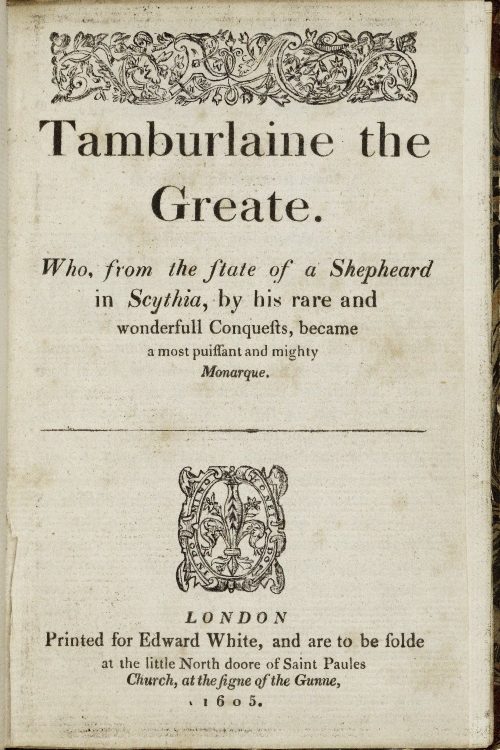
Tamburlaine the Greate. Who, from the state of a Shepheard in Scythia, by his rare and wonderfull Conquests, became a most puissant and mighty Monarque.
London Printed for Edward White, and are to be solde at the little North doore of Saint Paules-Church, at the signe of the Gunne, 1605. 4to.Tamburlaine the Greate. With his impassionate furie, for the death of his Lady and Loue fair Zenocrate: his forme of exhortation and discipline to his three Sonnes, and the manner of his owne death. The second part.
London Printed by E. A. for Ed. White, and are to be solde at his Shop neere the little North doore of Saint Paules Church at the Signe of the Gun. 1606. 4to.
The text of the present edition is given from the 8vo of 1592, collated with the 4tos of 1605-6.
TO THE GENTLEMEN-READERS 1 AND OTHERS THAT TAKE PLEASURE
IN READING HISTORIES. 2
Gentlemen and courteous readers whosoever: I have here published in print, for your sakes, the two tragical discourses of the Scythian shepherd Tamburlaine, that became so great a conqueror and so mighty a monarch. My hope is, that they will be now no less acceptable unto you to read after your serious affairs and studies than they have been lately delightful for many of you to see when the same were shewed in London upon stages. I have purposely omitted and left out some fond 3 and frivolous gestures, digressing, and, in my poor opinion, far unmeet for the matter, which I thought might seem more tedious unto the wise than any way else to be regarded, though haply they have been of some vain-conceited fondlings greatly gaped at, what time they were shewed upon the stage in their graced deformities: nevertheless now to be mixtured in print with such matter of worth, it would prove a great disgrace to so honourable and stately a history.
Great folly were it in me to commend unto your wisdoms either the eloquence of the author that writ them or the worthiness of the matter itself. I therefore leave unto your learned censures 4 both the one and the other, and myself the poor printer of them unto your most courteous and favourable protection; which if you vouchsafe to accept, you shall evermore bind me to employ what travail and service I can to the advancing and pleasuring of your excellent degree.
Yours, most humble at commandment,
R[ichard] J[ones], printer.
THE FIRST PART OF TAMBURLAINE THE GREAT.
THE PROLOGUE.
From jigging veins of rhyming mother-wits,
And such conceits as clownage keeps in pay,
We’ll lead you to the stately tent of war,
Where you shall hear the Scythian Tamburlaine
Threatening the world with high astounding terms,
And scourging kingdoms with his conquering sword.
View but his picture in this tragic glass,
And then applaud his fortunes as you please.
DRAMATIS PERSONAE.
MYCETES, king of Persia.
COSROE, his brother.
MEANDER, ]
THERIDAMAS, ]
ORTYGIUS, ] Persian lords.
CENEUS, ]
MENAPHON, ]
TAMBURLAINE, a Scythian shepherd.
TECHELLES, ]
USUMCASANE, ] his followers.
BAJAZETH, emperor of the Turks.
KING OF FEZ.
KING OF MOROCCO.
KING OF ARGIER.
KING OF ARABIA.
SOLDAN OF EGYPT.
GOVERNOR OF DAMASCUS.
AGYDAS, ]
MAGNETES, ] Median lords.
CAPOLIN, an Egyptian.
PHILEMUS, Bassoes, Lords, Citizens, Moors, Soldiers, and
Attendants.ZENOCRATE, daughter to the Soldan of Egypt.
ANIPPE, her maid.
ZABINA, wife to BAJAZETH.
EBEA, her maid.
Virgins of Damascus.
THE FIRST PART OF TAMBURLAINE THE GREAT.
ACT I.
SCENE I.
Enter MYCETES, COSROE, MEANDER, THERIDAMAS, ORTYGIUS,
CENEUS, MENAPHON, with others.MYCETES. Brother Cosroe, I find myself agriev’d;
Yet insufficient to express the same,
For it requires a great and thundering speech:
Good brother, tell the cause unto my lords;
I know you have a better wit than I.COSROE. Unhappy Persia,—that in former age
Hast been the seat of mighty conquerors,
That, in their prowess and their policies,
Have triumph’d over Afric, 5 and the bounds
Of Europe where the sun dares scarce appear
For freezing meteors and congealed cold,—
Now to be rul’d and govern’d by a man
At whose birth-day Cynthia with Saturn join’d,
And Jove, the Sun, and Mercury denied
To shed their 6 influence in his fickle brain!
Now Turks and Tartars shake their swords at thee,
Meaning to mangle all thy provinces.MYCETES. Brother, I see your meaning well enough,
And through 7 your planets I perceive you think
I am not wise enough to be a king:
But I refer me to my noblemen,
That know my wit, and can be witnesses.
I might command you to be slain for this,—
Meander, might I not?MEANDER. Not for so small a fault, my sovereign lord.
MYCETES. I mean it not, but yet I know I might.—
Yet live; yea, live; Mycetes wills it so.—
Meander, thou, my faithful counsellor,
Declare the cause of my conceived grief,
Which is, God knows, about that Tamburlaine,
That, like a fox in midst of harvest-time,
Doth prey upon my flocks of passengers;
And, as I hear, doth mean to pull my plumes:
Therefore ’tis good and meet for to be wise.MEANDER. Oft have I heard your majesty complain
Of Tamburlaine, that sturdy Scythian thief,
That robs your merchants of Persepolis
Trading by land unto the Western Isles,
And in your confines with his lawless train
Daily commits incivil 8 outrages,
Hoping (misled by dreaming prophecies)
To reign in Asia, and with barbarous arms
To make himself the monarch of the East:
But, ere he march in Asia, or display
His vagrant ensign in the Persian fields,
Your grace hath taken order by Theridamas,
Charg’d with a thousand horse, to apprehend
And bring him captive to your highness’ throne.MYCETES. Full true thou speak’st, and like thyself, my lord,
Whom I may term a Damon for thy love:
Therefore ’tis best, if so it like you all,
To send my thousand horse incontinent 9
To apprehend that paltry Scythian.
How like you this, my honourable lords?
Is it not a kingly resolution?COSROE. It cannot choose, because it comes from you.
MYCETES. Then hear thy charge, valiant Theridamas,
The chiefest 10 captain of Mycetes’ host,
The hope of Persia, and the very legs
Whereon our state doth lean as on a staff,
That holds us up and foils our neighbour foes:
Thou shalt be leader of this thousand horse,
Whose foaming gall with rage and high disdain
Have sworn the death of wicked Tamburlaine.
Go frowning forth; but come thou smiling home,
As did Sir Paris with the Grecian dame:
Return with speed; time passeth swift away;
Our life is frail, and we may die to-day.THERIDAMAS. Before the moon renew her borrow’d light,
Doubt not, my lord and gracious sovereign,
But Tamburlaine and that Tartarian rout 11
Shall either perish by our warlike hands,
Or plead for mercy at your highness’ feet.MYCETES. Go, stout Theridamas; thy words are swords,
And with thy looks thou conquerest all thy foes.
I long to see thee back return from thence,
That I may view these milk-white steeds of mine
All loaden with the heads of killed men,
And, from their knees even to their hoofs below,
Besmear’d with blood that makes a dainty show.THERIDAMAS. Then now, my lord, I humbly take my leave.
MYCETES. Theridamas, farewell ten thousand times.
[Exit THERIDAMAS.]
Ah, Menaphon, why stay’st thou thus behind,
When other men press 12 forward for renown?
Go, Menaphon, go into Scythia,
And foot by foot follow Theridamas.COSROE. Nay, pray you, 13 let him stay; a greater [task]
Fits Menaphon than warring with a thief:
Create him pro-rex of all 14 Africa,
That he may win the Babylonians’ hearts,
Which will revolt from Persian government,
Unless they have a wiser king than you.MYCETES. Unless they have a wiser king than you!
These are his words; Meander, set them down.COSROE. And add this to them,—that all Asia
Lament to see the folly of their king.MYCETES. Well, here I swear by this my royal seat—
COSROE. You may do well to kiss it, then.
MYCETES. Emboss’d with silk as best beseems my state,
To be reveng’d for these contemptuous words!
O, where is duty and allegiance now?
Fled to the Caspian or the Ocean main?
What shall I call thee? brother? no, a foe;
Monster of nature, shame unto thy stock,
That dar’st presume thy sovereign for to mock!—
Meander, come: I am abus’d, Meander.[Exeunt all except COSROE and MENAPHON.]
MENAPHON. How now, my lord! what, mated 15 and amaz’d
To hear the king thus threaten like himself!COSROE. Ah, Menaphon, I pass not 16 for his threats!
The plot is laid by Persian noblemen
And captains of the Median garrisons
To crown me emperor of Asia:
But this it is that doth excruciate
The very substance of my vexed soul,
To see our neighbours, that were wont to quake
And tremble at the Persian monarch’s name,
Now sit and laugh our regiment 17 to scorn;
And that which might resolve 18 me into tears,
Men from the farthest equinoctial line
Have swarm’d in troops into the Eastern India,
Lading their ships 19 with gold and precious stones,
And made their spoils from all our provinces.MENAPHON. This should entreat your highness to rejoice,
Since Fortune gives you opportunity
To gain the title of a conqueror
By curing of this maimed empery.
Afric and Europe bordering on your land,
And continent to your dominions,
How easily may you, with a mighty host,
Pass 20 into Graecia, as did Cyrus once,
And cause them to withdraw their forces home,
Lest you 21 subdue the pride of Christendom![Trumpet within.]
COSROE. But, Menaphon, what means this trumpet’s sound?
MENAPHON. Behold, my lord, Ortygius and the rest
Bringing the crown to make you emperor!Re-enter ORTYGIUS and CENEUS, 22 with others, bearing a
crown.ORTYGIUS. Magnificent and mighty prince Cosroe,
We, in the name of other Persian states 23
And commons of this mighty monarchy,
Present thee with th’ imperial diadem.CENEUS. The warlike soldiers and the gentlemen,
That heretofore have fill’d Persepolis
With Afric captains taken in the field,
Whose ransom made them march in coats of gold,
With costly jewels hanging at their ears,
And shining stones upon their lofty crests,
Now living idle in the walled towns,
Wanting both pay and martial discipline,
Begin in troops to threaten civil war,
And openly exclaim against their 24 king:
Therefore, to stay all sudden mutinies,
We will invest your highness emperor;
Whereat the soldiers will conceive more joy
Than did the Macedonians at the spoil
Of great Darius and his wealthy host.COSROE. Well, since I see the state of Persia droop
And languish in my brother’s government,
I willingly receive th’ imperial crown,
And vow to wear it for my country’s good,
In spite of them shall malice my estate.ORTYGIUS. And, in assurance of desir’d success,
We here do crown thee monarch of the East [;]
Emperor of Asia and Persia; 25
Great lord of Media and Armenia;
Duke of Africa and Albania,
Mesopotamia and of Parthia,
East India and the late-discover’d isles;
Chief lord of all the wide vast Euxine Sea,
And of the ever-raging 26 Caspian Lake.ALL. 27 Long live Cosroe, mighty emperor!
COSROE. And Jove may 28 never let me longer live
Than I may seek to gratify your love,
And cause the soldiers that thus honour me
To triumph over many provinces!
By whose desires of discipline in arms
I doubt not shortly but to reign sole king,
And with the army of Theridamas
(Whither we presently will fly, my lords,)
To rest secure against my brother’s force.ORTYGIUS. We knew, 29 my lord, before we brought the crown,
Intending your investion so near
The residence of your despised brother,
The lords 30 would not be too exasperate
To injury 31 or suppress your worthy title;
Or, if they would, there are in readiness
Ten thousand horse to carry you from hence,
In spite of all suspected enemies.COSROE. I know it well, my lord, and thank you all.
ORTYGIUS. Sound up the trumpets, then.
[Trumpets sounded.]
ALL. 32 God save the king!
[Exeunt.]
SCENE II.
Enter TAMBURLAINE leading ZENOCRATE, TECHELLES, USUMCASANE,
AGYDAS, MAGNETES, LORDS, and SOLDIERS loaden with treasure.TAMBURLAINE. Come, lady, let not this appal your thoughts;
The jewels and the treasure we have ta’en
Shall be reserv’d, and you in better state
Than if you were arriv’d in Syria,
Even in the circle of your father’s arms,
The mighty Soldan of Aegyptia.ZENOCRATE. Ah, shepherd, pity my distressed plight!
(If, as thou seem’st, thou art so mean a man,)
And seek not to enrich thy followers
By lawless rapine from a silly maid,
Who, travelling 33 with these Median lords
To Memphis, from my uncle’s country of Media,
Where, all my youth, I have been governed,
Have pass’d the army of the mighty Turk,
Bearing his privy-signet and his hand
To safe-conduct us thorough 34 Africa.MAGNETES. And, since we have arriv’d in Scythia,
Besides rich presents from the puissant Cham,
We have his highness’ letters to command
Aid and assistance, if we stand in need.TAMBURLAINE. But now you see these letters and commands
Are countermanded by a greater man;
And through my provinces you must expect
Letters of conduct from my mightiness,
If you intend to keep your treasure safe.
But, since I love to live at liberty,
As easily may you get the Soldan’s crown
As any prizes out of my precinct;
For they are friends that help to wean my state
Till men and kingdoms help to strengthen it,
And must maintain my life exempt from servitude.—
But, tell me, madam, is your grace betroth’d?ZENOCRATE. I am, my lord,—for so you do import.
TAMBURLAINE. I am a lord, for so my deeds shall prove;
And yet a shepherd by my parentage.
But, lady, this fair face and heavenly hue
Must grace his bed that conquers Asia,
And means to be a terror to the world,
Measuring the limits of his empery
By east and west, as Phoebus doth his course.—
Lie here, ye weeds, that I disdain to wear!
This complete armour and this curtle-axe
Are adjuncts more beseeming Tamburlaine.—
And, madam, whatsoever you esteem
Of this success, and loss unvalued, 35
Both may invest you empress of the East;
And these that seem but silly country swains
May have the leading of so great an host
As with their weight shall make the mountains quake,
Even as when windy exhalations,
Fighting for passage, tilt within the earth.TECHELLES. As princely lions, when they rouse themselves,
Stretching their paws, and threatening herds of beasts,
So in his armour looketh Tamburlaine.
Methinks I see kings kneeling at his feet,
And he with frowning brows and fiery looks
Spurning their crowns from off their captive heads.USUMCASANE. And making thee and me, Techelles, kings,
That even to death will follow Tamburlaine.TAMBURLAINE. Nobly resolv’d, sweet friends and followers!
These lords perhaps do scorn our estimates,
And think we prattle with distemper’d spirits:
But, since they measure our deserts so mean,
That in conceit 36 bear empires on our spears,
Affecting thoughts coequal with the clouds,
They shall be kept our forced followers
Till with their eyes they view us emperors.ZENOCRATE. The gods, defenders of the innocent.
Will never prosper your intended drifts,
That thus oppress poor friendless passengers.
Therefore at least admit us liberty,
Even as thou hop’st to be eternized
By living Asia’s mighty emperor.AGYDAS. I hope our lady’s treasure and our own
May serve for ransom to our liberties:
Return our mules and empty camels back,
That we may travel into Syria,
Where her betrothed lord, Alcidamus,
Expects the arrival of her highness’ person.MAGNETES. And wheresoever we repose ourselves,
We will report but well of Tamburlaine.TAMBURLAINE. Disdains Zenocrate to live with me?
Or you, my lords, to be my followers?
Think you I weigh this treasure more than you?
Not all the gold in India’s wealthy arms
Shall buy the meanest soldier in my train.
Zenocrate, lovelier than the love of Jove,
Brighter than is the silver Rhodope, 37
Fairer than whitest snow on Scythian hills,
Thy person is more worth to Tamburlaine
Than the possession of the Persian crown,
Which gracious stars have promis’d at my birth.
A hundred Tartars shall attend on thee,
Mounted on steeds swifter than Pegasus;
Thy garments shall be made of Median silk,
Enchas’d with precious jewels of mine own,
More rich and valurous 38 than Zenocrate’s;
With milk-white harts upon an ivory sled
Thou shalt be drawn amidst the frozen pools, 39
And scale the icy mountains’ lofty tops,
Which with thy beauty will be soon resolv’d: 40
My martial prizes, with five hundred men,
Won on the fifty-headed Volga’s waves,
Shall we all offer 41 to Zenocrate,
And then myself to fair Zenocrate.TECHELLES. What now! in love?
TAMBURLAINE. Techelles, women must be flattered:
But this is she with whom I am in 42 love.Enter a SOLDIER.
SOLDIER. News, news!
TAMBURLAINE. How now! what’s the matter?
SOLDIER. A thousand Persian horsemen are at hand,
Sent from the king to overcome us all.TAMBURLAINE. How now, my lords of Egypt, and Zenocrate!
Now must your jewels be restor’d again,
And I, that triumph’d 43 so, be overcome?
How say you, lordings? is not this your hope?AGYDAS. We hope yourself will willingly restore them.
TAMBURLAINE. Such hope, such fortune, have the thousand horse.
Soft ye, my lords, and sweet Zenocrate!
You must be forced from me ere you go.—
A thousand horsemen! we five hundred foot!
An odds too great for us to stand against.
But are they rich? and is their armour good!SOLDIER. Their plumed helms are wrought with beaten gold,
Their swords enamell’d, and about their necks
Hang massy chains of gold down to the waist;
In every part exceeding brave 44 and rich.TAMBURLAINE. Then shall we fight courageously with them?
Or look you I should play the orator?TECHELLES. No; cowards and faint-hearted runaways
Look for orations when the foe is near:
Our swords shall play the orators for us.USUMCASANE. Come, let us meet them at the mountain-top, 45
And with a sudden and an hot alarum
Drive all their horses headlong down the hill.TECHELLES. Come, let us march.
TAMBURLAINE. Stay, Techelles; ask a parle first.
The SOLDIERS enter.
Open the mails, 46 yet guard the treasure sure:
Lay out our golden wedges to the view,
That their reflections may amaze the Persians;
And look we friendly on them when they come:
But, if they offer word or violence,
We’ll fight, five hundred men-at-arms to one,
Before we part with our possession;
And ‘gainst the general we will lift our swords,
And either lance 47 his greedy thirsting throat,
Or take him prisoner, and his chain shall serve
For manacles till he be ransom’d home.TECHELLES. I hear them come: shall we encounter them?
TAMBURLAINE. Keep all your standings, and not stir a foot:
Myself will bide the danger of the brunt.Enter THERIDAMAS with others.
THERIDAMAS. Where is this 48 Scythian Tamburlaine?
TAMBURLAINE. Whom seek’st thou, Persian? I am Tamburlaine.
THERIDAMAS. Tamburlaine!
A Scythian shepherd so embellished
With nature’s pride and richest furniture!
His looks do menace heaven and dare the gods;
His fiery eyes are fix’d upon the earth,
As if he now devis’d some stratagem,
Or meant to pierce Avernus’ darksome vaults 49
To pull the triple-headed dog from hell.TAMBURLAINE. Noble and mild this Persian seems to be,
If outward habit judge the inward man.TECHELLES. His deep affections make him passionate.
TAMBURLAINE. With what a majesty he rears his looks!—
In thee, thou valiant man of Persia,
I see the folly of thy 50 emperor.
Art thou but captain of a thousand horse,
That by characters graven in thy brows,
And by thy martial face and stout aspect,
Deserv’st to have the leading of an host?
Forsake thy king, and do but join with me,
And we will triumph over all the world:
I hold the Fates bound fast in iron chains,
And with my hand turn Fortune’s wheel about;
And sooner shall the sun fall from his sphere
Than Tamburlaine be slain or overcome.
Draw forth thy sword, thou mighty man-at-arms,
Intending but to raze my charmed skin,
And Jove himself will stretch his hand from heaven
To ward the blow, and shield me safe from harm.
See, how he rains down heaps of gold in showers,
As if he meant to give my soldiers pay!
And, as a sure and grounded argument
That I shall be the monarch of the East,
He sends this Soldan’s daughter rich and brave, 51
To be my queen and portly emperess.
If thou wilt stay with me, renowmed 52 man,
And lead thy thousand horse with my conduct,
Besides thy share of this Egyptian prize,
Those thousand horse shall sweat with martial spoil
Of conquer’d kingdoms and of cities sack’d:
Both we will walk upon the lofty cliffs; 53
And Christian merchants, 54 that with Russian stems 55
Plough up huge furrows in the Caspian Sea,
Shall vail 56 to us as lords of all the lake;
Both we will reign as consuls of the earth,
And mighty kings shall be our senators.
Jove sometime masked in a shepherd’s weed;
And by those steps that he hath scal’d the heavens
May we become immortal like the gods.
Join with me now in this my mean estate,
(I call it mean, because, being yet obscure,
The nations far-remov’d admire me not,)
And when my name and honour shall be spread
As far as Boreas claps his brazen wings,
Or fair Bootes 57 sends his cheerful light,
Then shalt thou be competitor 58 with me,
And sit with Tamburlaine in all his majesty.THERIDAMAS. Not Hermes, prolocutor to the gods,
Could use persuasions more pathetical.TAMBURLAINE. Nor are Apollo’s oracles more true
Than thou shalt find my vaunts substantial.TECHELLES. We are his friends; and, if the Persian king
Should offer present dukedoms to our state,
We think it loss to make exchange for that
We are assur’d of by our friend’s success.USUMCASANE. And kingdoms at the least we all expect,
Besides the honour in assured conquests,
Where kings shall crouch unto our conquering swords,
And hosts of soldiers stand amaz’d at us,
When with their fearful tongues they shall confess,
These are the men that all the world admires.THERIDAMAS. What strong enchantments tice my yielding soul
To these 59 resolved, noble Scythians!
But shall I prove a traitor to my king?TAMBURLAINE. No; but the trusty friend of Tamburlaine.
THERIDAMAS. Won with thy words, and conquer’d with thy looks,
I yield myself, my men, and horse to thee,
To be partaker of thy good or ill,
As long as life maintains Theridamas.TAMBURLAINE. Theridamas, my friend, take here my hand,
Which is as much as if I swore by heaven,
And call’d the gods to witness of my vow.
Thus shall my heart be still combin’d with thine
Until our bodies turn to elements,
And both our souls aspire celestial thrones.—
Techelles and Casane, welcome him.TECHELLES. Welcome, renowmed 60 Persian, to us all!
USUMCASANE. Long may Theridamas remain with us!
TAMBURLAINE. These are my friends, in whom I more rejoice
Than doth the king of Persia in his crown;
And, by the love of Pylades and Orestes,
Whose statues 61 we adore in Scythia,
Thyself and them shall never part from me
Before I crown you kings 62 in Asia.
Make much of them, gentle Theridamas,
And they will never leave thee till the death.THERIDAMAS. Nor thee nor them, 63 thrice-noble Tamburlaine,
Shall want my heart to be with gladness pierc’d,
To do you honour and security.TAMBURLAINE. A thousand thanks, worthy Theridamas.—
And now, fair madam, and my noble lords,
If you will 64 willingly remain with me,
You shall have honours as your merits be;
Or else you shall be forc’d with slavery.AGYDAS. We yield unto thee, happy Tamburlaine.
TAMBURLAINE. For you, then, madam, I am out of doubt.
ZENOCRATE. I must be pleas’d perforce,—wretched Zenocrate!
[Exeunt.]
ACT II.
SCENE I.
Enter COSROE, MENAPHON, ORTYGIUS, and CENEUS, with SOLDIERS.
COSROE. Thus far are we towards Theridamas,
And valiant Tamburlaine, the man of fame,
The man that in the forehead of his fortune
Bears figures of renown and miracle.
But tell me, that hast seen him, Menaphon,
What stature wields he, and what personage?MENAPHON. Of stature tall, and straightly fashioned,
Like his desire, lift upwards and divine;
So large of limbs, his joints so strongly knit,
Such breadth of shoulders as might mainly bear
Old Atlas’ burden; ‘twixt his manly pitch, 65
A pearl more worth than all the world is plac’d,
Wherein by curious sovereignty of art
Are fix’d his piercing instruments of sight,
Whose fiery circles bear encompassed
A heaven of heavenly bodies in their spheres,
That guides his steps and actions to the throne
Where honour sits invested royally;
Pale of complexion, wrought in him with passion,
Thirsting with sovereignty and 66 love of arms;
His lofty brows in folds do figure death,
And in their smoothness amity and life;
About them hangs a knot of amber hair,
Wrapped in curls, as fierce Achilles’ was,
On which the breath of heaven delights to play,
Making it dance with wanton majesty;
His arms and fingers long and sinewy, 67
Betokening valour and excess of strength;—
In every part proportion’d like the man
Should make the world subdu’d 68 to Tamburlaine.COSROE. Well hast thou pourtray’d in thy terms of life
The face and personage of a wondrous man:
Nature doth strive with Fortune 69 and his stars
To make him famous in accomplish’d worth;
And well his merits shew him to be made
His fortune’s master and the king of men,
That could persuade, at such a sudden pinch,
With reasons of his valour and his life,
A thousand sworn and overmatching foes.
Then, when our powers in points of swords are join’d,
And clos’d in compass of the killing bullet,
Though strait the passage and the port 70 be made
That leads to palace of my brother’s life,
Proud is 71 his fortune if we pierce it not;
And, when the princely Persian diadem
Shall overweigh his weary witless head,
And fall, like mellow’d fruit, with shakes of death,
In fair 72 Persia noble Tamburlaine
Shall be my regent, and remain as king.ORTYGIUS. In happy hour we have set the crown
Upon your kingly head, that seeks our honour
In joining with the man ordain’d by heaven
To further every action to the best.CENEUS. He that with shepherds and a little spoil
Durst, in disdain of wrong and tyranny,
Defend his freedom ‘gainst a monarchy,
What will he do supported by a king,
Leading a troop of gentlemen and lords,
And stuff’d with treasure for his highest thoughts!COSROE. And such shall wait on worthy Tamburlaine.
Our army will be forty thousand strong,
When Tamburlaine and brave Theridamas
Have met us by the river Araris;
And all conjoin’d to meet the witless king,
That now is marching near to Parthia,
And, with unwilling soldiers faintly arm’d,
To seek revenge on me and Tamburlaine;
To whom, sweet Menaphon, direct me straight.MENAPHON. I will, my lord.
[Exeunt.]
SCENE II.
Enter MYCETES, MEANDER, with other LORDS; and SOLDIERS.
MYCETES. Come, my Meander, let us to this gear.
I tell you true, my heart is swoln with wrath
On this same thievish villain Tamburlaine,
And of 73 that false Cosroe, my traitorous brother.
Would it not grieve a king to be so abus’d,
And have a thousand horsemen ta’en away?
And, which is worse, 74 to have his diadem
Sought for by such scald knaves as love him not?
I think it would: well, then, by heavens I swear,
Aurora shall not peep out of her doors,
But I will have Cosroe by the head,
And kill proud Tamburlaine with point of sword.
Tell you the rest, Meander: I have said.MEANDER. Then, having pass’d Armenian deserts now,
And pitch’d our tents under the Georgian hills,
Whose tops are cover’d with Tartarian thieves,
That lie in ambush, waiting for a prey,
What should we do but bid them battle straight,
And rid the world of those detested troops?
Lest, if we let them linger here a while,
They gather strength by power of fresh supplies.
This country swarms with vile outragious men
That live by rapine and by lawless spoil,
Fit soldiers for the 75 wicked Tamburlaine;
And he that could with gifts and promises
Inveigle him that led a thousand horse,
And make him false his faith unto his 76 king,
Will quickly win such as be 77 like himself.
Therefore cheer up your minds; prepare to fight:
He that can take or slaughter Tamburlaine,
Shall rule the province of Albania;
Who brings that traitor’s head, Theridamas,
Shall have a government in Media,
Beside 78 the spoil of him and all his train:
But, if Cosroe (as our spials say,
And as we know) remains with Tamburlaine,
His highness’ pleasure is that he should live,
And be reclaim’d with princely lenity.Enter a SPY.
SPY. An hundred horsemen of my company,
Scouting abroad upon these champion 79 plains,
Have view’d the army of the Scythians;
Which make report it far exceeds the king’s.MEANDER. Suppose they be in number infinite,
Yet being void of martial discipline,
All running headlong, greedy after 80 spoils,
And more regarding gain than victory,
Like to the cruel brothers of the earth,
Sprung 81 of the teeth of 82 dragons venomous,
Their careless swords shall lance 83 their fellows’ throats,
And make us triumph in their overthrow.MYCETES. Was there such brethren, sweet Meander, say,
That sprung of teeth of dragons venomous?MEANDER. So poets say, my lord.
MYCETES. And ’tis a pretty toy to be a poet.
Well, well, Meander, thou art deeply read;
And having thee, I have a jewel sure.
Go on, my lord, and give your charge, I say;
Thy wit will make us conquerors to-day.MEANDER. Then, noble soldiers, to entrap these thieves
That live confounded in disorder’d troops,
If wealth or riches may prevail with them,
We have our camels laden all with gold,
Which you that be but common soldiers
Shall fling in every corner of the field;
And, while the base-born Tartars take it up,
You, fighting more for honour than for gold,
Shall massacre those greedy-minded slaves;
And, when their scatter’d army is subdu’d,
And you march on their slaughter’d carcasses,
Share equally the gold that bought their lives,
And live like gentlemen in Persia.
Strike up the 84 drum, and march courageously:
Fortune herself doth sit upon our crests.MYCETES. He tells you true, my masters; so he does.—
Drums, why sound ye not when Meander speaks?[Exeunt, drums sounding.]
SCENE III.
Enter COSROE, TAMBURLAINE, THERIDAMAS, TECHELLES,
USUMCASANE,
and ORTYGIUS, with others.COSROE. Now, worthy Tamburlaine, have I repos’d
In thy approved fortunes all my hope.
What think’st thou, man, shall come of our attempts?
For, even as from assured oracle,
I take thy doom for satisfaction.TAMBURLAINE. And so mistake you not a whit, my lord;
For fates and oracles [of] heaven have sworn
To royalize the deeds of Tamburlaine,
And make them blest that share in his attempts:
And doubt you not but, if you favour me,
And let my fortunes and my valour sway
To some 85 direction in your martial deeds,
The world will 86 strive with hosts of men-at-arms
To swarm unto the ensign I support.
The host of Xerxes, which by fame is said
To drink the mighty Parthian Araris,
Was but a handful to that we will have:
Our quivering lances, shaking in the air,
And bullets, like Jove’s dreadful thunderbolts,
Enroll’d in flames and fiery smouldering mists,
Shall threat the gods more than Cyclopian wars;
And with our sun-bright armour, as we march,
We’ll chase the stars from heaven, and dim their eyes
That stand and muse at our admired arms.THERIDAMAS. You see, my lord, what working words he hath;
But, when you see his actions top 87 his speech,
Your speech will stay, or so extol his worth
As I shall be commended and excus’d
For turning my poor charge to his direction:
And these his two renowmed 88 friends, my lord,
Would make one thirst 89 and strive to be retain’d
In such a great degree of amity.TECHELLES. With duty and 90 with amity we yield
Our utmost service to the fair 91 Cosroe.COSROE. Which I esteem as portion of my crown.
Usumcasane and Techelles both,
When she 92 that rules in Rhamnus’ 93 golden gates,
And makes a passage for all prosperous arms,
Shall make me solely emperor of Asia,
Then shall your meeds 94 and valours be advanc’d
To rooms of honour and nobility.TAMBURLAINE. Then haste, Cosroe, to be king alone,
That I with these my friends and all my men
May triumph in our long-expected fate.
The king, your brother, is now hard at hand:
Meet with the fool, and rid your royal shoulders
Of such a burden as outweighs the sands
And all the craggy rocks of Caspia.Enter a MESSENGER.
MESSENGER. My lord,
We have discovered the enemy
Ready to charge you with a mighty army.COSROE. Come, Tamburlaine; now whet thy winged sword,
And lift thy lofty arm into 95 the clouds,
That it may reach the king of Persia’s crown,
And set it safe on my victorious head.TAMBURLAINE. See where it is, the keenest curtle-axe
That e’er made passage thorough Persian arms!
These are the wings shall make it fly as swift
As doth the lightning or the breath of heaven,
And kill as sure 96 as it swiftly flies.COSROE. Thy words assure me of kind success:
Go, valiant soldier, go before, and charge
The fainting army of that foolish king.TAMBURLAINE. Usumcasane and Techelles, come:
We are enow to scare the enemy,
And more than needs to make an emperor.[Exeunt to the battle.]
SCENE IV.
Enter MYCETES with his crown in his hand. 97
MYCETES. Accurs’d be he that first invented war!
They knew not, ah, they knew not, simple men,
How those were 98 hit by pelting cannon-shot
Stand staggering 99 like a quivering aspen-leaf
Fearing the force of Boreas’ boisterous blasts!
In what a lamentable case were I,
If nature had not given me wisdom’s lore!
For kings are clouts that every man shoots at,
Our crown the pin 100 that thousands seek to cleave:
Therefore in policy I think it good
To hide it close; a goodly stratagem,
And far from any man that is a fool:
So shall not I be known; or if I be,
They cannot take away my crown from me.
Here will I hide it in this simple hole.Enter TAMBURLAINE.
TAMBURLAINE. What, fearful coward, straggling from the camp,
When kings themselves are present in the field?MYCETES. Thou liest.
TAMBURLAINE. Base villain, darest thou give me 101 the lie?
MYCETES. Away! I am the king; go; touch me not.
Thou break’st the law of arms, unless thou kneel,
And cry me “mercy, noble king!”TAMBURLAINE. Are you the witty king of Persia?
MYCETES. Ay, marry, 102 am I: have you any suit to me?
TAMBURLAINE. I would entreat you to speak but three wise words.
MYCETES. So I can when I see my time.
TAMBURLAINE. Is this your crown?
MYCETES. Ay: didst thou ever see a fairer?
TAMBURLAINE. You will not sell it, will you?
MYCETES. Such another word, and I will have thee executed. Come,
give it me.TAMBURLAINE. No; I took it prisoner.
MYCETES. You lie; I gave it you.
TAMBURLAINE. Then ’tis mine.
MYCETES. No; I mean I let you keep it.
TAMBURLAINE. Well, I mean you shall have it again.
Here, take it for a while: I lend it thee,
Till I may see thee hemm’d with armed men;
Then shalt thou see me pull it from thy head:
Thou art no match for mighty Tamburlaine.[Exit.]
MYCETES. O gods, is this Tamburlaine the thief?
I marvel much he stole it not away.[Trumpets within sound to the battle: he runs out.]
SCENE V.
Enter COSROE, TAMBURLAINE, MENAPHON, MEANDER, ORTYGIUS,
THERIDAMAS, TECHELLES, USUMCASANE, with others.TAMBURLAINE. Hold thee, Cosroe; wear two imperial crowns;
Think thee invested now as royally,
Even by the mighty hand of Tamburlaine,
As if as many kings as could encompass thee
With greatest pomp had crown’d thee emperor.COSROE. So do I, thrice-renowmed man-at-arms; 103
And none shall keep the crown but Tamburlaine:
Thee do I make my regent of Persia,
And general-lieutenant of my armies.—
Meander, you, that were our brother’s guide,
And chiefest 104 counsellor in all his acts,
Since he is yielded to the stroke of war,
On your submission we with thanks excuse,
And give you equal place in our affairs.MEANDER. Most happy 105 emperor, in humblest terms
I vow my service to your majesty,
With utmost virtue of my faith and duty.COSROE. Thanks, good Meander.—Then, Cosroe, reign,
And govern Persia in her former pomp.
Now send embassage to thy neighbour kings,
And let them know the Persian king is chang’d,
From one that knew not what a king should do,
To one that can command what ‘longs thereto.
And now we will to fair Persepolis
With twenty thousand expert soldiers.
The lords and captains of my brother’s camp
With little slaughter take Meander’s course,
And gladly yield them to my gracious rule.—
Ortygius and Menaphon, my trusty friends,
Now will I gratify your former good,
And grace your calling with a greater sway.ORTYGIUS. And as we ever aim’d 106 at your behoof,
And sought your state all honour it 107 deserv’d,
So will we with our powers and our 108 lives
Endeavour to preserve and prosper it.COSROE. I will not thank thee, sweet Ortygius;
Better replies shall prove my purposes.—
And now, Lord Tamburlaine, my brother’s camp
I leave to thee and to Theridamas,
To follow me to fair Persepolis;
Then will we 109 march to all those Indian mines
My witless brother to the Christians lost,
And ransom them with fame and usury:
And, till thou overtake me, Tamburlaine,
(Staying to order all the scatter’d troops,)
Farewell, lord regent and his happy friends.
I long to sit upon my brother’s throne.MEANDER. Your majesty shall shortly have your wish,
And ride in triumph through Persepolis.[Exeunt all except TAMBURLAINE, THERIDAMAS, TECHELLES, and
USUMCASANE.]TAMBURLAINE. And ride in triumph through Persepolis!—
Is it not brave to be a king, Techelles?—
Usumcasane and Theridamas,
Is it not passing brave to be a king,
And ride in triumph through Persepolis?TECHELLES. O, my lord, it is sweet and full of pomp!
USUMCASANE. To be a king is half to be a god.
THERIDAMAS. A god is not so glorious as a king:
I think the pleasure they enjoy in heaven,
Cannot compare with kingly joys in 110 earth;—
To wear a crown enchas’d with pearl and gold,
Whose virtues carry with it life and death;
To ask and have, command and be obey’d;
When looks breed love, with looks to gain the prize,—
Such power attractive shines in princes’ eyes.TAMBURLAINE. Why, say, Theridamas, wilt thou be a king?
THERIDAMAS. Nay, though I praise it, I can live without it.
TAMBURLAINE. What say my other friends? will you be kings?
TECHELLES. I, if I could, with all my heart, my lord.
TAMBURLAINE. Why, that’s well said, Techelles: so would I;—
And so would you, my masters, would you not?USUMCASANE. What, then, my lord?
TAMBURLAINE. Why, then, Casane, 111 shall we wish for aught
The world affords in greatest novelty,
And rest attemptless, faint, and destitute?
Methinks we should not. I am strongly mov’d,
That if I should desire the Persian crown,
I could attain it with a wondrous ease:
And would not all our soldiers soon consent,
If we should aim at such a dignity?THERIDAMAS. I know they would with our persuasions.
TAMBURLAINE. Why, then, Theridamas, I’ll first assay
To get the Persian kingdom to myself;
Then thou for Parthia; they for Scythia and Media;
And, if I prosper, all shall be as sure
As if the Turk, the Pope, Afric, and Greece,
Came creeping to us with their crowns a-piece. 112TECHELLES. Then shall we send to this triumphing king,
And bid him battle for his novel crown?USUMCASANE. Nay, quickly, then, before his room be hot.
TAMBURLAINE. ‘Twill prove a pretty jest, in faith, my friends.
THERIDAMAS. A jest to charge on twenty thousand men!
I judge the purchase 113 more important far.TAMBURLAINE. Judge by thyself, Theridamas, not me;
For presently Techelles here shall haste
To bid him battle ere he pass too far,
And lose more labour than the gain will quite: 114
Then shalt thou see this 115 Scythian Tamburlaine
Make but a jest to win the Persian crown.—
Techelles, take a thousand horse with thee,
And bid him turn him 116 back to war with us,
That only made him king to make us sport:
We will not steal upon him cowardly,
But give him warning and 117 more warriors:
Haste thee, Techelles; we will follow thee.[Exit TECHELLES.]
What saith Theridamas?
THERIDAMAS. Go on, for me.
[Exeunt.]
SCENE VI.
Enter COSROE, MEANDER, ORTYGIUS, and MENAPHON, with
SOLDIERS.COSROE. What means this devilish shepherd, to aspire
With such a giantly presumption,
To cast up hills against the face of heaven,
And dare the force of angry Jupiter?
But, as he thrust them underneath the hills,
And press’d out fire from their burning jaws,
So will I send this monstrous slave to hell,
Where flames shall ever feed upon his soul.MEANDER. Some powers divine, or else infernal, mix’d
Their angry seeds at his conception;
For he was never sprung 118 of human race,
Since with the spirit of his fearful pride,
He dares 119 so doubtlessly resolve of rule,
And by profession be ambitious.ORTYGIUS. What god, or fiend, or spirit of the earth,
Or monster turned to a manly shape,
Or of what mould or mettle he be made,
What star or fate 120 soever govern him,
Let us put on our meet encountering minds;
And, in detesting such a devilish thief,
In love of honour and defence of right,
Be arm’d against the hate of such a foe,
Whether from earth, or hell, or heaven he grow.COSROE. Nobly resolv’d, my good Ortygius;
And, since we all have suck’d one wholesome air,
And with the same proportion of elements
Resolve, 121 I hope we are resembled,
Vowing our loves to equal death and life.
Let’s cheer our soldiers to encounter him,
That grievous image of ingratitude,
That fiery thirster after sovereignty,
And burn him in the fury of that flame
That none can quench but blood and empery.
Resolve, my lords and loving soldiers, now
To save your king and country from decay.
Then strike up, drum; and all the stars that make
The loathsome circle of my dated life,
Direct my weapon to his barbarous heart,
That thus opposeth him against the gods,
And scorns the powers that govern Persia![Exeunt, drums sounding.]
SCENE VII.
Alarms of battle within. Then enter COSROE wounded,
TAMBURLAINE, THERIDAMAS, TECHELLES, USUMCASANE, with others.COSROE. Barbarous 122 and bloody Tamburlaine,
Thus to deprive me of my crown and life!—
Treacherous and false Theridamas,
Even at the morning of my happy state,
Scarce being seated in my royal throne,
To work my downfall and untimely end!
An uncouth pain torments my grieved soul;
And death arrests the organ of my voice,
Who, entering at the breach thy sword hath made,
Sacks every vein and artier 123 of my heart.—
Bloody and insatiate Tamburlaine!TAMBURLAINE. The thirst of reign and sweetness of a crown,
That caus’d the eldest son of heavenly Ops
To thrust his doting father from his chair,
And place himself in the empyreal heaven,
Mov’d me to manage arms against thy state.
What better precedent than mighty Jove?
Nature, that fram’d us of four elements
Warring within our breasts for regiment, 124
Doth teach us all to have aspiring minds:
Our souls, whose faculties can comprehend
The wondrous architecture of the world,
And measure every wandering planet’s course,
Still climbing after knowledge infinite,
And always moving as the restless spheres,
Will us to wear ourselves, and never rest,
Until we reach the ripest fruit 125 of all,
That perfect bliss and sole felicity,
The sweet fruition of an earthly crown.THERIDAMAS. And that made me to join with Tamburlaine;
For he is gross and like the massy earth
That moves not upwards, nor by princely deeds
Doth mean to soar above the highest sort.TECHELLES. And that made us, the friends of Tamburlaine,
To lift our swords against the Persian king.USUMCASANE. For as, when Jove did thrust old Saturn down,
Neptune and Dis gain’d each of them a crown,
So do we hope to reign in Asia,
If Tamburlaine be plac’d in Persia.COSROE. The strangest men that ever nature made!
I know not how to take their tyrannies.
My bloodless body waxeth chill and cold,
And with my blood my life slides through my wound;
My soul begins to take her flight to hell,
And summons all my senses to depart:
The heat and moisture, which did feed each other,
For want of nourishment to feed them both,
Are 126 dry and cold; and now doth ghastly Death
With greedy talents 127 gripe my bleeding heart,
And like a harpy 128 tires on my life.—
Theridamas and Tamburlaine, I die:
And fearful vengeance light upon you both![Dies.—TAMBURLAINE takes COSROE’S crown, and puts it on
his own head.]TAMBURLAINE. Not all the curses which the 129 Furies breathe
Shall make me leave so rich a prize as this.
Theridamas, Techelles, and the rest,
Who think you now is king of Persia?ALL. Tamburlaine! Tamburlaine!
TAMBURLAINE. Though Mars himself, the angry god of arms,
And all the earthly potentates conspire
To dispossess me of this diadem,
Yet will I wear it in despite of them,
As great commander of this eastern world,
If you but say that Tamburlaine shall reign.ALL. Long live Tamburlaine, and reign in Asia!
TAMBURLAINE. So; now it is more surer on my head
Than if the gods had held a parliament,
And all pronounc’d me king of Persia.[Exeunt.]
ACT III.
SCENE I.
Enter BAJAZETH, the KINGS OF FEZ, MOROCCO, and ARGIER, with
others, in great pomp.BAJAZETH. Great kings of Barbary, and my portly bassoes, 130
We hear the Tartars and the eastern thieves,
Under the conduct of one Tamburlaine,
Presume a bickering with your emperor,
And think to rouse us from our dreadful siege
Of the famous Grecian Constantinople.
You know our army is invincible;
As many circumcised Turks we have,
And warlike bands of Christians renied, 131
As hath the ocean or the Terrene 132 sea
Small drops of water when the moon begins
To join in one her semicircled horns:
Yet would we not be brav’d with foreign power,
Nor raise our siege before the Grecians yield,
Or breathless lie before the city-walls.KING OF FEZ. Renowmed 133 emperor and mighty general,
What, if you sent the bassoes of your guard
To charge him to remain in Asia,
Or else to threaten death and deadly arms
As from the mouth of mighty Bajazeth?BAJAZETH. Hie thee, my basso, 134 fast to Persia;
Tell him thy lord, the Turkish emperor,
Dread lord of Afric, Europe, and Asia,
Great king and conqueror of Graecia,
The ocean, Terrene, and the Coal-black sea,
The high and highest monarch of the world,
Wills and commands, (for say not I entreat,)
Not 135 once to set his foot in 136 Africa,
Or spread 137 his colours in Graecia,
Lest he incur the fury of my wrath:
Tell him I am content to take a truce,
Because I hear he bears a valiant mind:
But if, presuming on his silly power,
He be so mad to manage arms with me,
Then stay thou with him,—say, I bid thee so;
And if, before the sun have measur’d heaven 138
With triple circuit, thou regreet us not,
We mean to take his morning’s next arise
For messenger he will not be reclaim’d,
And mean to fetch thee in despite of him.BASSO. Most great and puissant monarch of the earth,
Your basso will accomplish your behest,
And shew your pleasure to the Persian,
As fits the legate of the stately Turk.[Exit.]
KING OF ARGIER. They say he is the king of Persia;
But, if he dare attempt to stir your siege,
‘Twere requisite he should be ten times more,
For all flesh quakes at your magnificence.BAJAZETH. True, Argier; and tremble[s] at my looks.
KING OF MOROCCO. The spring is hinder’d by your smothering host;
For neither rain can fall upon the earth,
Nor sun reflex his virtuous beams thereon,
The ground is mantled with such multitudes.BAJAZETH. All this is true as holy Mahomet;
And all the trees are blasted with our breaths.KING OF FEZ. What thinks your greatness best to be achiev’d
In pursuit of the city’s overthrow?BAJAZETH. I will the captive pioners 139 of Argier
Cut off the water that by leaden pipes
Runs to the city from the mountain Carnon;
Two thousand horse shall forage up and down,
That no relief or succour come by land;
And all the sea my galleys countermand:
Then shall our footmen lie within the trench,
And with their cannons, mouth’d like Orcus’ gulf,
Batter the walls, and we will enter in;
And thus the Grecians shall be conquered.[Exeunt.]
SCENE II.
Enter ZENOCRATE, AGYDAS, ANIPPE, with others.
AGYDAS. Madam Zenocrate, may I presume
To know the cause of these unquiet fits
That work such trouble to your wonted rest?
‘Tis more than pity such a heavenly face
Should by heart’s sorrow wax so wan and pale,
When your offensive rape by Tamburlaine
(Which of your whole displeasures should be most)
Hath seem’d to be digested long ago.ZENOCRATE. Although it be digested long ago,
As his exceeding favours have deserv’d,
And might content the Queen of Heaven, as well
As it hath chang’d my first-conceiv’d disdain;
Yet since a farther passion feeds my thoughts
With ceaseless 140 and disconsolate conceits, 141
Which dye my looks so lifeless as they are,
And might, if my extremes had full events,
Make me the ghastly counterfeit 142 of death.AGYDAS. Eternal heaven sooner be dissolv’d,
And all that pierceth Phoebus’ silver eye,
Before such hap fall to Zenocrate!ZENOCRATE. Ah, life and soul, still hover in his 143 breast,
And leave my body senseless as the earth,
Or else unite you 144 to his life and soul,
That I may live and die with Tamburlaine!Enter, behind, TAMBURLAINE, with TECHELLES, and others.
AGYDAS. With Tamburlaine! Ah, fair Zenocrate,
Let not a man so vile and barbarous,
That holds you from your father in despite,
And keeps you from the honours of a queen,
(Being suppos’d his worthless concubine,)
Be honour’d with your love but for necessity!
So, now the mighty Soldan hears of you,
Your highness needs not doubt but in short time
He will, with Tamburlaine’s destruction,
Redeem you from this deadly servitude.ZENOCRATE. Leave 145 to wound me with these words,
And speak of Tamburlaine as he deserves:
The entertainment we have had of him
Is far from villany or servitude,
And might in noble minds be counted princely.AGYDAS. How can you fancy one that looks so fierce,
Only dispos’d to martial stratagems?
Who, when he shall embrace you in his arms,
Will tell how many thousand men he slew;
And, when you look for amorous discourse,
Will rattle forth his facts 146 of war and blood,
Too harsh a subject for your dainty ears.ZENOCRATE. As looks the sun through Nilus’ flowing stream,
Or when the Morning holds him in her arms,
So looks my lordly love, fair Tamburlaine;
His talk much 147 sweeter than the Muses’ song
They sung for honour ‘gainst Pierides, 148
Or when Minerva did with Neptune strive:
And higher would I rear my estimate
Than Juno, sister to the highest god,
If I were match’d with mighty Tamburlaine.AGYDAS. Yet be not so inconstant in your love,
But let the young Arabian 149 live in hope,
After your rescue to enjoy his choice.
You see, though first the king of Persia,
Being a shepherd, seem’d to love you much,
Now, in his majesty, he leaves those looks,
Those words of favour, and those comfortings,
And gives no more than common courtesies.ZENOCRATE. Thence rise the tears that so distain my cheeks,
Fearing his love 150 through my unworthiness.[TAMBURLAINE goes to her, and takes her away lovingly by
the hand, looking wrathfully on AGYDAS, and says nothing.
Exeunt all except AGYDAS.]AGYDAS. Betray’d by fortune and suspicious love,
Threaten’d with frowning wrath and jealousy,
Surpris’d with fear of 151 hideous revenge,
I stand aghast; but most astonied
To see his choler shut in secret thoughts,
And wrapt in silence of his angry soul:
Upon his brows was pourtray’d ugly death;
And in his eyes the fury 152 of his heart,
That shone 153 as comets, menacing revenge,
And cast a pale complexion on his cheeks.
As when the seaman sees the Hyades
Gather an army of Cimmerian clouds,
(Auster and Aquilon with winged steeds,
All sweating, tilt about the watery heavens,
With shivering spears enforcing thunder-claps,
And from their shields strike flames of lightning,)
All-fearful folds his sails, and sounds the main,
Lifting his prayers to the heavens for aid
Against the terror of the winds and waves;
So fares Agydas for the late-felt frowns,
That send 154 a tempest to my daunted thoughts,
And make my soul divine her overthrow.Re-enter TECHELLES with a naked dagger, and USUMCASANE.
TECHELLES. See you, Agydas, how the king salutes you!
He bids you prophesy what it imports.AGYDAS. I prophesied before, and now I prove
The killing frowns of jealousy and love.
He needed not with words confirm my fear,
For words are vain where working tools present
The naked action of my threaten’d end:
It says, Agydas, thou shalt surely die,
And of extremities elect the least;
More honour and less pain it may procure,
To die by this resolved hand of thine
Than stay the torments he and heaven have sworn.
Then haste, Agydas, and prevent the plagues
Which thy prolonged fates may draw on thee:
Go wander free from fear of tyrant’s rage,
Removed from the torments and the hell
Wherewith he may excruciate thy soul;
And let Agydas by Agydas die,
And with this stab slumber eternally.[Stabs himself.]
TECHELLES. Usumcasane, see, how right the man
Hath hit the meaning of my lord the king!USUMCASANE. Faith, and, Techelles, it was manly done;
And, since he was so wise and honourable,
Let us afford him now the bearing hence,
And crave his triple-worthy burial.TECHELLES. Agreed, Casane; we will honour him.
[Exeunt, bearing out the body.]
SCENE III.
Enter TAMBURLAINE, TECHELLES, USUMCASANE, THERIDAMAS,
a BASSO, ZENOCRATE, ANIPPE, with others.TAMBURLAINE. Basso, by this thy lord and master knows
I mean to meet him in Bithynia:
See, how he comes! tush, Turks are full of brags,
And menace 155 more than they can well perform.
He meet me in the field, and fetch 156 thee hence!
Alas, poor Turk! his fortune is too weak
T’ encounter with the strength of Tamburlaine:
View well my camp, and speak indifferently;
Do not my captains and my soldiers look
As if they meant to conquer Africa?BASSO. Your men are valiant, but their number few,
And cannot terrify his mighty host:
My lord, the great commander of the world,
Besides fifteen contributory kings,
Hath now in arms ten thousand janizaries,
Mounted on lusty Mauritanian steeds,
Brought to the war by men of Tripoly;
Two hundred thousand footmen that have serv’d
In two set battles fought in Graecia;
And for the expedition of this war,
If he think good, can from his garrisons
Withdraw as many more to follow him.TECHELLES. The more he brings, the greater is the spoil;
For, when they perish by our warlike hands,
We mean to set 157 our footmen on their steeds,
And rifle all those stately janizars.TAMBURLAINE. But will those kings accompany your lord?
BASSO. Such as his highness please; but some must stay
To rule the provinces he late subdu’d.TAMBURLAINE. [To his OFFICERS]
Then fight courageously: their crowns are yours;
This hand shall set them on your conquering heads,
That made me emperor of Asia.USUMCASANE. Let him bring millions infinite of men,
Unpeopling Western Africa and Greece,
Yet we assure us of the victory.THERIDAMAS. Even he, that in a trice vanquish’d two kings
More mighty than the Turkish emperor,
Shall rouse him out of Europe, and pursue
His scatter’d army till they yield or die.TAMBURLAINE. Well said, Theridamas! speak in that mood;
For WILL and SHALL best fitteth Tamburlaine,
Whose smiling stars give him assured hope
Of martial triumph ere he meet his foes.
I that am term’d the scourge and wrath of God,
The only fear and terror of the world,
Will first subdue the Turk, and then enlarge
Those Christian captives which you keep as slaves,
Burdening their bodies with your heavy chains,
And feeding them with thin and slender fare;
That naked row about the Terrene 158 sea,
And, when they chance to rest or breathe 159 a space,
Are punish’d with bastones 160 so grievously
That they 161 lie panting on the galleys’ side,
And strive for life at every stroke they give.
These are the cruel pirates of Argier,
That damned train, the scum of Africa,
Inhabited with straggling runagates,
That make quick havoc of the Christian blood:
But, as I live, that town shall curse the time
That Tamburlaine set foot in Africa.Enter BAJAZETH, BASSOES, the KINGS OF FEZ, MOROCCO,
and ARGIER; ZABINA and EBEA.BAJAZETH. Bassoes and janizaries of my guard,
Attend upon the person of your lord,
The greatest potentate of Africa.TAMBURLAINE. Techelles and the rest, prepare your swords;
I mean t’ encounter with that Bajazeth.BAJAZETH. Kings of Fez, Morocco, 162 and Argier,
He calls me Bajazeth, whom you call lord!
Note the presumption of this Scythian slave!—
I tell thee, villain, those that lead my horse
Have to their names titles 163 of dignity;
And dar’st thou bluntly call me Bajazeth?TAMBURLAINE. And know, thou Turk, that those which lead my horse
Shall lead thee captive thorough Africa;
And dar’st thou bluntly call me Tamburlaine?BAJAZETH. By Mahomet my kinsman’s sepulchre,
And by the holy Alcoran I swear,
He shall be made a chaste and lustless eunuch,
And in my sarell 164 tend my concubines;
And all his captains, that thus stoutly stand,
Shall draw the chariot of my emperess,
Whom I have brought to see their overthrow!TAMBURLAINE. By this my sword that conquer’d Persia,
Thy fall shall make me famous through the world!
I will not tell thee how I’ll 165 handle thee,
But every common soldier of my camp
Shall smile to see thy miserable state.KING OF FEZ. What means the 166 mighty Turkish emperor,
To talk with one so base as Tamburlaine?KING OF MOROCCO. Ye Moors and valiant men of Barbary.
How can ye suffer these indignities?KING OF ARGIER. Leave words, and let them feel your lances’
points,
Which glided through the bowels of the Greeks.BAJAZETH. Well said, my stout contributory kings!
Your threefold army and my hugy 167 host
Shall swallow up these base-born Persians.TECHELLES. Puissant, renowm’d, 168 and mighty Tamburlaine,
Why stay we thus prolonging of 169 their lives?THERIDAMAS. I long to see those crowns won by our swords,
That we may rule 170 as kings of Africa.USUMCASANE. What coward would not fight for such a prize?
TAMBURLAINE. Fight all courageously, and be you kings:
I speak it, and my words are oracles.BAJAZETH. Zabina, mother of three braver 171 boys
Than Hercules, that in his infancy
Did pash 172 the jaws of serpents venomous;
Whose hands are made to gripe a warlike lance,
Their shoulders broad for complete armour fit,
Their limbs more large and of a bigger size
Than all the brats y-sprung 173 from Typhon’s loins;
Who, when they come unto their father’s age,
Will batter turrets with their manly fists;—
Sit here upon this royal chair of state,
And on thy head wear my imperial crown,
Until I bring this sturdy Tamburlaine
And all his captains bound in captive chains.ZABINA. Such good success happen to Bajazeth!
TAMBURLAINE. Zenocrate, the loveliest maid alive,
Fairer than rocks of pearl and precious stone,
The only paragon of Tamburlaine;
Whose eyes are brighter than the lamps of heaven,
And speech more pleasant than sweet harmony;
That with thy looks canst clear the darken’d sky,
And calm the rage of thundering Jupiter;
Sit down by her, adorned with my crown,
As if thou wert the empress of the world.
Stir not, Zenocrate, until thou see
Me march victoriously with all my men,
Triumphing over him and these his kings,
Which I will bring as vassals to thy feet;
Till then, take thou my crown, vaunt of my worth,
And manage words with her, as we will arms.ZENOCRATE. And may my love, the king of Persia,
Return with victory and free from wound!BAJAZETH. Now shalt thou feel the force of Turkish arms,
Which lately made all Europe quake for fear.
I have of Turks, Arabians, Moors, and Jews,
Enough to cover all Bithynia:
Let thousands die; their slaughter’d carcasses
Shall serve for walls and bulwarks to the rest;
And as the heads of Hydra, so my power,
Subdu’d, shall stand as mighty as before:
If they should yield their necks unto the sword,
Thy soldiers’ arms could not endure to strike
So many blows as I have heads for them. 174
Thou know’st not, foolish-hardy Tamburlaine,
What ’tis to meet me in the open field,
That leave no ground for thee to march upon.TAMBURLAINE. Our conquering swords shall marshal us the way
We use to march upon the slaughter’d foe,
Trampling their bowels with our horses’ hoofs,
Brave horses bred on the 175 white Tartarian hills
My camp is like to Julius Caesar’s host,
That never fought but had the victory;
Nor in Pharsalia was there such hot war
As these, my followers, willingly would have.
Legions of spirits, fleeting in the air,
Direct our bullets and our weapons’ points,
And make your strokes to wound the senseless light; 176
And when she sees our bloody colours spread,
Then Victory begins to take her flight,
Resting herself upon my milk-white tent.—
But come, my lords, to weapons let us fall;
The field is ours, the Turk, his wife, and all.[Exit with his followers.]
BAJAZETH. Come, kings and bassoes, let us glut our swords,
That thirst to drink the feeble Persians’ blood.[Exit with his followers.]
ZABINA. Base concubine, must thou be plac’d by me
That am the empress of the mighty Turk?ZENOCRATE. Disdainful Turkess, and unreverend boss, 177
Call’st thou me concubine, that am betroth’d
Unto the great and mighty Tamburlaine?ZABINA. To Tamburlaine, the great Tartarian thief!
ZENOCRATE. Thou wilt repent these lavish words of thine
When thy great basso-master and thyself
Must plead for mercy at his kingly feet,
And sue to me to be your advocate. 178ZABINA. And sue to thee! I tell thee, shameless girl,
Thou shalt be laundress to my waiting-maid.—
How lik’st thou her, Ebea? will she serve?EBEA. Madam, she thinks perhaps she is too fine;
But I shall turn her into other weeds,
And make her dainty fingers fall to work.ZENOCRATE. Hear’st thou, Anippe, how thy drudge doth talk?
And how my slave, her mistress, menaceth?
Both for their sauciness shall be employ’d
To dress the common soldiers’ meat and drink;
For we will scorn they should come near ourselves.ANIPPE. Yet sometimes let your highness send for them
To do the work my chambermaid disdains.[They sound to the battle within.]
ZENOCRATE. Ye gods and powers that govern Persia,
And made my lordly love her worthy king,
Now strengthen him against the Turkish Bajazeth,
And let his foes, like flocks of fearful roes
Pursu’d by hunters, fly his angry looks,
That I may see him issue conqueror!ZABINA. Now, Mahomet, solicit God himself,
And make him rain down murdering shot from heaven,
To dash the Scythians’ brains, and strike them dead,
That dare 179 to manage arms with him
That offer’d jewels to thy sacred shrine
When first he warr’d against the Christians![They sound again to the battle within.]
ZENOCRATE. By this the Turks lie weltering in their blood,
And Tamburlaine is lord of Africa.ZABINA. Thou art deceiv’d. I heard the trumpets sound
As when my emperor overthrew the Greeks,
And led them captive into Africa.
Straight will I use thee as thy pride deserves;
Prepare thyself to live and die my slave.ZENOCRATE. If Mahomet should come from heaven and swear
My royal lord is slain or conquered,
Yet should he not persuade me otherwise
But that he lives and will be conqueror.Re-enter BAJAZETH, pursued by TAMBURLAINE. 180
TAMBURLAINE. Now, king of bassoes, who is conqueror?
BAJAZETH. Thou, by the fortune of this damned foil. 181
TAMBURLAINE. Where are your stout contributory kings?
Re-enter TECHELLES, THERIDAMAS, and USUMCASANE.
TECHELLES. We have their crowns; their bodies strow the field.
TAMBURLAINE. Each man a crown! why, kingly fought, i’faith.
Deliver them into my treasury.ZENOCRATE. Now let me offer to my gracious lord
His royal crown again so highly won.TAMBURLAINE. Nay, take the Turkish crown from her, Zenocrate,
And crown me emperor of Africa.ZABINA. No, Tamburlaine; though now thou gat 182 the best,
Thou shalt not yet be lord of Africa.THERIDAMAS. Give her the crown, Turkess, you were best.
[Takes it from her.]
ZABINA. Injurious villains, thieves, runagates,
How dare you thus abuse my majesty?THERIDAMAS. Here, madam, you are empress; she is none.
[Gives it to ZENOCRATE.]
TAMBURLAINE. Not now, Theridamas; her time is past:
The pillars, that have bolster’d up those terms,
Are faln in clusters at my conquering feet.ZABINA. Though he be prisoner, he may be ransom’d.
TAMBURLAINE. Not all the world shall ransom Bajazeth.
BAJAZETH. Ah, fair Zabina! we have lost the field;
And never had the Turkish emperor
So great a foil by any foreign foe.
Now will the Christian miscreants be glad,
Ringing with joy their superstitious bells,
And making bonfires for my overthrow:
But, ere I die, those foul idolaters
Shall make me bonfires with their filthy bones;
For, though the glory of this day be lost,
Afric and Greece have garrisons enough
To make me sovereign of the earth again.TAMBURLAINE. Those walled garrisons will I subdue,
And write myself great lord of Africa:
So from the East unto the furthest West
Shall Tamburlaine extend his puissant arm.
The galleys and those pilling 183 brigandines,
That yearly sail to the Venetian gulf,
And hover in the Straits for Christians’ wreck,
Shall lie at anchor in the Isle Asant,
Until the Persian fleet and men-of-war,
Sailing along the oriental sea,
Have fetch’d about the Indian continent,
Even from Persepolis to Mexico,
And thence unto the Straits of Jubalter;
Where they shall meet and join their force in one.
Keeping in awe the Bay of Portingale,
And all the ocean by the British 184 shore;
And by this means I’ll win the world at last.BAJAZETH. Yet set a ransom on me, Tamburlaine.
TAMBURLAINE. What, think’st thou Tamburlaine esteems thy gold?
I’ll make the kings of India, ere I die,
Offer their mines, to sue for peace, to me,
And dig for treasure to appease my wrath.—
Come, bind them both, and one lead in the Turk;
The Turkess let my love’s maid lead away,[They bind them.]
BAJAZETH. Ah, villains, dare you touch my sacred arms?—
O Mahomet! O sleepy Mahomet!ZABINA. O cursed Mahomet, that mak’st us thus
The slaves to Scythians rude and barbarous!TAMBURLAINE. Come, bring them in; and for this happy conquest
Triumph, and solemnize a martial 185 feast.[Exeunt.]
ACT IV.
SCENE I.
Enter the SOLDAN OF EGYPT, CAPOLIN, LORDS, and a MESSENGER.
SOLDAN. Awake, ye men of Memphis! 186 hear the clang
Of Scythian trumpets; hear the basilisks, 187
That, roaring, shake Damascus’ turrets down!
The rogue of Volga holds Zenocrate,
The Soldan’s daughter, for his concubine,
And, with a troop of thieves and vagabonds,
Hath spread his colours to our high disgrace,
While you, faint-hearted base Egyptians,
Lie slumbering on the flowery banks of Nile,
As crocodiles that unaffrighted rest
While thundering cannons rattle on their skins.MESSENGER. Nay, mighty Soldan, did your greatness see
The frowning looks of fiery Tamburlaine,
That with his terror and imperious eyes
Commands the hearts of his associates,
It might amaze your royal majesty.SOLDAN. Villain, I tell thee, were that Tamburlaine
As monstrous 188 as Gorgon prince of hell,
The Soldan would not start a foot from him.
But speak, what power hath he?MESSENGER. Mighty lord,
Three hundred thousand men in armour clad,
Upon their prancing steeds, disdainfully
With wanton paces trampling on the ground;
Five hundred thousand footmen threatening shot,
Shaking their swords, their spears, and iron bills,
Environing their standard round, that stood
As bristle-pointed as a thorny wood;
Their warlike engines and munition
Exceed the forces of their martial men.SOLDAN. Nay, could their numbers countervail the stars,
Or ever-drizzling 189 drops of April showers,
Or wither’d leaves that autumn shaketh down,
Yet would the Soldan by his conquering power
So scatter and consume them in his rage,
That not a man should 190 live to rue their fall.CAPOLIN. So might your highness, had you time to sort
Your fighting men, and raise your royal host;
But Tamburlaine by expedition
Advantage takes of your unreadiness.SOLDAN. Let him take all th’ advantages he can:
Were all the world conspir’d to fight for him,
Nay, were he devil, 191 as he is no man,
Yet in revenge of fair Zenocrate,
Whom he detaineth in despite of us,
This arm should send him down to Erebus,
To shroud his shame in darkness of the night.MESSENGER. Pleaseth your mightiness to understand,
His resolution far exceedeth all.
The first day when he pitcheth down his tents,
White is their hue, and on his silver crest
A snowy feather spangled-white he bears,
To signify the mildness of his mind,
That, satiate with spoil, refuseth blood:
But, when Aurora mounts the second time,
As red as scarlet is his furniture;
Then must his kindled wrath be quench’d with blood,
Not sparing any that can manage arms:
But, if these threats move not submission,
Black are his colours, black pavilion;
His spear, his shield, his horse, his armour, plumes,
And jetty feathers, menace death and hell;
Without respect of sex, degree, or age,
He razeth all his foes with fire and sword.SOLDAN. Merciless villain, peasant, ignorant
Of lawful arms or martial discipline!
Pillage and murder are his usual trades:
The slave usurps the glorious name of war.
See, Capolin, the fair Arabian king, 192
That hath been disappointed by this slave
Of my fair daughter and his princely love,
May have fresh warning to go war with us,
And be reveng’d for her disparagement.[Exeunt.]
SCENE II.
Enter TAMBURLAINE, TECHELLES, THERIDAMAS, USUMCASANE,
ZENOCRATE, ANIPPE, two MOORS drawing BAJAZETH in a cage,
and ZABINA following him.TAMBURLAINE. Bring out my footstool.
[They take BAJAZETH out of the cage.]
BAJAZETH. Ye holy priests of heavenly Mahomet,
That, sacrificing, slice and cut your flesh,
Staining his altars with your purple blood,
Make heaven to frown, and every fixed star
To suck up poison from the moorish fens,
And pour it 193 in this glorious tyrant’s throat!TAMBURLAINE. The chiefest god, first mover of that sphere
Enchas’d with thousands ever-shining lamps,
Will sooner burn the glorious frame of heaven
Than it should 194 so conspire my overthrow.
But, villain, thou that wishest this 195 to me,
Fall prostrate on the low disdainful earth,
And be the footstool of great Tamburlaine,
That I may rise into 196 my royal throne.BAJAZETH. First shalt thou rip my bowels with thy sword,
And sacrifice my heart 197 to death and hell,
Before I yield to such a slavery.TAMBURLAINE. Base villain, vassal, slave to Tamburlaine,
Unworthy to embrace or touch the ground
That bears the honour of my royal weight;
Stoop, villain, stoop! stoop; 198 for so he bids
That may command thee piecemeal to be torn,
Or scatter’d like the lofty cedar-trees
Struck with the voice of thundering Jupiter.BAJAZETH. Then, as I look down to the damned fiends,
Fiends, look on me! and thou, dread god of hell,
With ebon sceptre strike this hateful earth,
And make it swallow both of us at once![TAMBURLAINE gets up on him into his chair.]
TAMBURLAINE. Now clear the triple region of the air,
And let the Majesty of Heaven behold
Their scourge and terror tread on emperors.
Smile, stars that reign’d at my nativity,
And dim the brightness of your 199 neighbour lamps;
Disdain to borrow light of Cynthia!
For I, the chiefest lamp of all the earth,
First rising in the east with mild aspect,
But fixed now in the meridian line,
Will send up fire to your turning spheres,
And cause the sun to borrow light of you.
My sword struck fire from his coat of steel,
Even in Bithynia, when I took this Turk;
As when a fiery exhalation,
Wrapt in the bowels of a freezing cloud,
Fighting for passage, make[s] the welkin crack,
And casts a flash of lightning to 200 the earth:
But, ere I march to wealthy Persia,
Or leave Damascus and th’ Egyptian fields,
As was the fame of Clymene’s brain-sick son
That almost brent 201 the axle-tree of heaven,
So shall our swords, our lances, and our shot
Fill all the air with fiery meteors;
Then, when the sky shall wax as red as blood,
It shall be said I made it red myself,
To make me think of naught but blood and war.ZABINA. Unworthy king, that by thy cruelty
Unlawfully usurp’st the Persian seat,
Dar’st thou, that never saw an emperor
Before thou met my husband in the field,
Being thy captive, thus abuse his state,
Keeping his kingly body in a cage,
That roofs of gold and sun-bright palaces
Should have prepar’d to entertain his grace?
And treading him beneath thy loathsome feet,
Whose feet the kings 202 of Africa have kiss’d?TECHELLES. You must devise some torment worse, my lord,
To make these captives rein their lavish tongues.TAMBURLAINE. Zenocrate, look better to your slave.
ZENOCRATE. She is my handmaid’s slave, and she shall look
That these abuses flow not from 203 her tongue.—
Chide her, Anippe.ANIPPE. Let these be warnings, then, for you, 204 my slave,
How you abuse the person of the king;
Or else I swear to have you whipt stark nak’d. 205BAJAZETH. Great Tamburlaine, great in my overthrow,
Ambitious pride shall make thee fall as low,
For treading on the back of Bajazeth,
That should be horsed on four mighty kings.TAMBURLAINE. Thy names, and titles, and thy dignities 206
Are fled from Bajazeth, and remain with me,
That will maintain it ‘gainst a world of kings.—
Put him in again.[They put him into the cage.]
BAJAZETH. Is this a place for mighty Bajazeth?
Confusion light on him that helps thee thus!TAMBURLAINE. There, whiles 207 he lives, shall Bajazeth be kept;
And, where I go, be thus in triumph drawn;
And thou, his wife, shalt 208 feed him with the scraps
My servitors shall bring thee from my board;
For he that gives him other food than this,
Shall sit by him, and starve to death himself:
This is my mind, and I will have it so.
Not all the kings and emperors of the earth,
If they would lay their crowne before my feet,
Shall ransom him, or take him from his cage:
The ages that shall talk of Tamburlaine,
Even from this day to Plato’s wondrous year,
Shall talk how I have handled Bajazeth:
These Moors, that drew him from Bithynia
To fair Damascus, where we now remain,
Shall lead him with us wheresoe’er we go.—
Techelles, and my loving followers,
Now may we see Damascus’ lofty towers,
Like to the shadows of Pyramides
That with their beauties grace 209 the Memphian fields.
The golden stature 210 of their feather’d bird, 211
That spreads her wings upon the city-walls,
Shall not defend it from our battering shot:
The townsmen mask in silk and cloth of gold,
And every house is as a treasury;
The men, the treasure, and the town are 212 ours.THERIDAMAS. Your tents of white now pitch’d before the gates,
And gentle flags of amity display’d,
I doubt not but the governor will yield,
Offering Damascus to your majesty.TAMBURLAINE. So shall he have his life, and all the rest:
But, if he stay until the bloody flag
Be once advanc’d on my vermilion tent,
He dies, and those that kept us out so long;
And, when they see me march in black array,
With mournful streamers hanging down their heads,
Were in that city all the world contain’d,
Not one should scape, but perish by our swords.ZENOCRATE. Yet would you have some pity for my sake,
Because it is my country 213 and my father’s.TAMBURLAINE. Not for the world, Zenocrate, if I have sworn.—
Come; bring in the Turk.[Exeunt.]
SCENE III.
Enter SOLDAN, KING OF ARABIA, 214 CAPOLIN, and SOLDIERS,
with streaming colours.SOLDAN. Methinks we march as Meleager did,
Environed with brave Argolian knights,
To chase the savage Calydonian 215 boar,
Or Cephalus, with lusty 216 Theban youths,
Against the wolf that angry Themis sent
To waste and spoil the sweet Aonian fields.
A monster of five hundred thousand heads,
Compact of rapine, piracy, and spoil,
The scum of men, the hate and scourge of God,
Raves in Aegyptia, and annoyeth us:
My lord, it is the bloody Tamburlaine,
A sturdy felon, and 217 a base-bred thief,
By murder raised to the Persian crown,
That dare control us in our territories.
To tame the pride of this presumptuous beast,
Join your Arabians with the Soldan’s power;
Let us unite our royal bands in one,
And hasten to remove Damascus’ siege.
It is a blemish to the majesty
And high estate of mighty emperors,
That such a base usurping vagabond
Should brave a king, or wear a princely crown.KING OF ARABIA. Renowmed 218 Soldan, have you lately heard
The overthrow of mighty Bajazeth
About the confines of Bithynia?
The slavery wherewith he persecutes
The noble Turk and his great emperess?SOLDAN. I have, and sorrow for his bad success;
But, noble lord of great Arabia,
Be so persuaded that the Soldan is
No more dismay’d with tidings of his fall,
Than in the haven when the pilot stands,
And views a stranger’s ship rent in the winds,
And shivered against a craggy rock:
Yet in compassion to his wretched state,
A sacred vow to heaven and him I make,
Confirming it with Ibis’ holy name, 219
That Tamburlaine shall rue the day, the 220 hour,
Wherein he wrought such ignominious wrong
Unto the hallow’d person of a prince,
Or kept the fair Zenocrate so long,
As concubine, I fear, to feed his lust.KING OF ARABIA. Let grief and fury hasten on revenge;
Let Tamburlaine for his offences feel
Such plagues as heaven and we can pour on him:
I long to break my spear upon his crest,
And prove the weight of his victorious arm;
For fame, I fear, hath been too prodigal
In sounding through the world his partial praise.SOLDAN. Capolin, hast thou survey’d our powers?
CAPOLIN. Great emperors of Egypt and Arabia,
The number of your hosts united is,
A hundred and fifty thousand horse,
Two hundred thousand foot, brave men-at-arms,
Courageous and 221 full of hardiness,
As frolic as the hunters in the chase
Of savage beasts amid the desert woods.KING OF ARABIA. My mind presageth fortunate success;
And, Tamburlaine, my spirit doth foresee
The utter ruin of thy men and thee.SOLDAN. Then rear your standards; let your sounding drums
Direct our soldiers to Damascus’ walls.—
Now, Tamburlaine, the mighty Soldan comes,
And leads with him the great Arabian king,
To dim thy baseness and 222 obscurity,
Famous for nothing but for theft and spoil;
To raze and scatter thy inglorious crew
Of Scythians and slavish Persians.[Exeunt.]
SCENE IV.
A banquet set out; and to it come TAMBURLAINE all in
scarlet, ZENOCRATE, THERIDAMAS, TECHELLES, USUMCASANE,
BAJAZETH drawn in his cage, ZABINA, and others.TAMBURLAINE. Now hang our bloody colours by Damascus,
Reflexing hues of blood upon their heads,
While they walk quivering on their city-walls,
Half-dead for fear before they feel my wrath.
Then let us freely banquet, and carouse
Full bowls of wine unto the god of war,
That means to fill your helmets full of gold,
And make Damascus’ spoils as rich to you
As was to Jason Colchos’ golden fleece.—
And now, Bajazeth, hast thou any stomach?BAJAZETH. Ay, such a stomach, cruel Tamburlaine, as I could
willingly feed upon thy blood-raw heart.TAMBURLAINE. Nay, thine own is easier to come by: pluck out
that; and ’twill serve thee and thy wife.—Well, Zenocrate,
Techelles, and the rest, fall to your victuals.BAJAZETH. Fall to, and never may your meat digest!—
Ye Furies, that can mask 223 invisible,
Dive to the bottom of Avernus’ pool,
And in your hands bring hellish poison up,
And squeeze it in the cup of Tamburlaine!
Or, winged snakes of Lerna, cast your stings,
And leave your venoms in this tyrant’s dish?ZABINA. And may this banquet prove as ominous
As Progne’s to th’ adulterous Thracian king
That fed upon the substance of his child!ZENOCRATE. My lord, 224 how can you suffer these
Outrageous curses by these slaves of yours?TAMBURLAINE. To let them see, divine Zenocrate,
I glory in the curses of my foes,
Having the power from the empyreal heaven
To turn them all upon their proper heads.TECHELLES. I pray you, give them leave, madam; this speech
is a goodly refreshing for them. 225THERIDAMAS. But, if his highness would let them be fed,
it would do them more good.TAMBURLAINE. Sirrah, why fall you not to? are you so daintily
brought up, you cannot eat your own flesh?BAJAZETH. First, legions of devils shall tear thee in pieces.
USUMCASANE. Villain, knowest thou to whom thou speakest?
TAMBURLAINE. O, let him alone.—Here; 226 eat, sir; take it
from 227 my sword’s point, or I’ll thrust it to thy heart.[BAJAZETH takes the food, and stamps upon it.]
THERIDAMAS. He stamps it under his feet, my lord.
TAMBURLAINE. Take it up, villain, and eat it; or I will make thee
slice 228 the brawns of thy arms into carbonadoes and eat them.USUMCASANE. Nay, ’twere better he killed his wife, and then she
shall be sure not to be starved, and he be provided for a month’s
victual beforehand.TAMBURLAINE. Here is my dagger: despatch her while she is fat;
for, if she live but a while longer, she will fall 229 into a
consumption with fretting, and then she will not be worth the
eating.THERIDAMAS. Dost thou think that Mahomet will suffer this?
TECHELLES. ‘Tis like he will, when he cannot let 230 it.
TAMBURLAINE. Go to; fall to your meat. What, not a bit!—Belike
he hath not been watered to-day: give him some drink.[They give BAJAZETH water to drink, and he flings it on
the ground.]Fast, and welcome, sir, while 231 hunger make you eat.—How now,
Zenocrate! doth not the Turk and his wife make a goodly show at a
banquet?ZENOCRATE. Yes, my lord.
THERIDAMAS.
Methinks ’tis a great deal better than a consort 232 of music.TAMBURLAINE. Yet music would do well to cheer up Zenocrate.
Pray thee, tell why art thou so sad? if thou wilt have a song,
the Turk shall strain his voice: but why is it?ZENOCRATE. My lord, to see my father’s town besieg’d,
The country wasted where myself was born,
How can it but afflict my very soul?
If any love remain in you, my lord,
Or if my love unto your majesty
May merit favour at your highness’ hands,
Then raise your siege from fair Damascus’ walls,
And with my father take a friendly truce.TAMBURLAINE. Zenocrate, were Egypt Jove’s own land,
Yet would I with my sword make Jove to stoop.
I will confute those blind geographers
That make a triple region in the world,
Excluding regions which I mean to trace,
And with this pen 233 reduce them to a map,
Calling the provinces, cities, and towns,
After my name and thine, Zenocrate:
Here at Damascus will I make the point
That shall begin the perpendicular:
And wouldst thou have me buy thy father’s love
With such a loss? tell me, Zenocrate.ZENOCRATE. Honour still wait on happy Tamburlaine!
Yet give me leave to plead for him, my lord.TAMBURLAINE. Content thyself: his person shall be safe,
And all the friends of fair Zenocrate,
If with their lives they will be pleas’d to yield,
Or may be forc’d to make me emperor;
For Egypt and Arabia must be mine.—
Feed, you slave; thou mayst think thyself happy to be fed from
my trencher.BAJAZETH. My empty stomach, full of idle heat,
Draws bloody humours from my feeble parts,
Preserving life by hastening 234 cruel death.
My veins are pale; my sinews hard and dry;
My joints benumb’d; unless I eat, I die.ZABINA. Eat, Bajazeth; let us live in spite of them, looking
some happy power will pity and enlarge us.TAMBURLAINE. Here, Turk; wilt thou have a clean trencher?
BAJAZETH. Ay, tyrant, and more meat.
TAMBURLAINE. Soft, sir! you must be dieted; too much eating
will make you surfeit.THERIDAMAS. So it would, my lord, ‘specially 235 having so small
a walk and so little exercise.[A second course is brought in of crowns.]
TAMBURLAINE. Theridamas, Techelles, and Casane, here are the
cates you desire to finger, are they not?THERIDAMAS. Ay, my lord: but none save kings must feed with
these.TECHELLES. ‘Tis enough for us to see them, and for Tamburlaine
only to enjoy them.TAMBURLAINE. Well; here is now to the Soldan of Egypt, the King
of Arabia, and the Governor of Damascus. Now, take these three
crowns, and pledge me, my contributory kings. I crown you here,
Theridamas, king of Argier; Techelles, king of Fez; and
Usumcasane, king of Morocco. 236—How say you to this, Turk? these are
not your contributory kings.BAJAZETH. Nor shall they long be thine, I warrant them.
TAMBURLAINE. Kings of Argier, Morocco, and of Fez,
You that have march’d with happy Tamburlaine
As far as from the frozen plage 237 of heaven
Unto the watery Morning’s ruddy bower,
And thence by land unto the torrid zone,
Deserve these titles I endow you with
By valour 238 and by magnanimity.
Your births shall be no blemish to your fame;
For virtue is the fount whence honour springs,
And they are worthy she investeth kings.THERIDAMAS. And, since your highness hath so well vouchsaf’d,
If we deserve them not with higher meeds
Than erst our states and actions have retain’d,
Take them away again, 239 and make us slaves.TAMBURLAINE. Well said, Theridamas: when holy Fates
Shall stablish me in strong Aegyptia,
We mean to travel to th’ antarctic pole,
Conquering the people underneath our feet,
And be renowm’d 240 as never emperors were.—
Zenocrate, I will not crown thee yet,
Until with greater honours I be grac’d.[Exeunt.]
ACT V.
SCENE I.
Enter the GOVERNOR OF DAMASCUS 241 with three or four
CITIZENS, and four VIRGINS with branches of laurel in
their hands.GOVERNOR. Still doth this man, or rather god of war,
Batter our walls and beat our turrets down;
And to resist with longer stubbornness,
Or hope of rescue from the Soldan’s power,
Were but to bring our wilful overthrow,
And make us desperate of our threaten’d lives.
We see his tents have now been altered
With terrors to the last and cruel’st hue;
His coal-black colours, every where advanc’d,
Threaten our city with a general spoil;
And, if we should with common rites of arms
Offer our safeties to his clemency,
I fear the custom proper to his sword,
Which he observes as parcel of his fame,
Intending so to terrify the world,
By any innovation or remorse 242
Will never be dispens’d with till our deaths.
Therefore, for these our harmless virgins’ sakes, 243
Whose honours and whose lives rely on him,
Let us have hope that their unspotted prayers,
Their blubber’d 244 cheeks, and hearty humble moans,
Will melt his fury into some remorse,
And use us like a loving conqueror. 245FIRST VIRGIN. If humble suite or imprecations
(Utter’d with tears of wretchedness and blood
Shed from the heads and hearts of all our sex,
Some made your wives, and some your children,)
Might have entreated your obdurate breasts
To entertain some care 246 of our securities
Whiles only danger beat upon our walls,
These more than dangerous warrants of our death
Had never been erected as they be,
Nor you depend on such weak helps 247 as we.GOVERNOR. Well, lovely virgins, think our country’s care,
Our love of honour, loath to be enthrall’d
To foreign powers and rough imperious yokes,
Would not with too much cowardice or 248 fear,
Before all hope of rescue were denied,
Submit yourselves and us to servitude.
Therefore, in that your safeties and our own,
Your honours, liberties, and lives were weigh’d
In equal care and balance with our own,
Endure as we the malice of our stars,
The wrath of Tamburlaine and power 249 of wars;
Or be the means the overweighing heavens
Have kept to qualify these hot extremes,
And bring us pardon in your cheerful looks.SECOND VIRGIN. Then here, before the Majesty of Heaven
And holy patrons of Aegyptia,
With knees and hearts submissive we entreat
Grace to our words and pity to our looks,
That this device may prove propitious,
And through the eyes and ears of Tamburlaine
Convey events of mercy to his heart;
Grant that these signs of victory we yield
May bind the temples of his conquering head,
To hide the folded furrows of his brows,
And shadow his displeased countenance
With happy looks of ruth and lenity.
Leave us, my lord, and loving countrymen:
What simple virgins may persuade, we will.GOVERNOR. Farewell, sweet virgins, on whose safe return
Depends our city, liberty, and lives.[Exeunt all except the VIRGINS.]
Enter TAMBURLAINE, all in black and very melancholy,
TECHELLES, THERIDAMAS, USUMCASANE, with others.TAMBURLAINE. What, are the turtles fray’d out of their nests?
Alas, poor fools, must you be first shall feel
The sworn destruction of Damascus?
They knew 250 my custom; could they not as well
Have sent ye out when first my milk-white flags,
Through which sweet Mercy threw her gentle beams,
Reflexed 251 them on their 252 disdainful eyes,
As 253 now when fury and incensed hate
Flings slaughtering terror from my coal-black tents, 254
And tells for truth submission 255 comes too late?FIRST VIRGIN. Most happy king and emperor of the earth,
Image of honour and nobility,
For whom the powers divine have made the world,
And on whose throne the holy Graces sit;
In whose sweet person is compris’d the sum
Of Nature’s skill and heavenly majesty;
Pity our plights! O, pity poor Damascus!
Pity old age, within whose silver hairs
Honour and reverence evermore have reign’d!
Pity the marriage-bed, where many a lord,
In prime and glory of his loving joy,
Embraceth now with tears of ruth and 256 blood
The jealous body of his fearful wife,
Whose cheeks and hearts, so punish’d with conceit, 257
To think thy puissant never-stayed arm
Will part their bodies, and prevent their souls
From heavens of comfort yet their age might bear,
Now wax all pale and wither’d to the death,
As well for grief our ruthless governor
Hath 258 thus refus’d the mercy of thy hand,
(Whose sceptre angels kiss and Furies dread,)
As for their liberties, their loves, or lives!
O, then, for these, and such as we ourselves,
For us, for infants, and for all our bloods,
That never nourish’d 259 thought against thy rule,
Pity, O, pity, sacred emperor,
The prostrate service of this wretched town;
And take in sign thereof this gilded wreath,
Whereto each man of rule hath given his hand,
And wish’d, 260 as worthy subjects, happy means
To be investers of thy royal brows
Even with the true Egyptian diadem!TAMBURLAINE. Virgins, in vain you labour to prevent
That which mine honour swears shall be perform’d.
Behold my sword; what see you at the point?FIRST VIRGIN. Nothing but fear and fatal steel, my lord.
TAMBURLAINE. Your fearful minds are thick and misty, then,
For there sits Death; there sits imperious 261 Death,
Keeping his circuit by the slicing edge.
But I am pleas’d you shall not see him there;
He now is seated on my horsemen’s spears,
And on their points his fleshless body feeds.—
Techelles, straight go charge a few of them
To charge these dames, and shew my servant Death,
Sitting in scarlet on their armed spears.VIRGINS. O, pity us!
TAMBURLAINE. Away with them, I say, and shew them Death!
[The VIRGINS are taken out by TECHELLES and others.]
I will not spare these proud Egyptians,
Nor change my martial observations
For all the wealth of Gihon’s golden waves,
Or for the love of Venus, would she leave
The angry god of arms and lie with me.
They have refus’d the offer of their lives,
And know my customs are as peremptory
As wrathful planets, death, or destiny.Re-enter TECHELLES.
What, have your horsemen shown the virgins Death?
TECHELLES. They have, my lord, and on Damascus’ walls
Have hoisted up their slaughter’d carcasses.TAMBURLAINE. A sight as baneful to their souls, I think,
As are Thessalian drugs or mithridate:
But go, my lords, put the rest to the sword.[Exeunt all except TAMBURLAINE.]
Ah, fair Zenocrate!—divine Zenocrate!
Fair is too foul an epithet for thee,—
That in thy passion 262 for thy country’s love,
And fear to see thy kingly father’s harm,
With hair dishevell’d wip’st thy watery cheeks;
And, like to Flora in her morning’s pride,
Shaking her silver tresses in the air,
Rain’st on the earth resolved 263 pearl in showers,
And sprinklest sapphires on thy shining face,
Where Beauty, mother to the Muses, sits,
And comments volumes with her ivory pen,
Taking instructions from thy flowing eyes;
Eyes, when that Ebena steps to heaven, 264
In silence of thy solemn evening’s walk,
Making the mantle of the richest night,
The moon, the planets, and the meteors, light;
There angels in their crystal armours fight 265
A doubtful battle with my tempted thoughts
For Egypt’s freedom and the Soldan’s life,
His life that so consumes Zenocrate;
Whose sorrows lay more siege unto my soul
Than all my army to Damascus’ walls;
And neither Persia’s 266 sovereign nor the Turk
Troubled my senses with conceit of foil
So much by much as doth Zenocrate.
What is beauty, saith my sufferings, then?
If all the pens that ever poets held
Had fed the feeling of their masters’ thoughts,
And every sweetness that inspir’d their hearts,
Their minds, and muses on admired themes;
If all the heavenly quintessence they still 267
From their immortal flowers of poesy,
Wherein, as in a mirror, we perceive
The highest reaches of a human wit;
If these had made one poem’s period,
And all combin’d in beauty’s worthiness,
Yet should there hover in their restless heads
One thought, one grace, one wonder, at the least,
Which into words no virtue can digest.
But how unseemly is it for my sex,
My discipline of arms and chivalry,
My nature, and the terror of my name,
To harbour thoughts effeminate and faint!
Save only that in beauty’s just applause,
With whose instinct the soul of man is touch’d;
And every warrior that is rapt with love
Of fame, of valour, and of victory,
Must needs have beauty beat on his conceits:
I thus conceiving, 268 and subduing both,
That which hath stoop’d the chiefest of the gods,
Even from the fiery-spangled veil of heaven,
To feel the lovely warmth of shepherds’ flames,
And mask in cottages of strowed reeds,
Shall give the world to note, for all my birth,
That virtue solely is the sum of glory,
And fashions men with true nobility.—
Who’s within there?Enter ATTENDANTS.
Hath Bajazeth been fed to-day?
ATTEND. 269 Ay, my lord.
TAMBURLAINE. Bring him forth; and let us know if the town be
ransacked.[Exeunt ATTENDANTS.]
Enter TECHELLES, THERIDAMAS, USUMCASANE, and others.
TECHELLES. The town is ours, my lord, and fresh supply
Of conquest and of spoil is offer’d us.TAMBURLAINE. That’s well, Techelles. What’s the news?
TECHELLES. The Soldan and the Arabian king together
March on us with 270 such eager violence
As if there were no way but one with us. 271TAMBURLAINE. No more there is not, I warrant thee, Techelles.
ATTENDANTS bring in BAJAZETH in his cage, followed by
ZABINA.
Exeunt ATTENDANTS.THERIDAMAS. We know the victory is ours, my lord;
But let us save the reverend Soldan’s life
For fair Zenocrate that so laments his state.TAMBURLAINE. That will we chiefly see unto, Theridamas,
For sweet Zenocrate, whose worthiness
Deserves a conquest over every heart.—
And now, my footstool, if I lose the field,
You hope of liberty and restitution?—
Here let him stay, my masters, from the tents,
Till we have made us ready for the field.—
Pray for us, Bajazeth; we are going.
[Exeunt all except BAJAZETH and ZABINA.]BAJAZETH. Go, never to return with victory!
Millions of men encompass thee about,
And gore thy body with as many wounds!
Sharp forked arrows light upon thy horse!
Furies from the black Cocytus’ lake,
Break up the earth, and with their fire-brands
Enforce thee run upon the baneful pikes!
Vollies of shot pierce through thy charmed skin,
And every bullet dipt in poison’d drugs!
Or roaring cannons sever all thy joints,
Making thee mount as high as eagles soar!ZABINA. Let all the swords and lances in the field
Stick in his breast as in their proper rooms!
At every pore 272 let blood come dropping forth,
That lingering pains may massacre his heart,
And madness send his damned soul to hell!BAJAZETH. Ah, fair Zabina! we may curse his power,
The heavens may frown, the earth for anger quake;
But such a star hath influence in 273 his sword
As rules the skies and countermands the gods
More than Cimmerian Styx or Destiny:
And then shall we in this detested guise,
With shame, with hunger, and with horror stay, 274
Griping our bowels with retorqued 275 thoughts,
And have no hope to end our ecstasies.ZABINA. Then is there left no Mahomet, no God,
No fiend, no fortune, nor no hope of end
To our infamous, monstrous slaveries.
Gape, earth, and let the fiends infernal view
A 276 hell as hopeless and as full of fear
As are the blasted banks of Erebus,
Where shaking ghosts with ever-howling groans
Hover about the ugly ferryman,
To get a passage to Elysium! 277
Why should we live?—O, wretches, beggars, slaves!—
Why live we, Bajazeth, and build up nests
So high within the region of the air,
By living long in this oppression,
That all the world will see and laugh to scorn
The former triumphs of our mightiness
In this obscure infernal servitude?BAJAZETH. O life, more loathsome to my vexed thoughts 278
Than noisome parbreak 279 of the Stygian snakes,
Which fills the nooks of hell with standing air,
Infecting all the ghosts with cureless griefs!
O dreary engines of my loathed sight,
That see my crown, my honour, and my name
Thrust under yoke and thraldom of a thief,
Why feed ye still on day’s accursed beams,
And sink not quite into my tortur’d soul?
You see my wife, my queen, and emperess,
Brought up and propped by the hand of Fame,
Queen of fifteen contributory queens,
Now thrown to rooms of black abjection, 280
Smeared with blots of basest drudgery,
And villainess 281 to shame, disdain, and misery.
Accursed Bajazeth, whose words of ruth, 282
That would with pity cheer Zabina’s heart,
And make our souls resolve 283 in ceaseless tears,
Sharp hunger bites upon and gripes the root
From whence the issues of my thoughts do break!
O poor Zabina! O my queen, my queen!
Fetch me some water for my burning breast,
To cool and comfort me with longer date,
That, in the shorten’d sequel of my life,
I may pour forth my soul into thine arms
With words of love, whose moaning intercourse
Hath hitherto been stay’d with wrath and hate
Of our expressless bann’d 284 inflictions.ZABINA. Sweet Bajazeth, I will prolong thy life
As long as any blood or spark of breath
Can quench or cool the torments of my grief.[Exit.]
BAJAZETH. Now, Bajazeth, abridge thy baneful days,
And beat the 285 brains out of thy conquer’d head,
Since other means are all forbidden me,
That may be ministers of my decay.
O highest lamp of ever-living 286 Jove,
Accursed day, infected with my griefs,
Hide now thy stained face in endless night,
And shut the windows of the lightsome heavens!
Let ugly Darkness with her rusty coach,
Engirt with tempests, wrapt in pitchy clouds,
Smother the earth with never-fading mists,
And let her horses from their nostrils breathe
Rebellious winds and dreadful thunder-claps,
That in this terror Tamburlaine may live,
And my pin’d soul, resolv’d in liquid air,
May still excruciate his tormented thoughts!
Then let the stony dart of senseless cold
Pierce through the centre of my wither’d heart,
And make a passage for my loathed life![He brains himself against the cage.]
Re-enter ZABINA.
ZABINA. What do mine eyes behold? my husband dead!
His skull all riven in twain! his brains dash’d out,
The brains of Bajazeth, my lord and sovereign!
O Bajazeth, my husband and my lord!
O Bajazeth! O Turk! O emperor!
Give him his liquor? not I. Bring milk and fire, and my blood
I bring him again.—Tear me in pieces—give 287 me the sword
with a ball of wild-fire upon it.—Down with him! down with
him!—Go to my child; away, away, away! ah, save that infant!
save him, save him!—I, even I, speak to her. 288—The sun was
down—streamers white, red, black—Here, here, here!—Fling the
meat in his face—Tamburlaine, Tamburlaine!—Let the soldiers be
buried.—Hell, death, Tamburlaine, 289 hell!—Make ready my
coach, 290 my chair, my jewels.—I come, I come, I come! 291[She runs against the cage, and brains herself.]
Enter ZENOCRATE with ANIPPE.
ZENOCRATE. Wretched Zenocrate! that liv’st to see
Damascus’ walls dy’d with Egyptians’ 292 blood,
Thy father’s subjects and thy countrymen;
The 293 streets strow’d with dissever’d joints of men,
And wounded bodies gasping yet for life;
But most accurs’d, to see the sun-bright troop
Of heavenly virgins and unspotted maids
(Whose looks might make the angry god of arms
To break his sword and mildly treat of love)
On horsemen’s lances to be hoisted up,
And guiltlessly endure a cruel death;
For every fell and stout Tartarian steed,
That stamp’d on others with their thundering hoofs,
When all their riders charg’d their quivering spears,
Began to check the ground and rein themselves,
Gazing upon the beauty of their looks.
Ah, Tamburlaine, wert thou the cause of this,
That term’st Zenocrate thy dearest love?
Whose lives were dearer to Zenocrate
Than her own life, or aught save thine own love.
But see, another bloody spectacle!
Ah, wretched eyes, the enemies of my heart,
How are ye glutted with these grievous objects,
And tell my soul more tales of bleeding ruth!—
See, see, Anippe, if they breathe or no.ANIPPE. No breath, nor sense, nor motion, in them both:
Ah, madam, this their slavery hath enforc’d,
And ruthless cruelty of Tamburlaine!ZENOCRATE. Earth, cast up fountains from thy 294 entrails,
And wet thy cheeks for their untimely deaths;
Shake with their weight in sign of fear and grief!
Blush, heaven, that gave them honour at their birth,
And let them die a death so barbarous!
Those that are proud of fickle empery
And place their chiefest good in earthly pomp,
Behold the Turk and his great emperess!
Ah, Tamburlaine my love, sweet Tamburlaine,
That fight’st for sceptres and for slippery crowns,
Behold the Turk and his great emperess!
Thou that, in conduct of thy happy stars,
Sleep’st every night with conquest on thy brows,
And yet wouldst shun the wavering turns of war, 295
In fear and feeling of the like distress
Behold the Turk and his great emperess!
Ah, mighty Jove and holy Mahomet,
Pardon my love! O, pardon his contempt
Of earthly fortune and respect of pity;
And let not conquest, ruthlessly pursu’d,
Be equally against his life incens’d
In this great Turk and hapless emperess!
And pardon me that was not mov’d with ruth
To see them live so long in misery!—
Ah, what may chance to thee, Zenocrate?ANIPPE. Madam, content yourself, and be resolv’d
Your love hath Fortune so at his command,
That she shall stay, and turn her wheel no more,
As long as life maintains his mighty arm
That fights for honour to adorn your head.Enter PHILEMUS.
ZENOCRATE. What other heavy news now brings Philemus?
PHILEMUS. Madam, your father, and the Arabian king,
The first affecter of your excellence,
Come 296 now, as Turnus ‘gainst Aeneas did,
Armed 297 with lance into the Aegyptian fields,
Ready for battle ‘gainst my lord the king.ZENOCRATE. Now shame and duty, love and fear present
A thousand sorrows to my martyr’d soul.
Whom should I wish the fatal victory,
When my poor pleasures are divided thus,
And rack’d by duty from my cursed heart?
My father and my first-betrothed love
Must fight against my life and present love;
Wherein the change I use condemns my faith,
And makes my deeds infamous through the world:
But, as the gods, to end the Trojans’ toil,
Prevented Turnus of Lavinia,
And fatally enrich’d Aeneas’ love,
So, for a final 298 issue to my griefs,
To pacify my country and my love,
Must Tamburlaine by their resistless powers,
With virtue of a gentle victory,
Conclude a league of honour to my hope;
Then, as the powers divine have pre-ordain’d,
With happy safety of my father’s life
Send like defence of fair Arabia[They sound to the battle within; and TAMBURLAINE enjoys
the victory: after which, the KING OF ARABIA 299 enters
wounded.]KING OF ARABIA. What cursed power guides the murdering hands
Of this infamous tyrant’s soldiers,
That no escape may save their enemies,
Nor fortune keep themselves from victory?
Lie down, Arabia, wounded to the death,
And let Zenocrate’s fair eyes behold,
That, as for her thou bear’st these wretched arms,
Even so for her thou diest in these arms,
Leaving thy 300 blood for witness of thy love.ZENOCRATE. Too dear a witness for such love, my lord!
Behold Zenocrate, the cursed object
Whose fortunes never mastered her griefs;
Behold her wounded in conceit 301 for thee,
As much as thy fair body is for me!KING OF ARABIA. Then shall I die with full contented heart,
Having beheld divine Zenocrate,
Whose sight with joy would take away my life
As now it bringeth sweetness to my wound,
If I had not been wounded as I am.
Ah, that the deadly pangs I suffer now
Would lend an hour’s licence to my tongue,
To make discourse of some sweet accidents
Have chanc’d thy merits in this worthless bondage,
And that I might be privy to the state
Of thy deserv’d contentment and thy love!
But, making now a virtue of thy sight,
To drive all sorrow from my fainting soul,
Since death denies me further cause of joy,
Depriv’d of care, my heart with comfort dies,
Since thy desired hand shall close mine eyes.[Dies.]
Re-enter TAMBURLAINE, leading the SOLDAN; TECHELLES,
THERIDAMAS, USUMCASANE, with others.TAMBURLAINE. Come, happy father of Zenocrate,
A title higher than thy Soldan’s name.
Though my right hand have 302 thus enthralled thee,
Thy princely daughter here shall set thee free;
She that hath calm’d the fury of my sword,
Which had ere this been bath’d in streams of blood
As vast and deep as Euphrates 303 or Nile.ZENOCRATE. O sight thrice-welcome to my joyful soul,
To see the king, my father, issue safe
From dangerous battle of my conquering love!SOLDAN. Well met, my only dear Zenocrate,
Though with the loss of Egypt and my crown!TAMBURLAINE. ‘Twas I, my lord, that gat the victory;
And therefore grieve not at your overthrow,
Since I shall render all into your hands,
And add more strength to your dominions
Than ever yet confirm’d th’ Egyptian crown.
The god of war resigns his room to me,
Meaning to make me general of the world:
Jove, viewing me in arms, looks pale and wan,
Fearing my power should 304 pull him from his throne:
Where’er I come the Fatal Sisters sweat, 305
And grisly Death, by running to and fro,
To do their ceaseless homage to my sword:
And here in Afric, where it seldom rains,
Since I arriv’d with my triumphant host,
Have swelling clouds, drawn from wide-gaping 306 wounds,
Been oft resolv’d 307 in bloody purple showers,
A meteor that might terrify the earth,
And make it quake at every drop it drinks:
Millions 308 of souls sit on the banks of Styx,
Waiting the back-return of Charon’s boat;
Hell and Elysium 309 swarm with ghosts of men
That I have sent from sundry foughten fields
To spread my fame through hell and up to heaven:
And see, my lord, a sight of strange import,—
Emperors and kings lie breathless at my feet;
The Turk and his great empress, as it seems,
Left to themselves while we were at the fight,
Have desperately despatch’d their slavish lives:
With them Arabia, too, hath left his life:
All sights of power to grace my victory;
And such are objects fit for Tamburlaine,
Wherein, as in a mirror, may be seen
His honour, that consists in shedding blood
When men presume to manage arms with him.SOLDAN. Mighty hath God and Mahomet made thy hand,
Renowmed 310 Tamburlaine, to whom all kings
Of force must yield their crowns and emperies;
And I am pleas’d with this my overthrow,
If, as beseems a person of thy state,
Thou hast with honour us’d Zenocrate.TAMBURLAINE. Her state and person want no pomp, you see;
And for all blot of foul inchastity,
I record 311 heaven, her heavenly self is clear:
Then let me find no further time 312 to grace
Her princely temples with the Persian crown;
But here these kings that on my fortunes wait,
And have been crown’d for proved worthiness
Even by this hand that shall establish them,
Shall now, adjoining all their hands with mine,
Invest her here the 313 Queen of Persia
What saith the noble Soldan, and Zenocrate?SOLDAN. I yield with thanks and protestations
Of endless honour to thee for her love.TAMBURLAINE. Then doubt I not 314 but fair Zenocrate
Will soon consent to satisfy us both.ZENOCRATE. Else 315 should I much forget myself, my lord.
THERIDAMAS. Then let us set the crown upon her head,
That long hath linger’d for so high a seat.TECHELLES. My hand is ready to perform the deed;
For now her marriage-time shall work us rest.USUMCASANE. And here’s the crown, my lord; help set it on. 316
TAMBURLAINE. Then sit thou down, divine Zenocrate;
And here we crown thee Queen of Persia,
And all the kingdoms and dominions
That late the power of Tamburlaine subdu’d.
As Juno, when the giants were suppress’d,
That darted mountains at her brother Jove,
So looks my love, shadowing in her brows
Triumphs and trophies for my victories;
Or as Latona’s daughter, bent to arms,
Adding more courage to my conquering mind.
To gratify the[e], sweet Zenocrate,
Egyptians, Moors, and men of Asia,
From Barbary unto the Western India,
Shall pay a yearly tribute to thy sire;
And from the bounds of Afric to the banks
Of Ganges shall his mighty arm extend.—
And now, my lords and loving followers,
That purchas’d kingdoms by your martial deeds,
Cast off your armour, put on scarlet robes,
Mount up your royal places of estate,
Environed with troops of noblemen,
And there make laws to rule your provinces:
Hang up your weapons on Alcides’ post[s];
For Tamburlaine takes truce with all the world.—
Thy first-betrothed love, Arabia,
Shall we with honour, as beseems, 317 entomb
With this great Turk and his fair emperess.
Then, after all these solemn exequies,
We will our rites 318 of marriage solemnize.[Exeunt.]
FOOTNOTES:
1 (return)
[ To the Gentlemen-readers, &c.] From the 8vo of 1592: in the 4tos this address is worded here and there differently. I have not thought it necessary to mark the varioe lectiones of the worthy printer’s composition.]
2 (return)
[ histories] i.e. dramas so called,—plays founded on history.]
3 (return)
[ fond] i.e. foolish.—Concerning the omissions here alluded to, some remarks will be found in the ACCOUNT OF MARLOWE AND HIS WRITINGS.]
The “Account of Marlowe and His Writings,” is the
introduction to this book of ‘The Works of Christopher
Marlowe.’ That is, the book from which this play has been
transcribed. The following is from pages xvi and xvii of
that introduction.“This tragedy, which was entered in the Stationers’ Books,
14th August, 1590,[a] and printed during the same year, has
not come down to us in its original fulness; and probably we
have no cause to lament the curtailments which it suffered
from the publisher of the first edition. “I have
purposely,”
he says, “omitted and left out some fond and frivolous
gestures, digressing, and, in my poor opinion, far unmeet
for the matter, which I thought might seem more tedious unto
the wise than any way else to be regarded, though haply they
have been of some vain-conceited fondlings greatly gaped at,
what time they were shewed upon the stage in their graced
deformities: nevertheless now to be mixtured in print with
such matter of worth, it would prove a great disgrace to so
honourable and stately a history.”[b] By the words, “fond
and frivolous gestures,” we are to understand those of the
“clown;” who very frequently figured, with more or less
prominence, even in the most serious dramas of the time.
The introduction of such buffooneries into tragedy[c] is
censured by Hall towards the conclusion of a passage which,
as it mentions “the Turkish Tamberlaine,” would seem to be
partly levelled at Marlowe:[d]“One higher-pitch’d doth set his soaring thought
On crowned kings that Fortune hath low brought,
Or some vpreared high-aspiring swaine,
As it might be THE TURKISH TAMBERLAINE.
Then weeneth he his base drink-drowned spright
Rapt to the three-fold loft of heauen hight,
When he conceiues vpon his fained stage
The stalking steps of his greate personage,
Graced with huf-cap termes and thundring threats,
That his poore hearers’ hayre quite vpright sets.* * * * * * * * *
NOW, LEAST SUCH FRIGHTFULL SHOWES OF FORTUNE’S FALL
AND BLOUDY TYRANTS’ RAGE SHOULD CHANCE APALL
THE DEAD-STROKE AUDIENCE, MIDST THE SILENT ROUT
COMES LEAPING IN A SELFE-MISFORMED LOUT,
AND LAUGHES, AND GRINS, AND FRAMES HIS MIMIK FACE,
AND IUSTLES STRAIGHT INTO THE PRINCE’S PLACE:
THEN DOTH THE THEATRE ECCHO ALL ALOUD
WITH GLADSOME NOYSE OF THAT APPLAUDING CROWD:
A GOODLY HOCH-POCH, WHEN VILE RUSSETTINGS
ARE MATCH[‘D] WITH MONARCHS AND WITH MIGHTIE KINGS!”[e]But Hall’s taste was more refined and classical than that
of his age; and the success of TAMBURLAINE, in which the
celebrated Alleyn represented the hero,[f] was adequate to
the most sanguine expectations which its author could have
formed.][a] “A ballad entituled the storye of Tamburlayne the
greate,” &c. (founded, I suppose, on Marlowe’s play)
was entered in the Stationers’ Books, 5th Nov. 1594.[b] P. 4 of the present volume.
[c] In Italy, at the commencement of the 18th century
(and probably much later), it was not unusual to
introduce “the Doctor,” “Harlequin,” “Pantalone,” and
“Coviello,” into deep tragedies. “I have seen,” says
Addison, “a translation of THE CID acted at Bolonia,
which would never have taken, had they not found a
place in it for these buffoons.” REMARKS ON SEVERAL
PARTS OF ITALY, &C. IN THE YEARS 1701, 1702, 1703,
p. 68, ed. 1745.[d] Perhaps I ought to add, that Marlowe was dead when
(in 1597) the satire, from which these lines are quoted,
was first given to the press.[e] Hall’s VIRGID. Lib. I. Sat. iii., ed. 1602.
[f] See Heywood’s Prol. to our author’s JEW OF MALTA,
p. 142 of the present volume.[See the Project
Gutenberg E-Text of ‘The Jew of Malta.’ “]
4 (return)
[ censures] i.e. judgments, opinions.]
5 (return)
[ Afric] So the 8vo.—The 4to “Affrica.”]
6 (return)
[ their] Old eds. “his.”]
7 (return)
[ through] So the 4to.—The 8vo “thorough.”]
8 (return)
[ incivil] i.e. barbarous.—So the 8vo.—The 4to “vnciuill.”]
9 (return)
[ incontinent] i.e. forthwith, immediately.]
10 (return)
[ chiefest] So the 8vo.—The 4to “chiefe.”]
11 (return)
[ rout] i.e. crew.]
12 (return)
[ press] So the 8vo.—The 4to “prease.”]
13 (return)
[ you] So the 8vo.—0mitted in the 4to.]
14 (return)
[ all] So the 4to.—0mitted in the 8vo.]
15 (return)
[ mated] i.e. confounded.]
16 (return)
[ pass not] i.e. care not.]
17 (return)
[ regiment] i.e. rule, government.]
18 (return)
[ resolve] i.e. dissolve.—So the 8vo.—The 4to “dissolue.”]
19 (return)
[ ships] So the 4to.—The 8vo “shippe.”]
20 (return)
[ Pass] So the 8vo.—The 4to “Hast.”]
21 (return)
[ you] So the 8vo.—The 4to “they.”]
22 (return)
[ Ceneus] Here both the old eds. “Conerus.”]
23 (return)
[ states] i.e. noblemen, persons of rank.]
24 (return)
[ their] So the 8vo.—The 4to “the.”]
25 (return)
[ and Persia] So the 8vo.—The 4to “and OF Persia.”]
26 (return)
[ ever-raging] So the 8vo.—The 4to “RIUER raging.”]
27 (return)
[ ALL] So the 4to.—Omitted in the 8vo.]
28 (return)
[ And Jove may, &c.] i.e. And may Jove, &c. This collocation of words is sometimes found in later writers: so in the Prologue to Fletcher’s WOMAN’S PRIZE,—”WHICH this may PROVE!”]
29 (return)
[ knew] So the 8vo.—The 4to “knowe.”]
30 (return)
[ lords] So the 4to.—The 8vo “Lord.”]
31 (return)
[ injury] This verb frequently occurs in our early writers. “Then haue you INIURIED manie.” Lyly’s ALEXANDER AND CAMPASPE, sig. D 4, ed. 1591. It would seem to have fallen into disuse soon after the commencement of the 17th century: in Heywood’s WOMAN KILLED WITH KINDNESS, 1607, we find,
“You INJURY that good man, and wrong me too.”
Sig. F 2.
but in ed. 1617 “injury” is altered to “iniure.”]
32 (return)
[ ALL] So the 4to.—0mitted in the 8vo.]
33 (return)
[ Who, travelling, &c.] The halting metre shews that there is some corruption in this and the next line.]
34 (return)
[ thorough] So the 8vo.—The 4to “through.”]
35 (return)
[ unvalued] i.e. not to be valued, or estimated.]
36 (return)
[ conceit] i.e. fancy, imagination.]
37 (return)
[ Rhodope] Old eds. “Rhodolfe.”]
38 (return)
[ valurous] i.e. valuable.]
39 (return)
[ pools] So the 8vo.—The 4to “Poles.”]
40 (return)
[ resolv’d] i.e. dissolved.—So the 8vo.—The 4to “desolu’d.”]
41 (return)
[ Shall we all offer] The 8vo “Shall we offer” (the word “all” having dropt out).—The 4to “WE ALL SHALL offer.”]
42 (return)
[ in] The 8vo “it.”—Omitted in the 4to.]
43 (return)
[ triumph’d] So the 8vo.—The 4to “tryumph.”]
44 (return)
[ brave] i.e. splendidly clad.]
45 (return)
[ top] So the 4to.—The 8vo “foot.”]
46 (return)
[ mails] i.e. bags, budgets.]
47 (return)
[ lance] So the 4to.—Here the 8vo has “lanch;” but more than once in the SEC. PART of the play it has “lance.”]
48 (return)
[ this] So the 8vo.—The 4to “the.”—Qy. “Where is this Scythian SHEPHERD Tamburlaine”? Compare the next words of Theridamas.]
49 (return)
[ vaults] Here the 8vo has “vauts,”—”which,” says one of the modern editors, “was common in Marlowe’s time:” and so it was; but in the SEC. PART of this play, act ii. sc. 4, the same 8vo gives,—
“As we descend into the infernal VAULTS.”]
50 (return)
[ thy] So the 8vo.—The 4to “the.”]
51 (return)
[ brave] See note | in preceding column.[i.e. note 44.]]
52 (return)
[ renowmed] i.e. renowned.—So the 8vo.—The 4to “renowned.” —The form “RENOWMED” (Fr. renomme) occurs repeatedly afterwards in this play, according to the 8vo. It is occasionally found in writers posterior to Marlowe’s time. e.g.
“Of Constantines great towne RENOUM’D in vaine.”
Verses to King James, prefixed to Lord Stirling’s
MONARCHICKE TRAGEDIES, ed. 1607.]
53 (return)
[ cliffs] So the 8vo.—The 4to “cliftes.”]
54 (return)
[ merchants] i.e. merchant-men, ships of trade.]
55 (return)
[ stems] i.e. prows.]
56 (return)
[ vail] i.e. lower their flags.]
57 (return)
[ Bootes] The 8vo “Botees.”—The 4to “Boetes.”]
58 (return)
[ competitor] i.e. associate, partner (a sense in which the word is used by Shakespeare).]
59 (return)
[ To these] Old eds. “ARE these.”]
60 (return)
[ renowmed] See note ||, p. 11.[i.e. note 52.]—So the 8vo. —The 4to “renowned.”]
61 (return)
[ statues] So the 4to.—”The first edition reads ‘statutes,’ but, as the Scythians worshipped Pylades and Orestes in temples, we have adopted the reading of the quarto as being most probably the correct one.” Ed. 1826.]
62 (return)
[ kings] So the 8vo.—The 4to “king.”]
63 (return)
[ Nor thee nor them] The modern editors silently print “Nor THEY nor THEIRS.”]
64 (return)
[ will] So the 8vo.—Omitted in the 4to.]
65 (return)
[ pitch] Is generally equivalent to—stature. (“I would have you tell me what PITCH he was of, Velim mihi dicas qua STATURA fuerit.” Coles’s DICT.) But here it means the highest part of the body,—the shoulders (see the 10th sign. of PITCH in Halliwell’s DICT. OF ARCH. AND PROV. WORDS),—the “pearl” being, of course, his head.]
66 (return)
[ and] So the 4to.—The 8vo “with.”]
67 (return)
[ His arms and fingers long and sinewy] So the 8vo, except that, by a misprint, it has “snowy” for “sinewy.”—The 4to gives the line thus,—
“His armes long, HIS fingers SNOWY-WHITE.”!!
(and so the line used to stand in Lamb’s SPEC. OF DRAM. POETS, till I made the necessary alteration in Mr. Moxon’s recent ed. of that selection.)]
68 (return)
[ subdu’d] So the 8vo.—The 4to “subdue.”]
69 (return)
[ Nature doth strive with Fortune, &c.] Qy did Shakespeare recollect this passage when he wrote,—
“Nature and Fortune join’d to make thee great”?
KING JOHN, act iii. sc. 1.]
70 (return)
[ port] i.e. gate.]
71 (return)
[ is] So the 8vo.—The 4to “in.”]
72 (return)
[ In fair, &c.] Here “fair” is to be considered as a dissyllable: compare, in the Fourth Act of our author’s JEW OF MALTA,
“I’ll feast you, lodge you, give you FAIR words,
And, after that,” &c.]
73 (return)
[ of] i.e. on.]
74 (return)
[ worse] So the 8vo.—The 4to “worst.”]
75 (return)
[ the] So the 8vo.—The 4to “that.”]
76 (return)
[ his] So the 8vo.—The 4to “the.”]
77 (return)
[ be] So the 8vo.—The 4to “are.”]
78 (return)
[ Beside] So the 8vo.—The 4to “Besides.”]
79 (return)
[ champion] i.e. champaign.]
80 (return)
[ greedy after] Old eds. “after greedie.”]
81 (return)
[ Sprung] Here, and in the next speech, both the old eds. “Sprong”: but in p. 18, l. 3, first col., the 4to has “sprung”, and in the SEC. PART of the play, act iv. sc. 4, they both give “SPRUNG from a tyrants loynes.”
[Page 18, First Column, Line 3, This Play:
“For he was never sprung[118: of human race,”]
82 (return)
[ teeth of] So the 8vo.—Omitted in the 4to.]
83 (return)
[ lance] Here both the old eds. “lanch”: but see note ||, p. 11.(i.e. note 47.)]
84 (return)
[ the] So the 8vo.—0mitted in the 4to.]
85 (return)
[ some] So the 4to.—The 8vo “scorne.”]
86 (return)
[ will] So the 8vo.—The 4to “shall.”]
87 (return)
[ top] i.e. rise above, surpass.—Old eds. “stop.”]
88 (return)
[ renowmed] See note ||, p. 11.[i.e. note 52.] So the 8vo. —The 4to “renowned.”]
89 (return)
[ thirst] The 8vo “thrust”: the 4to “thrist.”]
90 (return)
[ and] So the 4to.—The 8vo “not.”]
91 (return)
[ the fair] So the 8vo.—The 4to “THEE faire.”]
92 (return)
[ she] i.e. Nemesis.]
93 (return)
[ Rhamnus’] Old eds. “Rhamnis.”]
94 (return)
[ meeds] So the 8vo.—The 4to “deeds.”]
95 (return)
[ into] Used here (as the word was formerly often used) for UNTO.]
96 (return)
[ sure] A dissyllable here. In the next line “assure” is a trisyllable.]
97 (return)
[ with his crown in his hand] The old eds. add “offering to hide it;” but THAT he does presently after.]
98 (return)
[ those were] i.e. those who were, who have been.]
99 (return)
[ Stand staggering] So the 8vo.—The 4to “Stand THOSE staggering.”]
100 (return)
[ For kings are clouts that every man shoots at,
Our crown the pin, &c.
CLOUT means the white mark in the butts; PIN, the peg in the centre, which fastened it.]
101 (return)
[ me] So the 4to.—Omitted in the 8vo.]
102 (return)
[ MYCETES. Ay, marry, &c.] From this to “TAMBURLAINE. Well, I mean you shall have it again” inclusive, the dialogue is prose: compare act iv. sc. 4, p. 29.]
103 (return)
[ renowmed man-at-arms] See note ||, p. 11.[i.e. note 52.] So the 8vo.—The 4to “RENOWNED MEN at armes.”]
104 (return)
[ chiefest] So the 4to.—The 8vo “chiefe.”]
105 (return)
[ happy] So the 8vo.—The 4to “happiest.”]
106 (return)
[ aim’d] So the 4to.—The 8vo “and.”]
107 (return)
[ it] So the 4to.—The 8vo “is.”]
108 (return)
[ our] So the 4to.—Omitted in the 8vo.]
109 (return)
[ we] So the 8vo.—The 4to “I.”]
110 (return)
[ in earth] i.e. on earth. So in the Lord’s Prayer, “Thy will be done IN EARTH.”]
111 (return)
[ Casane] Both the old eds. here “Casanes.”]
112 (return)
[ a-piece] So the 4to.—The 8vo “apace.”]
113 (return)
[ purchase] i.e. booty, gain.]
114 (return)
[ quite] i.e. requite.]
115 (return)
[ this] So ([[deiktikos]]) the 8vo.—The 4to “the.”]
116 (return)
[ him] Old eds. “his.”]
117 (return)
[ and] So the 8vo.—The 4to “with.”]
118 (return)
[ sprung] See note ||, p. 14.[i.e. note 81.]]
119 (return)
[ dares] So the 8vo.—The 4to “dare.”]
120 (return)
[ fate] Old eds. “state.”]
121 (return)
[ Resolve] Seems to mean—dissolve (compare “our bodies turn to elements,” p. 12, sec. col.): but I suspect some corruption here.
Page 12, Second Column, This Play:
“TAMBURLAINE. . . . .
Until our bodies turn to elements,
And both our souls aspire celestial thrones.—”
etc.]]
122 (return)
[ Barbarous] Qy. “O barbarous”? in the next line but one, “O treacherous”? and in the last line of the speech, “O bloody”? But we occasionally find in our early dramatists lines which are defective in the first syllable; and in some of these instances at least it would almost seem that nothing has been omitted by the transcriber or printer.]
123 (return)
[ artier] i.e. artery. This form occurs again in the SEC. PART of the present play: so too in a copy of verses by Day;]
“Hid in the vaines and ARTIERS of the earthe.”
SHAKESPEARE SOC. PAPERS, vol. i. 19.
The word indeed was variously written of old:
“The ARTER strynge is the conduyt of the lyfe spiryte.”
Hormanni VULGARIA, sig. G iii. ed. 1530.“Riche treasures serue for th’ARTERS of the war.”
Lord Stirling’s DARIUS, act ii. Sig. C 2. ed. 1604.“Onelye the extrauagant ARTIRE of my arme is brused.”
EVERIE WOMAN IN HER HUMOR, 1609, sig. D 4.“And from the veines some bloud each ARTIRE draines.”
Davies’s MICROCOSMOS, 1611, p. 56.]
124 (return)
[ regiment] i.e. rule.]
125 (return)
[ fruit] So the 4to.—The 8vo “fruites.”]
126 (return)
[ are] Old eds. “Is.”]
127 (return)
[ talents] Was often used by our early writers for TALONS, as many passages might be adduced to shew. Hence the quibble in Shakespeare’s LOVE’S LABOUR (K\.OST, act iv. sc. 2., “If a TALENT be a claw,” &c.)]
128 (return)
[ harpy] So the 8vo.—The 4to “Harper;” and with that reading the line is cited, in a note on MACBETH, act iv. sc. 1, by Steevens, who also gives “tires UPON my life;” but “TIRES” (a well-known term in falconry, and equivalent here to—preys) is to be pronounced as a dissyllable. (In the 4to it in spelt “tyers.”]
129 (return)
[ the] So the 4to.—The 8vo “thy.”]
130 (return)
[ bassoes] i.e. bashaws.]
131 (return)
[ Christians renied] i.e. Christians who have denied, or renounced their faith.—In THE GENT. MAGAZINE for Jan. 1841, J. M. would read “Christians RENEGADENS” or “CHRISTIAN RENEGADES:”
but the old text is right; among many passages that might be cited, compare the following;
“And that Ydole is the God of false Cristene, that han
RENEYED hire FEYTHE.”
THE VOIAGE AND TRAVAILE OF SIR JOHN MAUNDEVILE,
p. 209. ed. 1725.“For that thou should’st RENY THY FAITH, and her thereby
possesse.
The Soldan did capitulat in vaine: the more thy blesse.”
Warner’s ALBIONS ENGLAND, B. XI. Ch. 68. p. 287. ed. 1596.]
132 (return)
[ Terrene] i.e. Mediterranean.]
133 (return)
[ Renowmed] See note ||, p. 11.[i.e. note 52.] So the 8vo. —The 4to “renowned.”]
134 (return)
[ basso] So the 8vo.—The 4to “Brother.”]
135 (return)
[ Not] So the 8vo.—The 4to “Nor.”]
136 (return)
[ in] So the 8vo.—The 4to “on.”]
137 (return)
[ Or spread, &c.] A word has dropt out from this line.]
138 (return)
[ measur’d heaven] So the 8vo.—The 4to “measured THE heauen.”]
139 (return)
[ pioners] The usual spelling of the word in our early writers (in Shakespeare, for instance).]
140 (return)
[ ceaseless] So the 8vo.—The 4to “carelesse.”]
141 (return)
[ conceits] i.e[.] fancies, imaginations.]
142 (return)
[ counterfeit] i.e. picture, resemblance.]
143 (return)
[ his] So the 8vo.—The 4to “the.”]
144 (return)
[ you] So the 8vo.—The 4to “me.”]
145 (return)
[ Leave] The author probably wrote, “AGYDAS, leave,” &c.]
146 (return)
[ facts] i.e. deeds.]
147 (return)
[ much] So the 8vo.—The 4to “more.”]
148 (return)
[ Pierides] i.e. The daughters of Pierus, who, having challenged the Muses to a trial of song, were overcome, and changed into magpies.]
149 (return)
[ the young Arabian] Scil. Alcidamus; see p. 10, l. 9, sec. col.
(Page 10, Second Column, Line 9, This Play:
“Where her betrothed lord, Alcidamus,”)]
150 (return)
[ Fearing his love] i.e. Fearing with respect to his love.]
151 (return)
[ of] so the 4to.—The 8vo “and.”]
152 (return)
[ fury] So the 4to.—The 8vo “furies.”]
153 (return)
[ shone] Old eds. “shine.”]
154 (return)
[ send] Old eds. “sent.”]
155 (return)
[ menace] So the 8vo.—The 4to “meane.”]
156 (return)
[ fetch] So the 8vo.—The 4to “fetcht.”]
157 (return)
[ set] So the 8vo.—The 4to “seate.”]
158 (return)
[ Terrene] i.e. Mediterranean.]
159 (return)
[ to rest or breathe] So the 8vo.—The 4to “to BREATH AND REST.”]
160 (return)
[ bastones] i.e. bastinadoes.]
161 (return)
[ they] So the 8vo.—0mitted in the 4to.]
162 (return)
[ Morocco] Here the old eds. “Moroccus,”—a barbarism which I have not retained, because previously, in the stage-direction at the commencement of this act, p. 19, they agree in reading “Morocco.”]
163 (return)
[ titles] So the 8vo.—The 4to “title.”]
164 (return)
[ sarell] i.e. seraglio.]
165 (return)
[ I’ll] So the 8vo.—The 4to “I will.”]
166 (return)
[ the] So the 8vo.—The 4to “this.”]
167 (return)
[ hugy] i.e. huge.]
168 (return)
[ renowm’d] See note ||, p. 11.[i.e. note 52.] So the 8vo. —The 4to “renowned.”]
169 (return)
[ of] So the 8vo.—The 4to “all.”]
170 (return)
[ rule] So the 8vo.—The 4to “raigne.”]
171 (return)
[ braver] So the 8vo.—The 4to “braue.”]
172 (return)
[ pash] i.e. crush to pieces by a stroke.]
173 (return)
[ y-sprung] Here the old eds. “ySPRONG.”—See note ||, p. 14. i.e. note 81.]
174 (return)
[ them] Old eds. “thee.”]
175 (return)
[ the] Has perhaps crept in by a mistake of the transcriber or printer.]
176 (return)
[ And make your strokes to wound the senseless light] The old eds. have,
“And make OUR strokes to wound the sencelesse LURE.”
(the last word being, perhaps, in the 8vo “lute.”) Here “light” is a very questionable reading: qy. “air”? (though the third line above ends with that word).)]
177 (return)
[ boss] In the GENT. MAG. for Jan. 1841, J. M. proposed to alter “boss” to “Bassa.” But Cotgrave, in his DICT., has; “A fat BOSSE. Femme bien grasse et grosse; une coche.”]
178 (return)
[ advocate] So the 4to.—The 8vo “aduocates.”]
179 (return)
[ That dare, &c.] Something dropt out from this line.]
180 (return)
[ Re-enter Bajazeth, pursued by Tamburlaine] The old eds. have,
“Bajazeth flies, and he pursues him. The battell short
(Qto. is short), and they enter, Bajazeth is ouercome.”
This not very intelligible stage-direction means perhaps that, after Bajazeth and Tamburlaine had entered, a short combat was to take place between them.]
181 (return)
[ foil] The old eds. “soil.”]
182 (return)
[ gat] So the 8vo.—The 4to “got.”]
183 (return)
[ pilling] i.e. plundering.]
184 (return)
[ British] So the 4to.—The 8vo “brightest.”]
185 (return)
[ martial] So the 8vo.—The 4to “materiall.”]
186 (return)
[ Awake, ye men of Memphis!] These words are put into the mouth of Judas, in Fletcher’s BONDUCA, at the commencement of act ii.; and in Fletcher’s WIT WITHOUT MONEY, act v. sc. 2. we find “thou man of Memphis.”]
187 (return)
[ basilisks] Pieces of ordnance so called. They were of immense size; see Douce’s ILLUST. OF SHAKESPEARE, i. 425.]
188 (return)
[ monstrous] To be read as a trisyllable.]
189 (return)
[ Or ever-drizzling] So the 4to.—The 8vo “Or drisling.”]
190 (return)
[ should] So the 4to.—The 8vo “shal.”]
191 (return)
[ he devil] So the 8vo.—The 4to “he THE deuill.”]
192 (return)
[ Arabian king] Scil. Alcidamus: see p. 10, l. 9, sec. col.
(Page 10, Second Column, Line 9, This Play:
“Where her betrothed lord, Alcidamus,”)]
193 (return)
[ it] So the 4to.—Omitted in the 8vo.]
194 (return)
[ it should] So the 4to.—The 8vo “should it.”]
195 (return)
[ this] So the 8vo.—The 4to “it.”]
196 (return)
[ into] So the 4to.—The 8vo “vnto.”]
197 (return)
[ heart] So the 4to.—The 8vo “soul.”]
198 (return)
[ stoop] Qy. “stoop, STOOP”?]
199 (return)
[ your] Old eds. “their.”—Compare the tenth line of the speech.]
200 (return)
[ to] So the 8vo.—The 4to “on.”]
201 (return)
[ brent] i.e. burnt. So the 8vo.—The 4to “burnt.”]
202 (return)
[ kings] So the 8vo.—The 4to “king.”]
203 (return)
[ from] So the 4to.—The 8vo “in.”]
204 (return)
[ then, for you] So the 4to.—The 8vo “for you then.”]
205 (return)
[ stark nak’d] Compare (among many passages which might be cited from our early poets),—
“rather on Nilus’ mud
Lay me STARK NAK’D, and let the water-flies
Blow me into abhorring!”
Shakespeare’s ANTONY AND CLEOPATRA, act v. sc. 2. (where
the modern editors print “naked.”)]
206 (return)
[ dignities] So the 8vo.—The 4to “dignitie.”]
207 (return)
[ whiles] So the 8vo.—The 4to “while.”]
208 (return)
[ shalt] So the 4to.—The 8vo “shal.”]
209 (return)
[ grace] Olds eds. “grac’d.”]
210 (return)
[ stature] So the 8vo.—The 4to “statue:” but again, in the SECOND PART of this play, act ii. sc. 4, we have, according to the 8vo—
“And here will I set up her STATURE.”
and, among many passages that might be cited from our early authors, compare the following;
“The STATURES huge, of Porphyrie and costlier matters made.”
Warner’s ALBIONS ENGLAND, p. 303. ed. 1596.“By them shal Isis STATURE gently stand.”
Chapman’s BLIND BEGGER OF ALEXANDRIA, 1598, sig. A 3.“Was not Anubis with his long nose of gold preferred before
Neptune, whose STATURE was but brasse?”
Lyly’s MIDAS, sig. A 2. ed. 1592.]
211 (return)
[ bird] i.e. the ibis.]
212 (return)
[ are] Old eds. “is.”]
213 (return)
[ country] Old eds. “countries.”]
214 (return)
[ King of Arabia] i.e. Alcidamus; see p. 10, l. 9, sec. col.
(Page 10, Second Column, Line 9, This Play:
“Where her betrothed lord, Alcidamus,”)]
215 (return)
[ Calydonian] So the 8vo.—The 4to “Calcedonian.”]
216 (return)
[ lusty] So the 8vo.—Omitted in the 4to.]
217 (return)
[ and] So the 4to.—0mitted in the 8vo.]
218 (return)
[ Renowmed] See note ||. p. 11.[i.e. note 52.] So the 8vo. —The 4to “Renow[ned.”]]
219 (return)
[ Ibis’ holy name] The ibis has been already alluded to in the lines (p. 27, sec. col.),—
“The golden stature of their feather’d bird,
That spreads her wings upon the city-walls”;
and it is well known to have been a sacred bird among the Egyptians (see Cicero DE NAT. DEORUM, I. 36). Compare the old play of THE TAMING OF A SHREW;
“Father, I SWEARE BY IBIS’ GOLDEN BEAKE,
More faire and radiente is my bonie Kate
Then siluer Zanthus,” &c.
p. 22. ed. Shakespeare Soc.
In the passage of our text the modern editors substitute “Isis'” for “Ibis’.”]
220 (return)
[ the] So the 8vo.—The 4to “and.”]
221 (return)
[ and] So the 8vo.—Omitted in the 4to.]
222 (return)
[ thy baseness and] So the 8vo.—The 4to “THE basnesse OF.”]
223 (return)
[ mask] So the 8vo.—The 4to “walke.”]
224 (return)
[ My lord, &c.] Something has dropt out: qy. “TAMELY suffer”?]
225 (return)
[ a goodly refreshing for them] So the 8vo.—The 4to “a GOOD refreshing TO them.”]
226 (return)
[ Here] So the 8vo.—The 4to “there.”]
227 (return)
[ it from] So the 8vo.—The 4to “it VP from.”]
228 (return)
[ slice] So the 8vo.—The 4to “fleece.”]
229 (return)
[ will fall] So the 8vo.—The 4to “will NOT fall.”]
230 (return)
[ let] i.e. hinder.]
231 (return)
[ while] i.e. until.]
232 (return)
[ consort] i.e. band.]
233 (return)
[ pen] i.e. his sword.]
234 (return)
[ hastening] So the 4to.—The 8vo “hasting.”]
235 (return)
[ ‘specially] So the 8vo.—The 4to “especially.”]
236 (return)
[ Morocco] Here and in the next speech the old eds. have “Morocus” and “Moroccus:” but see note ||, p. 22.(i.e. note 162.)]
237 (return)
[ plage] i.e. region.—Old eds. “place.”]
238 (return)
[ valour] Old eds. “value.”]
239 (return)
[ again] So the 8vo.—Omitted in the 4to.]
240 (return)
[ renowm’d] See note ||. p. 11.[i.e. note 52.] So the 8vo. —The 4to “renown’d.”]
241 (return)
[ Damascus] Both the old eds. here “Damasco:” but in many other places they agree in reading “Damascus.”]
242 (return)
[ remorse] i.e. pity.]
243 (return)
[ sakes] So the 8vo.—The 4to. “sake.”]
244 (return)
[ blubber’d] That this word formerly conveyed no ludicrous idea, appears from many passages of our early writers.]
245 (return)
[ And use us like a loving conqueror] “i.e. And that he will use us like, &c.” Ed. 1826.]
246 (return)
[ care] So the 4to.—The 8vo “cares.”]
247 (return)
[ helps] So the 8vo.—The 4to “help.”]
248 (return)
[ or] So the 8vo.—The 4to “for.”]
249 (return)
[ power] So the 8vo.—The 4to “powers.”]
250 (return)
[ knew] So the 8vo.—The 4to “know.”]
251 (return)
[ Reflexed] Old eds. “Reflexing.”]
252 (return)
[ their] Old eds. “your.”]
253 (return)
[ As] So the 8vo.—The 4to “And.”]
254 (return)
[ tents] So the 8vo.—The 4to “tent.”]
255 (return)
[ submission] Old eds. “submissions.”]
256 (return)
[ of ruth and] So the 8vo.—The 4to “AND ruth OF.”]
257 (return)
[ conceit] i.e. fancy, imagination.]
258 (return)
[ Hath] So the 4to.—The 8vo “Haue.”]
259 (return)
[ nourish’d] So the 8vo.—The 4to “nourish.”]
260 (return)
[ wish’d] So the 8vo.—The 4to “wish.”]
261 (return)
[ imperious] So the 8vo.—The 4to “imprecious.”]
262 (return)
[ passion] i.e. sorrow.]
263 (return)
[ resolved] i.e. dissolved.]
264 (return)
[ Eyes, when that Ebena steps to heaven, &c.] Either the transcriber or the printer has made sad work with this passage; nor am I able to suggest any probable emendation.]
265 (return)
[ fight] So the 8vo.—The 4to “fights.”]
266 (return)
[ Persia’s] Old eds. “Perseans,” and “Persians.”]
267 (return)
[ still] i.e. distil.]
268 (return)
[ I thus conceiving, and subduing both, That which hath stoop’d the chiefest of the gods, Even from the fiery-spangled veil of heaven, To feel the lovely warmth of shepherds’ flames, And mask in cottages of strowed reeds, &c.
i.e. I thus feeling, and also subduing, the power of Beauty, which has drawn down the chiefest of the gods even from, &c.
The 8vo has,
“I thus conceiuing and subduing both.
That which hath STOPT the TEMPEST of the Gods,
Euen from the fiery spangled vaile of heauen,
To feele the louely warmth of shepheards flames,
And MARTCH in cottages of strowed WEEDS,” &c.
The 4to has,
“I thus concieuing and subduing both,
That which hath STOPT the TEMPEST of the Gods,
Euen from the SPANGLED FIRIE vaile of heauen,
To feele the louely warmth of Shepheardes flames,
And MARCH in COATCHES of strowed WEEDES,” &c.
The alterations which I have made in this corrupted passage are supported by the following lines of the play;
“See now, ye slaves, my children STOOP YOUR PRIDE (i.e. make
your pride to stoop),
And lead your bodies sheep-like to the sword.”
Part Second,—act iv. sc. 1.“The chiefest god, FIRST MOVER OF THAT SPHERE”, &c.
Part First,—act iv. sc. 2.“Jove SOMETIME masked IN A SHEPHERD’S WEED”, &c.
Part First,—act i. sc. 2.
Perhaps in the third line of the present passage “fiery-spangled” should be “FIRE-YSPANGLED.”]
269 (return)
[ Attend.] Old eds. “An.” (a misprint probably), which the modern editors understand as “Anippe” (the waiting-maid of Zenocrate).]
270 (return)
[ March on us with] So the 4to.—The 8vo “MARTCHT on WITH vs with.”]
271 (return)
[ As if there were no way but one with us] i.e. as if we were to lose our lives. This phrase, which is common in our early writers, was not obsolete in Dryden’s time: “for, if he heard the malicious trumpeter proclaiming his name before his betters, he knew THERE WAS BUT ONE WAY WITH HIM.” Preface to ALL FOR LOVE.]
272 (return)
[ pore] So the 8vo.—The 4to “dore.”]
273 (return)
[ in] i.e. on.]
274 (return)
[ stay] Old eds. “aie” and “aye.”]
275 (return)
[ retorqued] i.e. bent back in reflections on our former happiness. So the 8vo.—The 4to “retortued.”]
276 (return)
[ A] Old eds. “As.”]
277 (return)
[ Elysium] Old eds. “Elisian.”]
278 (return)
[ thoughts] So the 8vo.—The 4to “thought.”]
279 (return)
[ parbreak] i.e. vomit.]
280 (return)
[ abjection] Old eds. “obiection.”]
281 (return)
[ villainess] i.e. servant, slave,]
282 (return)
[ ruth] So the 8vo.—The 4to “truth.”]
283 (return)
[ resolve] i.e. dissolve.]
284 (return)
[ bann’d] i.e. cursed.]
285 (return)
[ the] So the 4to.—The 8vo “thy.”]
286 (return)
[ ever-living] So the 8vo.—The 4to. “euerlasting.”]
287 (return)
[ give] So the 4to.—The 8vo “AND giue.”]
288 (return)
[ her] Must mean Zenocrate, whom Zabina fancies herself to be addressing.]
289 (return)
[ Let the soldiers be buried.—Hell, death, Tamburlaine] So the 8vo.—Omitted in the 4to. (Where the modern editors got their reading, “Let the soldiers be CURSED,” I know not.)]
290 (return)
[ Make ready my coach] Shakespeare seems to have remembered this passage when he made Ophelia say, “Come, my coach,” &c. HAMLET, act iv. sc. 5.]
291 (return)
[ I come, I come, I come] So the 8vo.—The 4to “I come, I come.”]
292 (return)
[ Egyptians’] So the 4to.—The 8vo “Egiptian.’]
293 (return)
[ The] Old eds. “Thy.”]
294 (return)
[ thy] So the 8vo.—The 4to “thine.”]
295 (return)
[ war] So the 8vo.—The 4to “warres.”]
296 (return)
[ Come] Old eds. “Comes” and “Comep.”]
297 (return)
[ Armed] So the 8vo.—The 4to “Armes.”]
298 (return)
[ final] So the 4to.—The 8vo “small.”]
299 (return)
[ King of Arabia] i.e. Alcidamus; see p. 10, l. 9, sec. col.]
[Page 10, Second Column, Line 9, This Play:
“Where her betrothed lord, Alcidamus,”]
300 (return)
[ thy] So the 4to.—The 8vo “my.”]
301 (return)
[ conceit] i.e. fancy, imagination.]
302 (return)
[ have] So the 8vo.—The 4to “hath.”]
303 (return)
[ Euphrates] So our old poets invariably, I believe, accentuate this word. [Note: ‘Euphrates’ was printed with no accented characters at all.]
304 (return)
[ should] So the 8vo.—The 4to “shall.”]
305 (return)
[ sweat] So the 8vo.—The 4to “sweare.”]
306 (return)
[ wide-gaping] Old eds. “wide GASPING.”]
307 (return)
[ resolv’d] i.e. dissolved.]
308 (return)
[ Millions] So the 8vo.—The 4to “Million.”]
309 (return)
[ Elysium] Old eds. “Elisian.”]
310 (return)
[ Renowmed] See note ||, p. 11.[i.e. note 52.] So the 8vo. —The 4to “Renowned.”]
311 (return)
[ record] i.e. take to witness.]
312 (return)
[ no further time] i.e. no more distant time.]
313 (return)
[ the] So the 8vo.—The 4to “my.”]
314 (return)
[ I not] So the 8vo.—The 4to “not I.”]
315 (return)
[ Else] So the 4to.—The 8vo “Then.”]
316 (return)
[ on] So the 4to.—Omitted in the 8vo.]
317 (return)
[ as beseems] So the 4to.—The 8vo “as BEST beseemes.”]
318 (return)
[ We will our rites, &c.] Old eds. “We will our CELEBRATED rites,” &c.—”The word ‘CELEBRATED’ occurs in both the old editions, but may well be dispensed with as regards both the sense and measure.” Ed. 1826. “I think this word got into the text from either the author or printer, who was perhaps the editor, doubting whether to use ‘SOLEMNIZE’ or ‘CELEBRATE;’ and it slipt from the margin, where it was probably placed, into the verse itself.” J. M. in GENT. MAG. for Jan. 1841.]
TRANSCRIBER’S COMMENTS ON THE PREPARATION OF THE E-TEXT: SQUARE BRACKETS:The square brackets, i.e. [ ] are copied from the printed book, without change, except that the stage directions usually do not have closing brackets. These have been added.
FOOTNOTES:For this E-Text version of the book, the footnotes have been consolidated at the end of the play.
Numbering of the footnotes has been changed, and each footnote is given a unique identity in the form [XXX].
CHANGES TO THE TEXT:Character names were expanded. For Example, TAMBURLAINE was TAMB., ZENOCRATE was ZENO., etc.
GREEK: One word, appearing in note 115, was printed in Greek Characters. This word has been transliterated as [deiktikos].