BOOK 2, ELEGY 11

Ad amicam navigantem (To his mistress going to sea)

The lofty pine from high Mount Pelion raught Ill ways by rough seas wond'ring waves first taught, Which rashly 'twixt the sharp rocks in the deep, Carried the famous golden-fleeced sheep. O would that no oars might in seas have sunk, The Argos wrack'd had deadly waters drunk. Lo, country gods, and known bed to forsake, Corinna means, and dangerous ways to take. For thee the east and west winds make me pale, With icy Boreas, and the southern gale: Thou shalt admire no woods or cities there, The unjust seas all bluish do appear. The ocean hath no painted stones or shells, The sucking shore with their abundance swells. Maids on the shore, with marble-white feet tread, So far 'tis safe, but to go farther dread. Let others tell how winds fierce battles wage, How Scylla's and Charybdis' waters rage. And with what rocks the fear'd Cerannia threat, In what gulf either Syrtes have their seat. Let others tell this, and what each one speaks Believe, no tempest the believer wreaks. Too late you look back, when with anchors weigh'd, The crooked bark hath her swift sails display'd. The careful ship-man now fears angry gusts, And with the waters sees death near him thrusts, But if that Triton toss the troubled flood, In all thy face will be no crimson blood. Then wilt thou Leda's noble twin-stars pray, And he is happy whom the earth holds, say. It is more safe to sleep, to read a book, The Thracian harp with cunning to have strook, But if my words with winged storms hence slip, Yet Galatea favour thou her ship. The loss of such a wench much blame will gather, Both to the sea-nymphs, and the sea-nymphs' father. Go, minding to return with prosperous wind, Whose blast may hither strongly be inclined, Let Nereus bend the waves unto this shore, Hither the winds blow, here the spring-tide roar. Request mild Zephyrus' help for thy avail, And with thy hand assist the swelling sail. I from the shore thy known ship first will see, And say it brings her that preserveth me; I'll clip and kiss thee with all contentation, For thy return shall fall the vow'd oblation, And in the form of beds we'll strew soft sand, Each little hill shall for a table stand: There wine being fill'd, thou many things shalt tell, How almost wrack'd thy ship in main seas fell. And hasting to me, neither darksome night, Nor violent south-winds did thee ought affright. I'll think all true, though it be feigned matter. Mine own desires why should myself not flatter? Let the bright day-star cause in heaven this day be, To bring that happy time so soon as may be.

BOOK 2, ELEGY 12

Exultat, quod amica potitus sit (He boasts that he has conquered his mistress)

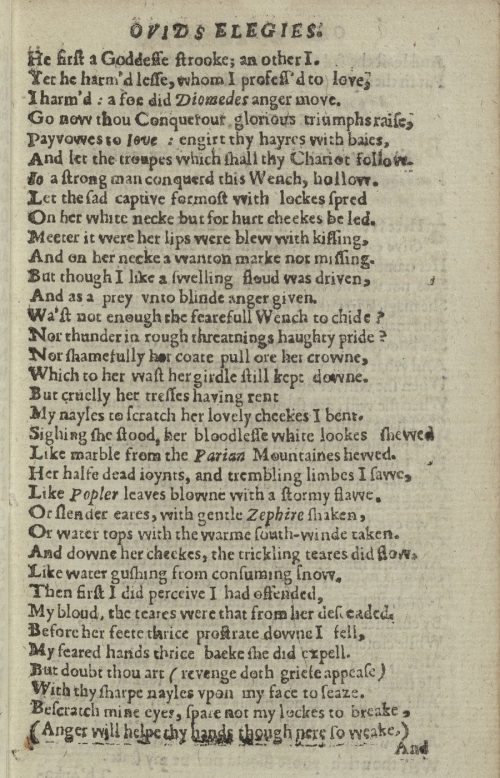
About my temples go triumphant bays, Conquer'd Corinna in my bosom lays. She whom her husband, guard, and gate, as foes, Lest Art should win her, firmly did enclose. That victory doth chiefly triumph merit, Which without bloodshed doth the pray inherit. No little ditched towns, no lowly walls, But to my share a captive damsel falls. When Troy by ten years battle tumbled down, With the Atrides many gain'd renown. But I no partner of my glory brook, Nor can another say his help I took. I, guide and soldier, won the field and wear her, I was both horseman, footman, standard bearer. Nor in my act hath fortune mingled chance, O care-got triumph hitherwards advance. Nor is my war's cause new, but for a queen Europe, and Asia in firm peace had been. The Laphiths and the Centaurs, for a woman, To cruel arms their drunken selves did summon. A woman forc'd the Troyans new to enter Wars, just Latinus, in thy kingdom's centre: A woman against late-built Rome did send The Sabine fathers, who sharp wars intend. I saw how bulls for a white heifer strive, She looking on them did more courage give. And me with many, but yet me without murther, Cupid commands to move his ensigns further.

BOOK 2, ELEGY 13

Ad Isidem, ut parientem Corinnam iuvet (To Isis, to help Corinna give birth)

While rashly her womb's burden she casts out, Weary Corinna hath her life in doubt. She secretly with me such harm attempted, Angry I was, but fear my wrath exempted. But she conceiv'd of me, or I am sure I oft have done, what might as much procure. Thou that frequents Canopus' pleasant fields, Memphis, and Pharos that sweet date trees yields, And where swift Nile in his large channel slipping, By seven huge mouths into the sea is skipping, By fear'd Anubis visage I thee pray, So in thy Temples shall Osiris stay, And the dull snake about thy off'rings creep, And in thy pomp horn'd Apis with thee keep, Turn thy looks hither, and in one spare twain, Thou giv'st my mistress life, she mine again. She oft hath serv'd thee upon certain days, Where the French rout engirt themselves with bays. On labouring women thou dost pity take, Whose bodies with their heavy burdens ache. My wench, Lucina, I intreat thee favour, Worthy she is, thou should'st in mercy save her. In white, with incense I'll thine altars greet, Myself will bring vow'd gifts before thy feet, Subscribing, Naso with Corinna sav'd: Do but deserve gifts with this title grav'd. But if in so great fear I may advise thee, To have this skirmish fought, let it suffice thee.

Please Support the Classic Literature Library

Buy Christopher Marlowe Books from Amazon.com

Ovid's Elegies Page 13

Christopher Marlowe

16th Century Literature

Free Books in the public domain from the Classic Literature Library ©

Christopher Marlowe
Classic Literature Library
Classic Authors

All Pages of This Book
The Jew of Malta
William Shakespeare
Christ in Flanders
The Second Book of the Chronicles
London NightLife
Affiliate Marketing