BOOK 1, ELEGY 11

Napen alloquitur, ut paratas tabellas ad Corinnam perferat (He tells Nape to carry a letter to Corinna)

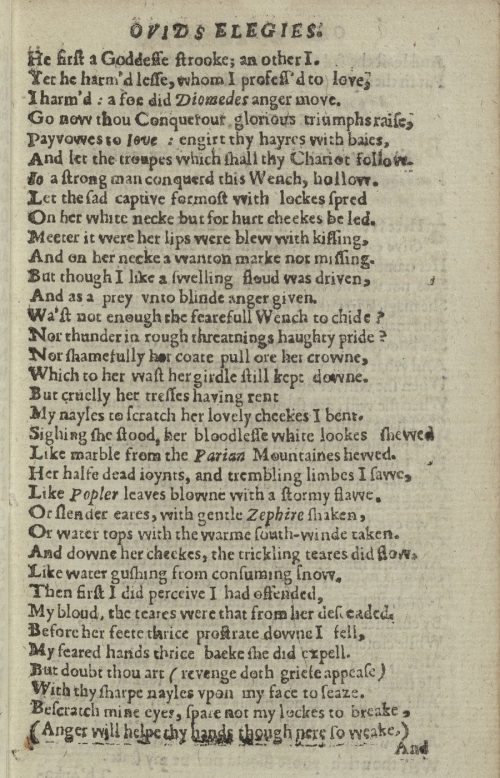
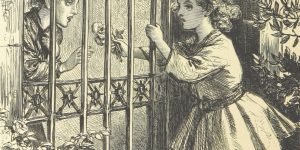
In skilful gathering ruffled hairs in order, Nape free-borne, whose cunning hath no border, Thy service for night's scapes is known commodious And to give signs dull wit to thee is odious. Corinna clips me oft by thy persuasion, Never to harm me made thy faith evasion. Receive these lines, them to my mistress carry, Be sedulous, let no stay cause thee tarry. Nor flint, nor iron, are in thy soft breast But pure simplicity in thee doth rest. And 'tis suppos'd Love's bow hath wounded thee, Defend the ensigns of thy war in me. If, what I do, she asks, say hope for night, The rest my hand doth in my letters write. Time passeth while I speak, give her my writ But see that forthwith she peruseth it. I charge thee mark her eyes and front in reading, By speechless looks we guess at things succeeding. Straight being read, will her to write much back, I hate fair paper should writ matter lack. Let her make verses, and some blotted letter On the last edge to stay mine eyes the better. What need she tire her hand to hold the quill, Let this word, 'Come', alone the tables fill. Then with triumphant laurel will I grace them And in the midst of Venus' temple place them. Subscribing that to her I consecrate My faithful tables, being vile maple late.

BOOK 1, ELEGY 12

Tabellas quas miserat execratur, quod amica noctem negabat (He curses the letter which he had sent, because his mistress refused him the night)

Bewail my chance, the sad book is return'd, This day denial hath my sport adjourn'd. Presages are not vain, when she departed Nape, by stumbling on the threshold, started. Going out again pass forth the door more wisely And somewhat higher bear thy foot precisely. Hence luckless tables, funeral wood be flying And thou the wax stuff'd full with notes denying, Which I think gather'd from cold hemlock's flower Wherein bad honey Corsic bees did power. Yet as if mixed with red lead thou wert ruddy, That colour rightly did appear so bloody. As evil wood thrown in the highways lie, Be broke with wheels of chariots passing by. And him that hew'd you out for needful uses I'll prove had hands impure with all abuses. Poor wretches on the tree themselves did strangle, There sat the hangman for men's necks to angle. To hoarse screech-owls foul shadows it allows, Vultures and furies nestled in the boughs. To these my love I foolishly committed And then with sweet words to my mistress fitted. More fitly had they wrangling bonds contain'd From barbarous lips of some attorney strain'd. Among day books and bills they had lame better In which the merchant wails his bankrupt debtor. Your name approves you made for such like things, The number two no good divining brings. Angry, I pray that rotten age you wracks And sluttish white-mould overgrow the wax.

BOOK 1, ELEGY 13

Ad Auroram ne properet (To the dawn, not to hurry)

Now on the sea from her old love comes she, That draws the day from heaven's cold axle-tree. Aurora whither slid'st thou? Down again, And birds for Memnon yearly shall be slain. Now in her tender arms I sweetly bide, If ever, now well lies she by my side. The air is cold, and sleep is sweetest now, And birds send forth shrill notes from every bough. Whither runn'st thou, that men, and women, love not? Hold in thy rosy horses that they move not. Ere thou rise, stars teach seamen where to sail, But when thou com'st they of their courses fail. Poor travellers though tir'd, rise at thy sight, And soldiers make them ready to the fight, The painful hind by thee to field is sent, Slow oxen early in the yoke are pent. Thou cozen'st boys of sleep, and dost betray them To pedants, that with cruel lashes pay them. Thou mak'st the surety to the lawyer run, That with one word hath nigh himself undone, The lawyer and the client hate thy view, Both whom thou raisest up to toil anew. By thy means women of their rest are barr'd, Thou sett'st their labouring hands to spin and card. All could I bear, but that the wench should rise, Who can endure, save him with whom none lies? How oft wished I night would not give thee place, Nor morning stars shun thy uprising face. How oft, that either wind would break thy coach, Or steeds might fall forc'd with thick clouds approach. Whither goest thou, hateful nymph? Memnon the elf Received his coal-black colour from thyself. Say that thy love with Cephalus were not known, Then thinkest thou thy loose life is not shown? Would Tithon might but talk of thee awhile, Not one in heav'n should be more base and vile. Thou leav'st his bed, because he's faint through age, And early mount'st thy hateful carriage: But held'st thou in thine arms some Cephalus, Then would'st thou cry, 'Stay night and run not thus'. Punish ye me, because years make him wain? I did not bid thee wed an aged swain. The moon sleeps with Endemion every day, Thou art as fair as she, then kiss and play. Jove, that thou should'st not haste but wait his leasure, Made two nights one to finish up his pleasure. I chid no more, she blush'd, and therefore heard me, Yet linger'd not the day, but morning scar'd me.

Please Support the Classic Literature Library

Buy Christopher Marlowe Books from Amazon.com

Ovid's Elegies Page 07

Christopher Marlowe

16th Century Literature

Free Books in the public domain from the Classic Literature Library ©

Christopher Marlowe
Classic Literature Library
Classic Authors

All Pages of This Book
The Jew of Malta
William Shakespeare
Christ in Flanders
The Second Book of the Chronicles
London NightLife
Affiliate Marketing