BOOK 1, ELEGY 7
Ad pacandam amicam, quam verberaverat (To placate his mistress, whom he had beaten)
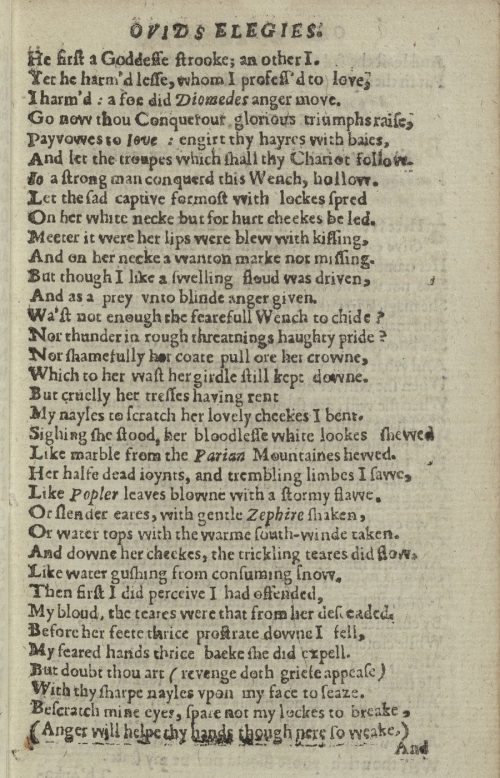
Bind fast my hands, they have deserved chains, While rage is absent, take some friend the pains. For rage against my wench mov'd my rash arm, My mistress weeps whom my mad hand did harm. I might have then my parents dear misus'd, Or holy gods with cruel strokes abus'd. Why? Ajax, master of the seven-fold shield, Butcher'd the flocks he found in spacious field, And he who on his mother veng'd his sire, Against the Destinies durst sharp darts require. Could I therefore her comely tresses tear? Yet was she graced with her ruffled hair. So fair she was, Atalanta she resembled, Before whose bow th'Arcadian wild beasts trembled. Such Ariadne was, when she bewails Her perjur'd Theseus' flying vows and sails, So chaste Minerva did Cassandra fall, Deflowr'd except, within thy Temple wall. That I was mad and barbarous all men cried, She nothing said, pale fear her tongue had tied. But secretly her looks with checks did trounce me, Her tears, she silent, guilty did pronounce me. Would of mine arms, my shoulders had been scanted, Better I could part of my self have wanted. To mine own self have I had strength so furious? And to my self could I be so injurious? Slaughter and mischiefs instruments, no better, Deserved chains these cursed hands shall fetter, Punished I am, if I a Roman beat, Over my mistress is my right more great? Tydides left worst signs of villany, He first a goddess strook; another I. Yet he harrn'd less, whom I profess'd to love, I harm'd: a foe did Diomedes anger move. Go now thou conqueror, glorious triumphs raise, Pay vows to Jove, engirt thy hairs with bays, And let the troops which shall thy chariot follow, 'Io, a strong man conquer'd this wench', hollow. Let the sad captive foremost with locks spread On her white neck but for hurt cheeks be led. Meeter it were her lips were blue with kissing And on her neck a wanton's mark not missing. But though I like a swelling flood was driven, And as a pray unto blind anger given, Was't not enough the fear ful wench to chide? Nor thunder in rough threatings haughty pride? Nor shamefully her coat pull o'er her crown, Which to her waist her girdle still kept down. But cruelly her tresses having rent, My nails to scratch her lovely cheeks I bent. Sighing she stood, her bloodless white looks shewed Like marble from the Parian Mountains hewed. Her half dead joints, and trembling limbs I saw, Like poplar leaves blown with a stormy flaw, Or slender ears, with gentle zephyr shaken, Or waters' tops with the warm south-wind taken. And down her cheeks, the trickling tears did flow, Like water gushing from consuming snow. Then first I did perceive I had offended, My blood, the tears were that from her descended. Before her feet thrice prostrate down I fell, My feared hands thrice back she did repel. But doubt thou not (revenge doth grief appease) With thy sharp nails upon my face to seize. Bescratch mine eyes, spare not my locks to break, (Anger will help thy hands though ne'er so weak). And lest the sad signs of my crime remain, Put in their place thy combed hairs again.
BOOK 1, ELEGY 8
Execratur lenam, quae puellam suam meretricia arte instituebat (He curses the bawd who has been instructing his mistress in the arts of a whore)
There is, whoe'er will know a bawd aright Give ear, there is an old trot, Dipsas hight. Her name comes from the thing: she being wise, Sees not the morn on rosy horses rise. She magic arts and Thessale charms doth know, And makes large streams back to their fountains flow, She knows with grass, with threads on wrong wheels spun And what with mares' rank humour may be done. When she will, clouds the darken'd heav'n obscure, When she will, day shines everywhere most pure. (If I have faith) I saw the stars drop blood, The purple moon with sanguine visage stood. Her I suspect among nights spirits to fly, And her old body in birds' plumes to lie. Fame saith as I suspect, and in her eyes Two eye-balls shine, and double light thence flies. Great grand-sires from their ancient graves she chides And with long charms the solid earth divides. She draws chaste women to incontinence, Nor doth her tongue want harmful eloquence. By chance I heard her talk, these words she said While closely hid betwixt two doors I laid. 'Mistress thou know'st, thou hast a blest youth pleas'd, He stayed, and on thy looks his gazes seiz'd. And why shouldst not please? None thy face exceeds, Ay me, thy body hath no worthy weeds. As thou art fair, would thou wert fortunate, Wert thou rich, poor should not be my estate. Th'opposed star of Mars hath done thee harm, Now Mars is gone: Venus thy side doth warm, And brings good fortune, a rich lover plants His love on thee, and can supply thy wants. Such is his form as may with thine compare, Would he not buy thee thou for him should'st care.' She blushed: 'Red shame becomes white cheeks, but this If feigned, doth well; if true it doth amiss. When on thy lap thine eyes thou dost deject, Each one according to his gifts respect. Perhaps the Sabines rude, when Tatius reigned, To yield their love to more then one disdained. Now Mars doth rage abroad without all pity, And Venus rules in her Aeneas' city. Fair women play, she's chaste whom none will have, Or, but for bashfulness herself would crave. Shake off these wrinkles that thy front assault, Wrinkles in beauty is a grievous fault. Penelope in bows her youths' strength tried, Of horn the bow was that approv'd their side. Time flying slides hence closely, and deceives us, And with swift horses the swift year soon leaves us. Brass shines with use; good garments would be worn, Houses not dwelt in, are with filth forlorn. Beauty not exercised with age is spent, Nor one or two men are sufficient. Many to rob is more sure, and less hateful, From dog-kept flocks come preys to wolves most grateful. Behold what gives the poet but new verses? And thereof many thousand he rehearses. The poets God arrayed in robes of gold, Of his gilt harp the well tun'd strings doth hold. Let Homer yield to such as presents bring, (Trust me) to give, it is a witty thing. Nor, so thou mayst obtain a wealthy prize, The vain name of inferior slaves despise. Nor let the arms of ancient lines beguile thee, Poor lover with thy grandsires I exile thee. Who seeks, for being fair, a night to have, What he will give, with greater instance crave. Make a small price, while thou thy nets dost lay, Lest they should fly, being ta'en, the tyrant play. Dissemble so, as lov'd he may be thought, And take heed lest he gets that love for nought. Deny him oft, feign now thy head doth ache: And Isis now will show what 'scuse to make. Receive him soon, lest patient use he gain, Or lest his love oft beaten back should wain. To beggars shut, to bringers ope thy gate, Let him within hear barr'd-out lovers prate. And as first wrong'd the wronged sometimes banish, Thy fault with his fault so repuls'd will vanish. But never give a spacious time to ire, Anger delayed doth oft to hate retire. And let thine eyes constrained learn to weep, That this, or that man may thy cheeks moist keep. Nor, if thou cozen'st one, dread to forswear , Venus to mocked men lends a senseless ear . Servants fit for thy purpose thou must hire To teach thy lover, what thy thoughts desire. Let them ask somewhat, many asking little, Within a while great heaps grow of a tittle. And sister, nurse, and mother spare him not, By many hands great wealth is quickly got. When causes fail thee to require a gift, By keeping of thy birth make but a shift. Beware lest he unrival'd loves secure, Take strife away, love doth not well endure. On all the bed men's tumbling let him view And thy neck with lascivious marks made blue. Chiefly shew him the gifts, which others send: If he gives nothing, let him from thee wend. When thou hast so much as he gives no more, Pray him to lend what thou mayst ne'er restore. Let thy tongue flatter, while thy mind harm works: Under sweet honey deadly poison lurks. If this thou dost, to me by long use known, Nor let my words be with the winds hence blown, Oft thou wilt say, live well, thou wilt pray oft, That my dead bones may in their grave lie soft.' As thus she spake, my shadow me betrayed, With much ado my hands I scarcely stay'd. But her blear eyes, bald scalp's thin hoary fleeces And rivell'd cheeks I would have pull'd a-pieces. The gods send thee no house, a poor old age, Perpetual thirst, and winter's lasting rage.