The Tragedy of Dido Queen of Carthage by Christopher Marlowe
The Tudor Facsimile Texts
The Tragedy of Dido Queen of Carthage
Written by
CHRISTOPHER MARLOWE and THOMAS NASH
1594
Date of this the earliest known edition…. 1594
[Bodleian]
Reproduced in Facsimile…. 1914
The Tudor Facsimile Texts
Under the Supervision and Editorship of JOHN S. FARMER
The Tragedy of Dido Queen of Carthage
Written by
CHRISTOPHER MARLOWE and THOMAS NASH
1594
Issued for Subscribers by the Editor of
THE TUDOR FACSIMILE TEXTS
MCMXIV
The Tragedy of Dido Queen of Carthage
Written by CHRISTOPHER MARLOWE and THOMAS NASH
1594
This play is facsimiled from the Bodley copy. Other examples (says Sir Sidney Lee, but unrecorded by Greg) are at Bridgewater House and at Chatsworth; the Devonshire Collection of Plays has recently been disposed of to an American collector.
For other and bibliographical details see D.N.B. I have included in this facsimile the page of manuscript in the Bodley example inasmuch as it contains matter of interest to the student.
The reproduction from the original was made by The Clarendon Press, Oxford.
JOHN S. FARMER.
[Transcriber’s Note: The following paragraphs have been transcribed from a handwritten page. Some text is illegible, and this has been marked with asterisks where appropriate.]
The tragedy of Dido is one of the scarcest plays in the English language. There are but two copies known to be extant; in the possession of D^r Wright and M^r Reed.
M^r Warton speaks in his Hist. of Eng. Poet (III. p. 435) of an Elegy being prefixed to it on the death of Marlowe; but no such is found in either of those copies. In answer to my inquiries on this subject he informed me by letter, [crossed-out text] that a copy of this play was in Osborne’s catalogue in the year 1754, that he then saw it in his shop (together with several of M^r Oldys’s books that Osborne had purchased), + that the elegy in question—”on Marlowe’s untimely death” was inserted immediately after the title page; that it mentioned a play of Marlowe’s entitled The Duke of Guise and four others; but whether particularly by name, he could not recollect. Unluckily he did not purchase this rare piece, + it is now God knows where.
Bishop Tanner likewise mentions this elegy in so particular a manner that he must have seen it. “Marlovius (Christopherus), quondam in academia Cantabrigiensi musarum alumnus; postea actor scenicus; deinde poeta dramaticus tragicus, paucis inferior Scripsit plurimas tragedias, sc. Tamerlane.-Tragedie of Dido Queen of Carthage. Pr. Come gentle Ganymed. Hanc perfecit + edidit Tho. Nash Lond. 1594. 4^to.—Petrarius in præfatione ad Secundam partem Herois et Leandri multa in Marlovii commendationem adfert; hoc etiam facit Tho. Nash in Carmine Elegiaco Tragidiæ Didonis præfiso in obitum Christop. Marlovii, ubi quatuor ejus tragidiarum mentionem facit, nec non et alterius de duce Guisio.” Bib. Britan. 1740.
I suspect M^r Warton had no other authority than this for saying that this play was left imperfect by Marlowe, and completed + published by Nashe; for it does not appear from the title page that it was not written in conjunction by him + Marlowe in the lifetime of the former. Perhaps Nashe’s Elegy might ascertain this point. Tanner had, I believe, no authority but Philipses, for calling Marlowe an actor.
There was an old Latin play on the subject of Dido, written by
John Rightwise and played before Cardinal Wolsey + again before
Queen Elizabeth in 1564. There is also another Latin play on this
subject Dido, tragedia nova so quatuor pri*ibus ***
**************** Virgilii disampla Antwerp ed, 1559.
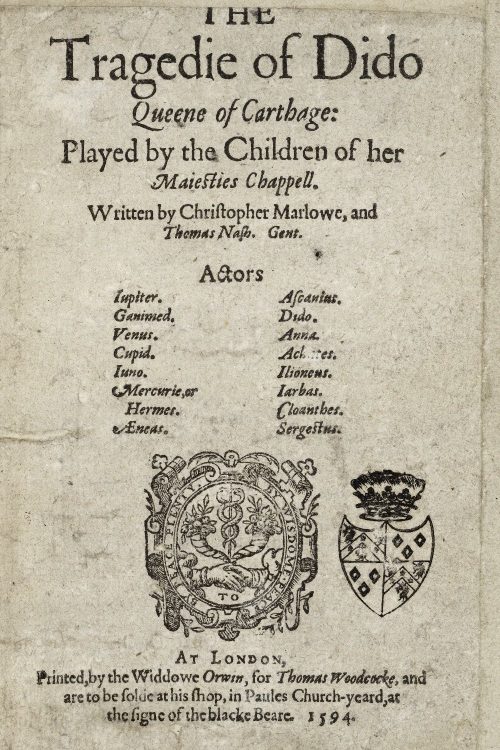
THE Tragedie of Dido Queene of Carthage:
Played by the Children of her Maiesties Chappell.
Written by Christopher Marlowe, and Thomas Nash. Gent.
Actors
Iupiter. Ascanius. Ganimed. Dido. Venus. Anna. Cupid. Achates. Iuno. Ilioneus. Mercurie. Iarbas. Hermes. Cloanthes. Æneas. Sergestus.
[Illustration: (Decorative) “BY PEACE PLENTY, BY WISDOME PEACE”]
AT LONDON,
Printed, by the Widdowe Orwin, for Thomas Woodcocke, and are to be solde at his shop, in Paules Church-yeard, at the signe of the blacke Beare. 1594.
[Illustration: (Decorative)]
The Tragedie of Dido Queene of Carthage.
Here the Curtaines draw, there is discovered Iupiter dandling Ganimed upon his knee, and Mercury lying asleepe.
Iup. Come gentle Ganimed and play with me, I loue thee well, say Iuno what she will.
Gan. I am much better for your worthles loue,
That will not shield me from her shrewith blowes:
To day when as I fild into your cups,
And held the cloath of pleasance whiles you dranke,
She reacht me such a rap for that I spilde,
As made the bloud run downe about mine eares.
Iup. What? dares she strike the darling of my thoughts?
By Saturnes soule, and this earth threatning aire,
That shaken thrise, makes Natures buildings quake,
I vow, if she but once frowne on thee more,
To hang her meteor like twixt heauen and earth,
And bind her hand and foote with golden cordes,
As once I did for harming Hercules.
Gan. Might I but see that pretie sport a foote,
O how would I with Helens brother laugh,
And bring the Gods to wonder at the game:
Sweet Iupiter, if ere I pleasde thine eye,
Or seemed faire walde in with Egles wings,
Grace my immortall beautie with this boone,
And I will spend my time in thy bright armes.
Iup. What ist sweet wagge I should deny thy youth?
Whose face reflects such pleasure to mine eyes,
As I exhal’d with thy fire darting beames,
Haue oft driuen backe the horses of the night.
When as they would haue hal’d thee from my sight:
Sit on my knee, and call for thy content,
Controule proud Fate, and cut the thred of time,
Why are not all the Gods at thy commaund,
And heauen and earth the bounds of thy delight?
Vulcan shall daunce to make thee laughing sport,
And my nine Daughters sing when thou art sad,
From Iunos bird Ile pluck her spotted pride,
To make thee fannes wherewith to coole thy face,
And Venus Swannes shall shed their siluer downe,
To sweeten out the slumbers of thy bed:
Hermes no more shall shew the world his wings,
If that thy fancie in his feathers dwell,
But as this one Ile teare them all from him,
Doe thou but say their colour pleaseth me:
Hold here my little loue these linked gems,
My Iuno ware vpon her marriage day,
Put thou about thy necke my owne sweet heart,
And tricke thy armes and shoulders with my theft.
Gan. I would haue a iewell for mine eare, And a fine brouch to put in my hat, And then Ile hugge with you an hundred times.
Iup. And shall haue Ganimed, if thou wilt be my loue.
Enter Venus.
Venus. I this is it, you can sit toying there,
And playing with that female wanton boy,
Whiles my Æneas wanders on the Seas,
And rests a pray to euery billowes pride.
Iuno, false Iuno in her Chariots pompe,
Drawne through the heauens by Steedes of Boreas brood,
Made Hebe to direct her ayrie wheeles
Into the windie countrie of the clowdes,
Where finding Æolus intrencht with stormes,
And guarded with a thousand grislie ghosts,
She humbly did beseech him for our bane,
And charg’d him drowne my sonne with all his traine.
Then gan the windes breake ope their brazen doores,
And all Æolia to be vp in armes:
Poore Troy must now be sackt vpon the Sea,
And Neptunes waues be enuious men of warre,
Epeus horse to Ætnas hill transformd,
Prepared stands to wracke their woodden walles,
And Æolus like Agamemnon sounds
The surges, his fierce souldiers to the spoyle:
See how the night Ulysses-like comes forth,
And intercepts the day as Dolon erst:
Ay me! the Starres supprisde like Rhesus Steedes,
Are drawne by darknes forth Astræus tents.
What shall I doe to saue thee my sweet boy?
When as the waues doe threat our Chrystall world,
And Proteus raising hils of flouds on high,
Entends ere long to sport him in the skie.
False Iupiter, rewardst thou vertue so?
What? is not pietie exempt from woe?
Then dye Æneas in thine innocence,
Since that religion hath no recompence.
Iup. Content thee Cytherea in thy care,
Since thy Æneas wandring fate is firme,
Whose wearie lims shall shortly make repose,
In those faire walles I promist him of yore:
But first in bloud must his good fortune bud,
Before he be the Lord of Turnus towne,
Or force her smile that hetherto hath frownd:
Three winters shall he with the Rutiles warre,
And in the end subdue them with his sword,
And full three Sommers likewise shall he waste,
In mannaging those fierce barbarian mindes:
Which once performd, poore Troy so long supprest,
From forth her ashes shall aduance her head,
And flourish once againe that erst was dead:
But bright Ascanius beauties better worke,
Who with the Sunne deuides one radiant shape,
Shall build his throne amidst those starrie towers,
That earth-borne Atlas groning vnderprops:
No bounds but heauen shall bound his Emperie,
Whose azured gates enchased with his name,
Shall make the morning halt her gray vprise,
To feede her eyes with his engrauen fame.
Thus in stoute Hectors race three hundred yeares,
The Romane Scepter royall shall remaine,
Till that a Princesse priest conceau’d by Mars,
Shall yeeld to dignitie a dubble birth,
Who will eternish Troy in their attempts.
Venus. How may I credite these thy flattering termes,
When yet both sea and sands beset their ships,
And Phœbus as in stygian pooles, refraines
To taint his tresses in the Tyrrhen maine?
Iup. I will take order for that presently: Hermes awake, and haste to Neptunes realme, Whereas the Wind-god warring now with Fate, Besiege the ofspring of our kingly loynes, Charge him from me to turne his stormie powers, And fetter them in Vulcans sturdie brasse, That durst thus proudly wrong our kinsmans peace. Venus farewell, thy sonne shall be our care: Come Ganimed, we must about this geare.
Exeunt Iupiter cum Ganimed.
Venus. Disquiet Seas lay downe your swelling lookes,
And court Æneas with your calmie cheere,
Whose beautious burden well might make you proude,
Had not the heauens conceau’d with hel-borne clowdes,
Vaild his resplendant glorie from your view,
For my sake pitie him Oceanus,
That erst-while issued from thy watrie loynes,
And had my being from thy bubling froth:
Triton I know hath fild his trumpe with Troy,
And therefore will take pitie on his toyle,
And call both Thetis and Cimodoæ,
To succour him in this extremitie.
Enter Æneas with Ascanius, with one or two more.
What? doe I see my sonne now come on shoare:
Venus, how art thou compast with content,
The while thine eyes attract their sought for ioyes:
Great Iupiter, still honourd maist thou be,
For this so friendly ayde in time of neede.
Here in this bush disguised will I stand,
Whiles my Æneas spends himselfe in plaints,
And heauen and earth with his vnrest acquaints.
Æn. You sonnes of care, companions of my course,
Priams misfortune followes vs by sea,
And Helens rape doth haunt thee at the heeles.
How many dangers haue we ouer past?
Both barking Scilla, and the sounding Rocks,
The Cyclops shelues, and grim Ceranias seate
Haue you oregone, and yet remaine aliue!
Pluck vp your hearts, since fate still rests our friend,
And chaunging heauens may those good daies returne,
Which Pergama did vaunt in all her pride.
Acha. Braue Prince of Troy, thou onely art our God,
That by thy vertues freest vs from annoy,
And makes our hopes suruiue to cunning ioyes:
Doe thou but smile, and clowdie heauen will cleare,
Whose night and day descendeth from thy browes:
Though we be now in extreame miserie,
And rest the map of weatherbeaten woe:
Yet shall the aged Sunne shed forth his aire,
To make vs liue vnto our former heate,
And euery beast the forrest doth send forth,
Bequeath her young ones to our scanted foode.
Asca. Father I faint, good father giue me meate.
Æn. Alas sweet boy, thou must be still a while,
Till we haue fire to dresse the meate we kild:
Gentle Achates, reach the Tinder boxe,
That we may make a fire to warme vs with,
And rost our new found victuals on this shoare.
Venus. See what strange arts necessitie findes out, How neere my sweet Æneas art thou driuen?
Æn. Hold, take this candle and goe light a fire, You shall haue leaues and windfall bowes enow Neere to these woods, to rost your meate withall: Ascanius, goe and drie thy drenched lims, Whiles I with my Achates roaue abroad, To know what coast the winde hath driuen vs on, Or whether men or beasts inhabite it.
Acha. The ayre is pleasant, and the soyle most fit
For Cities, and societies supports:
Yet much I maruell that I cannot finde,
No steps of men imprinted in the earth.
Venus. Now is the time for me to play my part:
Hoe yong men, saw you as you came
Any of all my Sisters wandring here?
Hauing a quiuer girded to her side,
And cloathed in a spotted Leopards skin.
Æn. I neither saw nor heard of any such:
But what may I faire Virgin call your name?
Whose lookes set forth no mortall forme to view,
Nor speech bewraies ought humaine in thy birth,
Thou art a Goddesse that delud’st our eyes,
And shrowdes thy beautie in this borrowd shape;
But whether thou the Sunnes bright Sister be,
Or one of chast Dianas fellow Nimphs,
Liue happie in the height of all content,
And lighten our extreames with this one boone,
As to instruct us vnder what good heauen
We breathe as now, and what this world is calde,
On which by tempests furie we are cast,
Tell vs, O tell vs that are ignorant,
And this right hand shall make thy Altars crack
With mountaine heapes of milke white Sacrifize.
Venus. Such honour, stranger, doe I not affect:
It is the vse for Turen maides to weare
Their bowe and quiuer in this modest sort,
And suite themselues in purple for the nonce,
That they may trip more lightly ore the lawndes,
And ouertake the tusked Bore in chase.
But for the land whereof thou doest enquire,
It is the punick kingdome rich and strong,
Adioyning on Agenors stately towne,
The kingly seate of Southerne Libia,
Whereas Sidonian Dido rules as Queene.
But what are you that aske of me these things?
Whence may you come, or whither will you goe?
Æn. Of Troy am I, Æneas is my name,
Who driuen by warre from forth my natiue world,
Put sailes to sea to seeke out Italy;
And my diuine descent from sceptred Iove,
With twise twelue Phrigian ships I plowed the deepe,
And made that way my mother Venus led:
But of them all scarce seuen doe anchor safe,
And they so wrackt and weltred by the waues,
As euery tide tilts twixt their oken sides:
And all of them vnburdened of their loade,
Are ballassed with billowes watrie weight.
But haples I, God wot, poore and vnknowne,
Doe trace these Libian deserts all despisde,
Exild forth Europe and wide Asia both,
And haue not any couerture but heauen.
Venus. Fortune hath fauord thee what ere thou be,
In sending thee vnto this curteous Coast:
A Gods name on and hast thee to the Court,
Where Dido will receiue ye with her smiles:
And for thy ships which thou supposest lost,
Not one of them hath perisht in the storme,
But are ariued safe not farre from hence:
And so I leaue thee to thy fortunes lot,
Wishing good lucke vnto thy wandring steps. Exit.
Æn. Achates, tis my mother that is fled,
I know her by the mouings of her feete:
Stay gentle Venus, flye not from thy sonne,
Too cruell, why wilt thou forsake me thus?
Or in these shades deceiu’st mine eye so oft?
Why talke we not together hand in hand?
And tell our griefes in more familiar termes:
But thou art gone and leau’st me here alone,
To dull the ayre with my discoursiue moane. Exit.
Enter Illioneus, and Cloanthes.
Illio. Follow ye Troians, follow this braue Lord, And plaine to him the summe of your distresse.
Iar. Why, what are you, or wherefore doe you sewe?
Illio. Wretches of Troy, enuied of the windes,
That craue such fauour at your honors feete,
As poore distressed miserie may pleade:
Saue, saue, O saue our ships from cruell fire,
That doe complaine the wounds of thousand waues,
And spare our liues whom euery spite pursues.
We come not we to wrong your Libian Gods,
Or steale your houshold lares from their shrines:
Our hands are not prepar’d to lawles spoyle,
Nor armed to offend in any kind:
Such force is farre from our vnweaponed thoughts,
Whose fading weale of victorie forsooke,
Forbids all hope to harbour neere our hearts.
Iar. But tell me Troians, Troians if you be, Vnto what fruitfull quarters were ye bound, Before that Boreas buckled with your sailes?
Cloan. There is a place Hesperia term’d by vs,
An ancient Empire, famoused for armes,
And fertile in faire Ceres furrowed wealth,
Which now we call Italia of his name,
That in such peace long time did rule the same:
Thither made we,
When suddenly gloomie Orion rose,
And led our ships into the shallow sands,
Whereas the Southerne winde with brackish breath,
Disperst them all amongst the wrackfull Rockes:
From thence a fewe of vs escapt to land,
The rest we feare are foulded in the flouds.
Iar. Braue men at armes, abandon fruitles feares, Since Carthage knowes to entertaine distresse.
Serg. I but the barbarous sort doe threat our ships,
And will not let vs lodge vpon the sands:
In multitudes they swarme vnto the shoare,
And from the first earth interdict our feete.
Iar. My selfe will see they shall not trouble ye,
Your men and you shall banquet in our Court,
And euery Troian be as welcome here,
As Iupiter to sillie Vausis house:
Come in with me, Ile bring you to my Queene,
Who shall confirme my words with further deedes.
Serg. Thankes gentle Lord for such vnlookt for grace,
Might we but once more see Æneas face,
Then would we hope to quite such friendly turnes,
As shall surpasse the wonder of our speech.
Actus 2.
Enter Æneas, Achates, and Ascanius.
Æn. Where am I now? these should be Carthage walles.
Acha. Why stands my sweete Æneas thus amazde?
Æn. O my Achates, Theban Niobe,
Who for her sonnes death wept out life and breath,
And drie with griefe was turnd into a stone,
Had not such passions in her head as I.
Me thinkes that towne there should be Troy, yon Idas hill,
There Zanthus streame, because here’s Priamus,
And when I know it is not, then I dye.
Ach. And in this humor is Achates to,
I cannot choose but fall vpon my knees,
And kisse his hand: O where is Hecuba,
Here she was wont to sit, but sauing ayre
Is nothing here, and what is this but stone?
Æn. O yet this stone doth make Æneas weepe,
And would my prayers (as Pigmalions did)
Could giue it life, that vnder his conduct
We might saile backe to Troy and be reuengde
On these hard harted Grecians; which reioyce
That nothing now is left of Priamus:
O Priamus is left and this is he,
Come, come abourd, pursue the hatefull Greekes.
Acha. What means Æneas?
Æn. Achates though mine eyes say this is stone, Yet thinkes my minde that this is Priamus: And when my grieued heart sighes and sayes no, Then would it leape out to giue Priam life: O were I not at all so thou mightst be. Achates, see King Priam wags his hand, He is aliue, Troy is not ouercome.
Ach. Thy mind Æneas that would haue it so Deludes thy eye sight, Priamus is dead.
Æn. Ah Troy is sackt, and Priamus is dead, And why should poore Æneas be aliue?
Asca. Sweete father leaue to weepe, this is not he: For were it Priam he would smile on me.
Acha. Æneas see here come the Citizens, Leaue to lament lest they laugh at our feares.
Enter Cloanthus, Sergestus, Illioneus.
Æn. Lords of this towne, or whatsoeuer stile
Belongs vnto your name, vouchsafe of ruth
To tell vs who inhabits this faire towne,
What kind of people, and who gouernes them:
For we are strangers driuen on this shore,
And scarcely know within what Clime we are.
Illio. I heare Æneas voyce, but see him not, For none of these can be our Generall.
Acha. Like Illioneus speakes this Noble man, But Illioneus goes not in such robes.
Serg. You are Achates, or I deciu’d.
Acha. Æneas see Sergestus or his ghost.
Illio. He meanes Æneas, let vs kisse his feete.
Cloan. It is our Captaine, see Ascanius.
Serg. Liue long Æneas and Ascanius.
Æn. Achates, speake, for I am ouerioyed.
Acha. O Illioneus, art thou yet aliue?
Illio. Blest be the time I see Achates face.
Cloan. Why turnes Æneas from his trustie friends?
Æn. Sergestus, Illioneus and the rest,
Your sight amazde me, O what destinies
Haue brought my sweete companions in such plight?
O tell me, for I long to be resolu’d.
Illio. Louely Æneas, these are Carthage walles,
And here Queene Dido weares th’imperiall Crowne,
Who for Troyes sake hath entertaind vs all,
And clad vs in these wealthie robes we weare.
Oft hath she askt vs vnder whom we seru’d,
And when we told her she would weepe for griefe,
Thinking the sea had swallowed vp thy ships,
And now she sees thee how will she reioyce?
Serg. See where her seruitors passe through the hall Bearing a banket, Dido is not farre.
Illio. Looke where she comes: Æneas viewd her well.
Æn. Well may I view her, but she sees not me.
Enter Dido and her traine.
Dido. What stranger art thou that doest eye me thus?
Æn. Sometime I was a Troian mightie Queene: But Troy is not, what shall I say I am?
Illio. Renowmed Dido, tis our Generall: warlike Æneas.
Dido. Warlike Æneas, and in these base robes? Goe fetch the garment which Sicheus ware: Braue Prince, welcome to Carthage and to me, Both happie that Æneas is our guest: Sit in this chaire and banquet with a Queene, Æneas is Æneas, were he clad In weedes as bad as euer Irus ware.
Æn. This is no seate for one thats comfortles,
May it please your grace to let Æneas waite:
For though my birth be great, my fortunes meane,
Too meane to be companion to a Queene.
Dido. Thy fortune may be greater then thy birth,
Sit downe Æneas, sit in Didos place,
And if this be thy sonne as I suppose,
Here let him sit, be merrie louely child.
Æn. This place beseemes me not, O pardon me.
Dido. Ile haue it so, Æneas be content.
Asca. Madame, you shall be my mother.
Dido. And so I will sweete child: be merrie man, Heres to thy better fortune and good starres.
Æn. In all humilitie I thanke your grace.
Dido. Remember who thou art, speake like thy selfe, Humilitie belongs to common groomes.
Æn. And who so miserable as Æneas is?
Dido. Lyes it in Didos hands to make thee blest, Then be assured thou art not miserable.
Æn. O Priamus, O Troy, oh Hecuba!
Dido. May I entreate thee to discourse at large,
And truely to how Troy was ouercome:
For many tales goe of that Cities fall,
And scarcely doe agree vpon one poynt:
Some say Antenor did betray the towne,
Others report twas Sinons periurie:
But all in this that Troy is ouercome,
And Priam dead, yet how we heare no newes.
Æn. A wofull tale bids Dido to vnfould,
Whose memorie like pale deaths stony mace,
Beates forth my senses from this troubled soule,
And makes Æneas sinke at Didos feete.
Dido. What faints Æneas to remember Troy? In whose defence he fought so valiantly: Looke vp and speake.
Æn. Then speake Æneas with Achilles tongue,
And Dido and you Carthaginian Peeres
Heare me, but yet with Mirmidons harsh eares,
Daily inur’d to broyles and Massacres,
Lest you be mou’d too much with my sad tale.
The Grecian souldiers tired with ten yeares warre;
Began to crye, let vs vnto our ships,
Troy is inuincible, why stay we here?
With whose outcryes Atrides being apal’d,
Summoned the Captaines to his princely tent,
Who looking on the scarres we Troians gaue,
Seeing the number of their men decreast,
And the remainder weake and out of heart,
Gaue vp their voyces to dislodge the Campe,
And so in troopes all marcht to Tenedos:
Where when they came, Vlysses on the sand
Assayd with honey words to turne them backe:
And as he spoke to further his entent,
The windes did driue huge billowes to the shoare,
And heauen was darkned with tempestuous clowdes:
Then he alleag’d the Gods would haue them stay,
And prophecied Troy should be ouercome:
And therewithall he calde false Sinon forth,
A man compact of craft and periurie,
Whose ticing tongue was made of Hermes pipe,
To force an hundred watchfull eyes to sleepe:
And him Epeus hauing made the horse,
With sacrificing wreathes vpon his head,
Vlysses sent to our vnhappie towne:
Who groueling in the mire of Zanthus bankes,
His hands bound at his back, and both his eyes
Turnd vp to heauen as one resolu’d to dye,
Our Phrigian shepherd haled within the gates,
And brought vnto the Court of Priamus:
To whom he vsed action so pitifull,
Lookes so remorcefull, vowes so forcible,
As therewithall the old man ouercome,
Kist him, imbrast him, and vnloosde his bands,
And then, O Dido pardon me.
Dido. Nay leaue not here, resolue me of the rest.
Æn. O th’inchaunting words of that base slaue,
Made him to thinke Epeus pine-tree Horse
A sacrifize t’appease Mineruas wrath:
The rather for that one Laocoon
Breaking a speare vpon his hollow breast,
Was with two winged Serpents stung to death.
Whereat agast, we were commanded straight
With reuerence to draw it into Troy.
In which vnhappie worke was I employd,
These hands did helpe to hale it to the gates,
Through which it could not enter twas so huge.
O had it neuer entred, Troy had stood.
But Priamus impatient of delay,
Inforst a wide breach in that rampierd wall,
Which thousand battering Rams could neuer pierce,
And so came in this fatall instrument:
At whose accursed feete as ouerioyed,
We banquetted till ouercome with wine,
Some surfetted, and others soundly slept.
Which Sinon viewing, causde the Greekish spyes
To hast to Tenedos and tell the Campe:
Then he vnlockt the Horse, and suddenly
From out his entrailes, Neoptolemus
Setting his speare vpon the ground, leapt forth,
And after him a thousand Grecians more,
In whose sterne faces shin’d the quenchles fire,
That after burnt the pride of Asia.
By this the Campe was come vnto the walles,
And through the breach did march into the streetes,
Where meeting with the rest, kill kill they cryed.
Frighted with this confused noyse, I rose,
And looking from a turret, might behold
Yong infants swimming in their parents bloud,
Headles carkasses piled vp in heapes,
Virgins halfe dead dragged by their golden haire,
And with maine force flung on a ring of pikes,
Old men with swords thrust through their aged sides,
Kneeling for mercie to a Greekish lad,
Who with steele Pol-axes dasht out their braines.
Then buckled I mine armour, drew my sword,
And thinking to goe downe, came Hectors ghost
With ashie visage, blewish, sulphure eyes,
His armes torne from his shoulders, and his breast
Furrowd with wounds, and that which made me weepe,
Thongs at his heeles, by which Achilles horse
Drew him in triumph through the Greekish Campe,
Burst from the earth, crying, Æneas flye,
Troy is a fire, the Grecians haue the towne,
Dido. O Hector who weepes not to heare thy name?
Æn. Yet flung I forth, and desperate of my life,
Ran in the thickest throngs, and with this sword
Sent many of their sauadge ghosts to hell.
At last came Pirrhus fell and full of ire.
His harnesse dropping bloud, and on his speare
The mangled head of Priams yongest sonne,
And after him his band of Mirmidons,
With balles of wilde fire in their murdering pawes,
Which made the funerall flame that burnt faire Troy:
All which hemd me about, crying, this is he.
Dido. Ah, how could poore Æneas scape their hands?
Æn. My mother Venus iealous of my health,
Conuaid me from their crooked nets and bands:
So I escapt the furious Pirrhus wrath:
Who then ran to the pallace of the King,
And at Ioues Altar finding Priamus,
About whose withered necke hung Hecuba,
Foulding his hand in hers, and ioyntly both
Beating their breasts and falling on the ground,
He with his faulchions poynt raisde vp at once,
And with Megeras eyes stared in their face,
Threatning a thousand deaths at euery glaunce.
To whom the aged King thus trembling spoke:
Achilles sonne, remember what I was,
Father of fiftie sonnes, but they are slaine,
Lord of my fortune, but my fortunes turnd,
King of this Citie, but my Troy is fired,
And now am neither father, Lord, nor King:
Yet who so wretched but desires to liue?
O let me liue, great Neoptolemus,
Not mou’d at all, but smiling at his teares,
This butcher whil’st his hands were yet held vp,
Treading vpon his breast, strooke off his hands.
Dido. O end Æneas, I can heare no more.
Æn. At which the franticke Queene leapt on his face,
And in his eyelids hanging by the nayles,
A little while prolong’d her husbands life:
At last the souldiers puld her by the heeles,
And swong her howling in the emptie ayre,
Which sent an eccho to the wounded King:
Whereat he lifted vp his bedred lims,
And would haue grappeld with Achilles sonne,
Forgetting both his want of strength and hands,
Which he disdaining whiskt his sword about,
And with the wound thereof the King fell downe:
Then from the nauell to the throat at once,
He ript old Priam: at whose latter gaspe
Ioues marble statue gan to bend the brow,
As lothing Pirrhus for this wicked act:
Yet he vndaunted tooke his fathers flagge,
And dipt it in the old Kings chill cold bloud,
And then in triumph ran into the streetes,
Through which he could not passe for slaughtred men:
So leaning on his sword he stood stone still,
Viewing the fire wherewith rich Ilion burnt.
By this I got my father on my backe,
This yong boy in mine armes, and by the hand
Led faire Creusa my beloued wife,
When thou Achates with thy sword mad’st way,
And we were round inuiron’d with the Greekes:
O there I lost my wife: and had not we
Fought manfully, I had not told this tale:
Yet manhood would not serue, of force we fled,
And as we went vnto our ships, thou knowest
We sawe Cassandra sprauling in the streetes,
Whom Aiax rauisht in Dianas Fawne,
Her cheekes swolne with sighes, her haire all rent,
Whom I tooke vp to beare vnto our ships;
But suddenly the Grecians followed vs,
And I alas, was forst to let her lye.
Then got we to our ships, and being abourd,
Polixena cryed out, Æneas stay,
The Greekes pursue me, stay and take me in.
Moued with her voyce, I lept into the sea,
Thinking to beare her on my backe abourd:
For all our ships were launcht into the deepe,
And as I swomme, she standing on the shoare,
Was by the cruell Mirmidons surprizd,
And after by that Pirrhus sacrifizde.
Dido. I dye with melting ruth, Æneas leaue.
Anna. O what became of aged Hecuba?
Iar. How got Æneas to the fleete againe?
Dido. But how scapt Helen, she that causde this warre?
Æn. Achates speake, sorrow hath tired me quite.
Acha. What happened to the Queene we cannot shewe,
We heare they led her captiue into Greece,
As for Æneas he swomme quickly backe,
And Helena betraied Diiphobus
Her Louer, after Alexander dyed,
And so was reconcil’d to Menelaus.
Dido. O had that ticing strumpet nere been borne:
Troian, thy ruthfull tale hath made me sad:
Come let vs thinke vpon some pleasing sport,
To rid me from these melancholly thoughts.
Exeunt omnes.
Enter Venus at another doore, and takes Ascanius by the sleeve.
Venus. Faire child stay thou with Didos waiting maide,
Ile giue thee Sugar-almonds, sweete Conserues,
A siluer girdle, and a golden purse,
And this yong Prince shall be thy playfellow.
Asca. Are you Queene Didos sonne?
Cupid. I, and my mother gaue me this fine bow.
Asca. Shall I haue such a quiuer and a bow?
Venus. Such bow, such quiuer, and such golden shafts,
Will Dido giue to sweete Ascanius:
For Didos sake I take thee in my armes,
And sticke these spangled feathers in thy hat,
Eate Comfites in mine armes, and I will sing.
Now is he fast asleepe, and in this groue
Amongst greene brakes Ile lay Ascanius,
And strewe him with sweete smelling Violets,
Blushing Roses, purple Hyacinthe:
These milke white Doues shall be his Centronels:
Who if that any seeke to doe him hurt,
Will quickly flye to Citheidas fist.
Now Cupid turne thee to Ascanius shape,
And goe to Dido who in stead of him
Will set thee on her lap and play with thee:
Then touch her white breast with this arrow head,
That she may dote vpon Æneas loue:
And by that meanes repaire his broken ships,
Victuall his Souldiers, giue him wealthie gifts,
And he at last depart to Italy,
Or els in Carthage make his kingly throne.
Cupid. I will faire mother, and so play my part,
As euery touch shall wound Queene Didos heart.
Venus. Sleepe my sweete nephew in these cooling shades,
Free from the murmure of these running streames,
The crye of beasts, the ratling of the windes,
Or whisking of these leaues, all shall be still,
And nothing interrupt thy quiet sleepe,
Till I returne and take thee hence againe. Exit.
Actus 3. Scena I.
Enter Cupid solus.
Cupid. Now Cupid cause the Carthaginian Queene,
To be inamourd of thy brothers lookes,
Conuey this golden arrowe in thy sleeue,
Lest she imagine thou art Venus sonne:
And when she strokes thee softly on the head,
Then shall I touch her breast and conquer her.
Enter Iarbus, Anna, and Dido.
Iar. How long faire Dido shall I pine for thee?
Tis not enough that thou doest graunt me loue,
But that I may enioy what I desire:
That loue is childish which consists in words.
Dido. Iarbus, know that thou of all my wooers
(And yet haue I had many mightier Kings)
Hast had the greatest fauours I could giue:
I feare me Dido hath been counted light,
In being too familiar with Iarbus:
Albeit the Gods doe know no wanton thought
Had euer residence in Didos breast.
Iar. But Dido is the fauour I request.
Dido. Feare not Iarbus, Dido may be thine.
Anna. Looke sister how Æneas little sonne Playes with your garments and imbraceth you.
Cupid. No Dido will not take me in her armes, I shall not be her sonne, she loues me not.
Dido. Weepe not sweet boy, thou shalt be Didos sonne,
Sit in my lap and let me heare thee sing.
No more my child, now talke another while,
And tell me where learnst thou this pretie song?
Cupid. My cosin Helen taught it me in Troy.
Dido. How louely is Ascanius when he smiles?
Cupid. Will Dido let me hang about her necke?
Dido. I wagge, and giue thee leaue to kisse her to.
Cupid. What will you giue me? now Ile haue this Fanne.
Dido. Take it Ascanius, for thy fathers sake.
Iar. Come Dido, leaue Ascanius, let vs walke.
Dido. Goe thou away, Ascanius shall stay.
Iar. Vngentle Queene, is this thy loue to me?
Dido. O stay Iarbus, and Ile goe with thee.
Cupid. And if my mother goe, Ile follow her.
Dido. Why staiest thou here? thou art no loue of mine?
Iar. Iarbus dye, seeing she abandons thee.
Dido. No, liue Iarbus, what hast thou deseru’d,
That I should say thou art no loue of mine?
Something thou hast deseru’d, away I say,
Depart from Carthage, come not in my sight.
Iar. Am I not King of rich Getulia?
Dido. Iarbus pardon me, and stay a while.
Cupid. Mother, looke here.
Dido. What telst thou me of rich Getulia? Am not I Queene of Libia? then depart.
Iar. I goe to feed the humour of my Loue, Yet not from Carthage for a thousand worlds.
Dido. Iarbus.
Iar. Doth Dido call me backe?
Dido. No, but I charge thee neuer looke on me.
Iar. Then pull out both mine eyes, or let me dye. Exit Iarb.
Anna. Wherefore doth Dido bid Iarbus goe?
Dido. Because his lothsome sight offends mine eye,
And in my thoughts is shrin’d another loue:
O Anna, didst thou know how sweet loue were,
Full soone wouldst thou abiure this single life.
Anna. Poore soule I know too well the sower of loue, O that Iarbus could but fancie me.
Dido. Is not Æneas faire and beautifull?
Anna. Yes, and Iarbus foule and fauourles.
Dido. Is he not eloquent in all his speech?
Anna. Yes, and Iarbus rude and rusticall.
Dido. Name not Iarbus, but sweete Anna say, Is not Æneas worthie Didos loue?
Anna. O sister, were you Empresse of the world, Æneas well deserues to be your loue, So lovely is he that where ere he goes, The people swarme to gaze him in the face.
Dido. But tell them none shall gaze on him but I, Lest their grosse eye-beames taint my louers cheekes: Anna, good sister Anna goe for him, Lest with these sweete thoughts I melt cleane away.
Anna. Then sister youle abiure Iarbus loue?
Dido. Yet must I heare that lothsome name againe? Runne for Æneas, or Ile flye to him. Exit Anna.
Cupid. You shall not hurt my father when he comes.
Dido. No, for thy sake Ile loue thy father well.
O dull conceipted Dido, that till now
Didst neuer thinke Æneas beautifull:
But now for quittance of this ouersight,
Ile make me bracelets of his golden haire,
His glistering eyes shall be my looking glasse,
His lips an altar, where Ile offer vp
As many kisses as the Sea hath sands,
In stead of musicke I will heare him speake,
His lookes shall be my only Librarie,
And thou Æneas, Didos treasurie,
In whose faire bosome I will locke more wealth,
Then twentie thousand Indiaes can affoord:
O here he comes, loue, loue, giue Dido leaue
To be more modest then her thoughts admit,
Lest I be made a wonder to the world.
Achates, how doth Carthage please your Lord?
Acha. That will Æneas shewe your maiestie.
Dido. Æneas art thou there?
Æn. I vnderstand your highnesse sent for me.
Dido. No, but now thou art here, tell me in sooth, In what might Dido highly pleasure thee.
Æn. So much haue I receiu’d at Didos hands,
As without blushing I can aske no more:
Yet Queene of Affricke, are my ships vnrigd,
My Sailes all rent in sunder with the winde,
My Oares broken, and my Tackling lost,
Yea all my Nauie split with Rockes and Shelfes:
Nor Sterne nor Anchor haue our maimed Fleete,
Our Masts the furious windes strooke ouer bourd:
Which piteous wants if Dido will supplie,
We will account her author of our liues.
Dido. Æneas, Ile repaire thy Troian ships,
Conditionally that thou wilt stay with me,
And let Achates saile to Italy:
Ile giue thee tackling made of riueld gold,
Wound on the barkes of odoriferous trees,
Oares of massie Iuorie full of holes,
Through which the water shall delight to play:
Thy Anchors shall be hewed from Christall Rockes,
Which if thou lose shall shine aboue the waues;
The Masts whereon thy swelling sailes shall hang,
Hollow Pyramides of siluer plate:
The sailes of foulded Lawne, where shall be wrought
The warres of Troy, but not Troyes ouerthrow:
For ballace, emptie Didos treasurie,
Take what ye will, but leaue Æneas here.
Achates, thou shalt be so meanly clad,
As Seaborne Nymphes shall swarme about thy ships,
And wanton Mermaides court thee with sweete songs,
Flinging in fauours of more soueraigne worth,
Then Thetis hangs about Apolloes necke,
So that Æneas may but stay with me.
Æn. Wherefore would Dido haue Æneas stay?
Dido. To warre against my bordering enemies: Æneas, thinke not Dido is in loue: For if that any man could conquer me, I had been wedded ere Æneas came: See where the pictures of my suiters hang, And are not these as faire as faire may be?
Acha. I saw this man at Troy ere Troy was sackt.
Æn. I this in Greece when Paris stole faire Helen.
Illio. This man and I were at Olympus games.
Serg. I know this face, he is a Persian borne, I traueld with him to Ætolia.
Cloan. And I in Athens with this gentleman, Vnlesse I be deceiu’d disputed once.
Dido. But speake Æneas, know you none of these?
Æn. No Madame, but it seemes that these are Kings.
Dido. All these and others which I neuer sawe,
Haue been most vrgent suiters for my loue,
Some came in person, others sent their Legats:
Yet none obtaind me, I am free from all,
And yet God knowes intangled vnto one.
This was an Orator, and thought by words
To compasse me, but yet he was deceiu’d:
And this a Spartan Courtier vaine and wilde,
But his fantastick humours pleasde not me:
This was Alcion, a Musition,
But playd he nere so sweet, I let him goe:
This was the wealthie King of Thessaly,
But I had gold enough and cast him off:
This Meleagers sonne, a warlike Prince,
But weapons gree not with my tender yeares:
The rest are such as all the world well knowes,
Yet how I sweare by heauen and him I loue,
I was as farre from loue, as they from hate.
Æn. O happie shall he be whom Dido loues.
Dido. Then neuer say that thou art miserable,
Because it may be thou shalt be my loue:
Yet boast not of it, for I loue thee not,
And yet I hate thee not: O if I speake
I shall betray my selfe: Æneas speake,
We two will goe a hunting in the woods,
But not so much for thee, thou art but one,
As for Achates, and his followers. Exeunt.
Enter Iuno to Ascanius asleepe.
Iuno. Here lyes my hate, Æneas cursed brat,
The boy wherein false destinie delights,
The heire of furie, the fauorite of the face,
That vgly impe that shall outweare my wrath,
And wrong my deitie with high disgrace:
But I will take another order now,
And race th’eternall Register of time:
Troy shall no more call him her second hope,
Nor Venus triumph in his tender youth:
For here in spight of heauen Ile murder him,
And feede infection with his left out life:
Say Paris, now shall Venus haue the ball?
Say vengeance, now shall her Ascanius dye.
O no God wot, I cannot watch my time,
Nor quit good turnes with double fee downe told:
Tut, I am simple without made to hurt,
And haue no gall at all to grieue my foes:
But lustfull Ioue and his adulterous child,
Shall finde it written on confusions front,
That onely Iuno rules in Rhamnuse towne.
Enter Venus.
Venus. What should this meane? my Doues are back returnd, Who warne me of such daunger prest at hand, To harme my sweete Ascanius louely life. Iuno, my mortall foe, what make you here? Auaunt old witch and trouble not my wits.
Iuno. Fie Venus, that such causeles words of wrath,
Should ere defile so faire a mouth as thine:
Are not we both sprong of celestiall rase,
And banquet as two Sisters with the Gods?
Why is it then displeasure should disioyne,
Whom kindred and acquaintance counites.
Venus. Out hatefull hag, thou wouldst haue slaine my sonne,
Had not my Doues discou’rd thy entent:
But I will teare thy eyes fro forth thy head,
And feast the birds with their bloud-shotten balles,
If thou but lay thy fingers on my boy.
Iuno. Is this then all the thankes that I shall haue,
For sauing him from Snakes and Serpents stings,
That would haue kild him sleeping as he lay?
What though I was offended with thy sonne,
And wrought him mickle woe on sea and land,
When for the hate of Troian Ganimed,
That was aduanced by my Hebes shame,
And Paris iudgement of the heauenly ball,
I mustred all the windes vnto his wracke,
And vrg’d each Element to his annoy:
Yet now I doe repent me of his ruth,
And wish that I had neuer wrongd him so:
Bootles I sawe it was to warre with fate,
That hath so many vnresisted friends:
Wherefore I chaunge my counsell with the time,
And planted loue where enuie erst had sprong.
Venus. Sister of Ioue, if that thy loue be such,
As these thy protestations doe paint forth,
We two as friends one fortune will deuide:
Cupid shall lay his arrowes in thy lap,
And to a Scepter chaunge his golden shafts,
Fancie and modestie shall liue as mates,
And thy faire peacockes by my pigeons pearch:
Loue my Æneas, and desire is thine,
The day, the night, my Swannes, my sweetes are thine.
Iuno. More then melodious are these words to me,
That ouercioy my soule with their content:
Venus, sweete Venus, how may I deserue
Such amourous fauours at thy beautious hand?
But that thou maist more easilie perceiue,
How highly I doe prize this amitie,
Harke to a motion of eternall league,
Which I will make in quittance of thy loue:
Thy sonne thou knowest with Dido now remaines,
And feedes his eyes with fauours of her Court,
She likewise in admyring spends her time,
And cannot talke nor thinke of ought but him:
Why should not they then ioyne in marriage,
And bring forth mightie Kings to Carthage towne,
Whom casualtie of sea hath made such friends?
And Venus, let there be a match confirmd
Betwixt these two, whose loues are so alike,
And both our Deities conioynd in one,
Shall chaine felicitie vnto their throne.
Venus. Well could I like this reconcilements meanes,
But much I feare my sonne will nere consent,
Whose armed soule alreadie on the sea,
Darts forth her light to Lauinias shoare.
Iuno. Faire Queene of loue, I will deuorce these doubts,
And finde the way to wearie such fond thoughts:
This day they both a hunting forth will ride
Into these woods, adioyning to these walles,
When in the midst of all their gamesome sports,
Ile make the Clowdes dissolue their watrie workes,
And drench Siluanus dwellings with their shewers,
Then in one Caue the Queene and he shall meete,
And interchangeably discourse their thoughts,
Whose short conclusion will seale vp their hearts,
Vnto the purpose which we now propound.
Venus. Sister, I see you sauour of my wiles,
Be it as you will haue for this once,
Meane time, Ascanius shall be my charge,
Whom I will beare to Ida in mine armes,
And couch him in Adonis purple downe, Exeunt.
Enter Dido, Æneas, Anna, Iarbus, Achates, and followers.
Dido. Æneas, thinke not but I honor thee,
That thus in person goe with thee to hunt:
My princely robes thou seest are layd aside,
Whose glittering pompe Dianas shrowdes supplies,
All fellowes now disposde alike to sporte,
The woods are wide, and we haue store of game:
Faire Troian, hold my golden bowe awhile,
Vntill I gird my quiuer to my side:
Lords goe before, we two must talke alone.
Iar. Vngentle, can she wrong Iarbus so? Ile dye before a stranger haue that grace: We two will talke alone, what words be these?
Dido. What makes Iarbus here of all the rest? We could haue gone without your companie.
Æn. But loue and duetie led him on perhaps, To presse beyond acceptance to your sight.
Iar. Why man of Troy, doe I offend thine eyes? Or art thou grieude thy betters presse so nye?
Dido. How now Getulian, are ye growne so braue, To challenge vs with your comparisons? Pesant, goe seeke companions like thy selfe, And meddle not with any that I loue: Æneas, be not moude at what he sayes, For otherwhile he will be out of ioynt.
Iar. Women may wrong by priuiledge of loue:
But should that man of men (Dido except)
Haue taunted me in these opprobrious termes,
I would haue either drunke his dying bloud,
Or els I would haue giuen my life in gage?
Dido. Huntsmen, why pitch you not your toyles apace, And rowse the light foote Deere from forth their laire.
Anna. Sister, see see Ascanius in his pompe, Bearing his huntspeare brauely in his hand.
Dido. Yea little sonne, are you so forward now?
Asca. I mother, I shall one day be a man,
And better able vnto other armes,
Meane time these wanton weapons serue my warre,
Which I will breake betwixt a Lyons iawes.
Dido. What, darest thou looke a Lyon in the face?
Asca. I, and outface him to, doe what he can.
Anna. How like his father speaketh he in all?
Æn. And mought I liue to see him sacke rich Thebes,
And loade his speare with Grecian Princes heads,
Then would I wish me with Anchises Tombe,
And dead to honour that hath brought me vp.
Iar. And might I liue to see thee shipt away,
And hoyst aloft on Neptunes hideous hilles,
Then would I wish me in faire Didos armes,
And dead to scorne that hath pursued me so.
Æn. Stoute friend Achates, doest thou know this wood?
Acha. As I remember, here you shot the Deere,
That sau’d your famisht souldiers liues from death,
When first you set your foote vpon the shoare,
And here we met fair Venus virgine like,
Bearing her bowe and quiuer at her backe.
Æn. O how these irksome labours now delight,
And ouerioy my thoughts with their escape:
Who would not vndergoe all kind of toyle,
To be well stor’d with such a winters tale?
Dido. Æneas, leaue these dumpes and lets away, Some to the mountaines, some vnto the soyle, You to the vallies, thou vnto the house.
Exeunt omnes: manent.
Iar. I, this it is which wounds me to the death,
To see a Phrigian far fet to the sea,
Preferd before a man of maiestie:
O loue, O hate, O cruell womens hearts,
That imitate the Moone in euery chaunge,
And like the Planets euer loue to raunge:
What shall I doe thus wronged with disdaine?
Reuenge me on Æneas, or on her:
On her? fond man, that were to warre gainst heauen,
And with one shaft prouoke ten thousand darts:
This Troians end will be thy enuies aime,
Whose bloud will reconcile thee to content,
And make loue drunken with thy sweete desire:
But Dido that now holdeth him so deare,
Will dye with very tidings of his death:
But time will discontinue her content,
And mould her minde vnto newe fancies shapes:
O God of heauen, turne the hand of fate
Vnto that happie day of my delight,
And then, what then? Iarbus shall but loue:
So doth he now, though not with equall gaine,
That resteth in the riuall of thy paine,
Who nere will cease to soare till he be slaine. Exit.
The storme. Enter Æneas and Dido in the Caue at seuerall times.
Dido. Æneas.
Æn. Dido.
Dido. Tell me deare loue, how found you out this Caue?
Æn. By chance sweete Queene, as Mars and Venus met.
Dido. Why, that was in a net, where we are loose, And yet I am not free, oh would I were.
Æn. Why, what is it that Dido may desire And not obtaine, be it in humaine power?
Dido. The thing that I will dye before I aske, And yet desire to haue before I dye.
Æn. It is not ought Æneas may achieue?
Dido. Æneas no, although his eyes doe pearce.
Æn. What, hath Iarbus angred her in ought? And will she be auenged on his life?
Dido. Not angred me, except in angring thee.
Æn. Who then of all so cruell may he be, That should detaine thy eye in his defects?
Dido. The man that I doe eye where ere I am, Whose amorous face like Pean sparkles fire, When as he buts his beames on Floras bed, Prometheus hath put on Cupids shape, And I must perish in his burning armes: Æneas, O Æneas, quench these flames.
Æn. What ailes my Queene, is she falne sicke of late?
Dido. Not sicke my loue, but sicke, I must conceale The torment, that it bootes me not reueale; And yet Ile speake, and yet Ile hold my peace, Doe shame her worst, I will disclose my griefe: Æneas, thou art he, what did I say? Something it was that now I haue forgot.
Æn. What meanes faire Dido by this doubtfull speech?
Dido. Nay, nothing, but Æneas loues me not.
Æn. Æneas thoughts dare not ascend so high As Didos heart, which Monarkes might not scale.
Dido. It was because I sawe no King like thee,
Whose golden Crowne might ballance my content:
But now that I haue found what to effect,
I followe one that loueth fame for me,
And rather had seeme faire Sirens eyes,
Then to the Carthage Queene that dyes for him.
Æn. If that your maiestie can looke so lowe,
As my despised worths, that shun all praise,
With this my hand I giue to you my heart,
And vow by all the Gods of Hospitalitie,
By heauen and earth, and my faire brothers bowe,
By Paphos, Capys, and the purple Sea,
From whence my radiant mother did descend,
And by this Sword that saued me from the Greekes,
Neuer to leaue these newe vpreared walles,
Whiles Dido liues and rules in Iunos towne,
Neuer to like or loue any but her.
Dido. What more then delian musicke doe I heare,
That calles my soule from forth his liuing seate,
To moue vnto the measures of delight:
Kind clowdes that sent forth such a curteous storme,
As made disdaine to flye to fancies lap:
Stoute loue in mine armes make thy Italy,
Whose Crowne and kingdome rests at thy commande.
Sicheus, not Æneas be thou calde:
The King of Carthage, not Anchises sonne:
Hold, take these Iewels at thy Louers hand,
These golden bracelets, and this wedding ring,
Wherewith my husband woo’d me yet a maide,
And be thou king of Libia, by my guift.
Exeunt to the Caue.
Actus 4. Scena 1.
Enter Achates, Ascanius, Iarbus, and Anna.
Acha. Did euer men see such a sudden storme? Or day so cleere so suddenly orecast?
Iar. I thinke some fell Inchantresse dwelleth here,
That can call them forth when as she please,
And diue into blacke tempests treasurie,
When as she mcanes to maske the world with clowdes.
Anna. In all my life I neuer knew the like, It haild, it snowde, it lightned all at once.
Acha. I thinke it was the diuels reuelling night,
There was such hurly burly in the heauens:
Doubtles Apollos Axeltree is crackt,
Or aged Atlas shoulder out of ioynt,
The motion was soouer violent.
Iar. In all this coyle, where haue ye left the Queene?
Asca. Nay, where is my warlike father, can you tell?
Anna. Behold where both of them come forth the Caue.
Iar. Come forth the Caue: can heauen endure this sight?
Iarbus, curse that vnreuenging Ioue,
Whose flintie darts slept in Tiphous den,
Whiles these adulterers surfetted with sinne:
Nature, why mad’st me not some poysonous beast,
That with the sharpnes of my edged sting,
I might haue stakte them both vnto the earth,
Whil’st they were sporting in this darksome Caue?
Æn. The ayre is cleere, and Southerne windes are whist, Come Dido, let vs hasten to the towne, Since gloomie Æolus doth cease to frowne.
Dido. Achates and Ascanius, well met.
Æn. Faire Anna, how escapt you from the shower?
Anna. As others did, by running to the wood.
Dido. But where were you Iarbus all this while?
Iar. Not with Æneas in the vgly Caue.
Dido. I see Æneas sticketh in your minde, But I will soone put by that stumbling blocke, And quell those hopes that thus employ your cares. Exeunt.
Enters Iarbus to Sacrifice.
Iar. Come seruants, come bring forth the Sacrifize,
That I may pacifie that gloomie Ioue,
Whose emptie Altars haue enlarg’d our illes.
Eternall Ioue, great master of the Clowdes,
Father of gladnesse, and all frollicke thoughts,
That with thy gloomie hand corrects the heauen,
When ayrie creatures warre amongst themselues:
Heare, heare, O heare Iarbus plaining prayers,
Whose hideous ecchoes make the welkin howle,
And all the woods Eliza to resound:
The woman that thou wild vs entertaine,
Where straying in our borders vp and downe,
She crau’d a hide of ground to build a towne,
With whom we did deuide both lawes and land,
And all the fruites that plentie els sends forth,
Scorning our loues and royall marriage rites,
Yeelds vp her beautie to a strangers bed,
Who hauing wrought her shame, is straight way fled:
Now if thou beest a pitying God of power,
On whom ruth and compassion euer waites,
Redresse these wrongs, and warne him to his ships,
That now afflicts me with his flattering eyes.
Enter Anna.
Anna. How now Iarbus, at your prayers so hard?
Iar. I Anna, is there ought you would with me?
Anna. Nay, no such waightie busines of import,
But may be slackt vntill another time:
Yet if you would partake with me the cause
Of this deuotion that detaineth you,
I would be thankfull for such curtesie.
Iar. Anna, against this Troian doe I pray, Who seekes to rob me of thy Sisters loue, And dive into her heart by coloured lookes.
Anna. Alas poore King that labours so in vaine.
For her that so delighteth in thy paine:
Be rul’d by me, and seeke some other loue,
Whose yeelding heart may yeeld thee more reliefe.
Iar. Mine eye is fixt where fancie cannot start,
O leaue me, leaue me to my silent thoughts,
That register the numbers of my ruth,
And I will either moue the thoughtles flint,
Or drop out both mine eyes in drisling teares,
Before my sorrowes tide haue any stint.
Anna. I will not leaue Iarbus whom I loue, In this delight of dying pensiuenes: Away with Dido, Anna be thy song, Anna that doth admire thee more then heauen.
Iar. I may nor will list to such loathsome chaunge,
That intercepts the course of my desire:
Seruants, come fetch these emptie vessels here,
For I will flye from these alluring eyes,
That doe pursue my peace where ere it goes. Exit.
Anna. Iarbus stay, louing Iarbus stay,
For I haue honey to present thee with:
Hard hearted, wilt not deigne to heare me speake,
Ile follow thee with outcryes nere the lesse,
And strewe thy walkes with my discheueld haire. Exit.
Enter Æneas alone.
Æn. Carthage, my friendly host adue, Since destinie doth call me from the shoare: Hermes this night descending in a dreame, Hath summond me to fruitfull Italy: Ioue wils it so, my mother wils it so: Let my Phenissa graunt, and then I goe: Graunt she or no, Æneas must away, Whose golden fortunes clogd with courtly ease, Cannot ascend to Fames immortall house, Or banquet in bright honors burnisht hall, Till he hath furrowed Neptunes glassie fieldes, And cut a passage through his toples hilles: Achates come forth, Sergestus, Illioneus, Cloanthus, haste away, Æneas calles.
Enter Achates, Cloanthus, Sergestus, and Illioneus.
Acha. What willes our Lord, or wherefore did he call?
Æn. The dreames (braue mates) that did beset my bed,
When sleepe but newly had imbrast the night,
Commaunds me leaue these vnrenowmed beames,
Whereas Nobilitie abhors to stay,
And none but base Æneas will abide:
Abourd, abourd, since Fates doe bid abourd,
And slice the Sea with sable coloured ships,
On whom the nimble windes may all day waight,
And follow them as footemen through the deepe:
Yet Dido casts her eyes like anchors out,
To stay my Fleete from loosing forth the Bay:
Come backe, come backe, I heare her crye a farre,
And let me linke my bodie to my lips,
That tyed together by the striuing tongues,
We may as one saile into Italy.
Acha. Banish that ticing dame from forth your mouth,
And follow your foreseeing starres in all;
This is no life for men at armes to liue,
Where daliance doth consume a Souldiers strength,
And wanton motions of alluring eyes,
Effeminate our mindes inur’d to warre.
Illio. Why, let vs build a Citie of our owne,
And not stand lingering here for amorous lookes:
Will Dido raise old Priam forth his graue,
And build the towne againe the Greekes did burne?
No no, she cares not how we sinke or swimme,
So she may haue Æneas in her armes.
Cloan. To Italy, sweete friends to Italy, We will not stay a minute longer here.
Æn. Troians abourd, and I will follow you,
I faine would goe, yet beautie calles me backe:
To leaue her so and not once say farewell,
Were to transgresse against all lawes of loue:
But if I vse such ceremonious thankes,
As parting friends accustome on the shoare,
Her siluer armes will coll me round about,
And teares of pearle, crye stay, Æneas, stay:
Each word she sayes will then containe a Crowne,
And euery speech be ended with a kisse:
I may not dure this female drudgerie,
To sea Æneas, finde out Italy. Exit.
Enter Dido and Anna.
Dido. O Anna, runne vnto the water side,
They say Æneas men are going abourd,
It may be he will steale away with them:
Stay not to answere me, runne Anna runne.
O foolish Troians that would steale from hence,
And not let Dido vnderstand their drift:
I would haue giuen Achates store of gold,
And Illioneus gum and Libian spice,
The common souldiers rich imbrodered coates,
And siluer whistles to controule the windes,
Which Circes sent Sicheus when he liued:
Vnworthie are they of a Queenes reward:
See where they come, how might I doe to chide?
Enter Anna, with Æneas, Achates, Illioneus, and Sergestus.
Anna. Twas time to runne, Æneas had been gone, The sailes were hoysing vp, and he abourd.
Dido. Is this thy loue to me?
Æn. O princely Dido, giue me leaue to speake, I went to take my farewell Achates.
Dido. How haps Achates bid me not farewell?
Acha. Because I feard your grace would keepe me here.
Dido. To rid thee of that doubt, abourd againe, I charge thee put to sea and stay not here.
Acha. Then let Æneas goe abourd with vs.
Dido. Get you abourd, Æneas meanes to stay.
Æn. The sea is rough, the windes blow to the shoare.
Dido. O false Æneas, now the sea is rough, But when you were abourd twas calme enough, Thou and Achates ment to saile away.
Æn. Hath not the Carthage Queene mine onely sonne? Thinkes Dido I will goe and leaue him here?
Dido. Æneas pardon me, for I forgot
That yong Ascanius lay with me this night:
Loue made me iealous, but to make amends,
Weare the emperiall Crowne of Libia,
Sway thou the Punike Scepter in my steede,
And punish me Æneas for this crime.
Æn. This kisse shall be faire Didos punishment.
Dido. O how a Crowne becomes Æneas head! Stay here Æneas, and commaund as King.
Æn. How vaine am I to weare this Diadem,
And beare this golden Scepter in my hand?
A Burgonet of steele, and not a Crowne,
A Sword, and not a Scepter fits Æneas.
Dido. O keepe them still, and let me gaze my fill:
Now lookes Æneas like immortall Ioue,
O where is Ganimed to hold his cup,
And Mercury to flye for what he calles,
Ten thousand Cupids houer in the ayre,
And fanne it in Æneas louely face,
O that the Clowdes were here wherein thou fleest,
That thou and I vnseene might sport our selues:
Heauens enuious of our ioyes is waxen pale,
And when we whisper, then the starres fall downe,
To be partakers of our honey talke.
Æn. O Dido, patronesse of all our liues,
When I leaue thee, death be my punishment,
Swell raging seas, frowne wayward destinies,
Blow windes, threaten ye Rockes and sandie shelfes,
This is the harbour that Æneas seekes,
Lets see what tempests can anoy me now.
Dido. Not all the world can take thee from mine armes,
Æneas may commaund as many Moores,
As in the Sea are little water drops:
And now to make experience of my loue,
Faire sister Anna leade my louer forth,
And seated on my Gennet, let him ride
As Didos husband through the punicke streetes,
And will my guard with Mauritanian darts,
To waite vpon him as their soueraigne Lord.
Anna. What if the Citizens repine thereat?
Dido. Those that dislike what Dido giues in charge,
Commaund my guard to slay for their offence:
Shall vulgar pesants storme at what I doe?
The ground is mine that giues them sustenance,
The ayre wherein they breathe, the water, fire,
All that they haue, their lands, their goods, their liues,
And I the Goddesse of all these, commaund
Æneas ride as Carthaginian King.
Acha. Æneas for his parentage deserues As large a kingdome as is Libia.
Æn. I, and vnlesse the destinies be false, I shall be planted in as rich a land.
Dido. Speake of no other land, this land is thine, Dido is thine, henceforth Ile call thee Lord: Doe as I bid thee, sister leade the way, And from a turret Ile behold my loue.
Æn. Then here in me shall flourish Priams race,
And thou and I Achates, for reuenge,
For Troy, for Priam, for his fiftie sonnes,
Our kinsmens loues, and thousand guiltles soules,
Will leade an hoste against the hatefull Greekes,
And fire proude Lacedemon ore their heads. Exit.
Dido. Speakes not Æneas like a Conqueror?
O blessed tempests that did driue him in,
O happie sand that made him runne aground:
Henceforth you shall be our Carthage Gods:
I, but it may be he will leaue my loue,
And seeke a forraine land calde Italy:
O that I had a charme to keepe the windes
Within the closure of a golden ball,
Or that the Tyrrhen sea were in mine armes,
That he might suffer shipwracke on my breast,
As oft as he attempts to hoyst vp saile:
I must preuent him, wishing will not serue:
Goe, bid my Nurse take yong Ascanius,
And beare him in the countrey to her house,
Æneas will not goe without his sonne:
Yet left he should, for I am full of feare,
Bring me his oares, his tackling, and his sailes;
What if I sinke his ships? O heele frowne.
Better he frowne, then I should dye for griefe:
I cannot see him frowne, it may not be:
Armies of foes resolu’d to winne this towne,
Or impious traitors vowde to haue my life,
Affright me not, onely Æneas frowne
Is that which terrifies poore Didos heart:
Nor bloudie speares appearing in the ayre,
Presage the downfall of my Emperie,
Nor blazing Commets threatens Didos death,
It is Æneas frowne that ends my daies:
If he forsake me not, I neuer dye,
For in his lookes I see eternitie,
And heele make me immortall with a kisse.
Enter a Lord.
Your Nurse is gone with yong Ascanius,
And heres Æneas tackling, oares and sailes.
Dido. Are these the sailes that in despight of me,
Packt with the windes to beare Æneas hence?
Ile hang ye in the chamber where I lye,
Driue if you can my house to Italy:
Ile set the casement open that the windes
May enter in, and once againe conspire
Against the life of me poore Carthage Queene:
But though he goe, he stayes in Carthage still,
And let rich Carthage fleete vpon the seas,
So I may haue Æneas in mine armes.
Is this the wood that grew in Carthage plaines,
And would be toyling in the watrie billowes,
To rob their mistresse of her Troian guest?
O cursed tree, hadst thou but wit or sense,
To measure how I prize Æneas loue,
Thou wouldst haue leapt from out the Sailers hands,
And told me that Æneas ment to goe:
And yet I blame thee not, thou art but wood.
The water which our Poets terme a Nimph,
Why did it suffer thee to touch her breast,
And shrunke not backe, knowing my loue was there?
The water is an Element, no Nimph,
Why should I blame Æneas for his flight?
O Dido, blame not him, but breake his oares,
These were the instruments that launcht him forth,
Theres not so much as this base tackling too,
But dares to heape vp sorrowe to my heart:
Was it not you that hoysed vp these sailes?
Why burst you not, and they fell in the seas?
For this will Dido tye ye full of knots,
And sheere ye all asunder with her hands:
Now serue to chastize shipboyes for their faults,
Ye shall no more offend the Carthage Queene,
Now let him hang my fauours on his masts,
And see if those will serue in steed of sailes:
For tackling, let him take the chaines of gold,
Which I bestowd vpon his followers:
In steed of oares, let him vse his hands,
And swim to Italy, Ile keepe these sure:
Come beare them in. Exit.
Enter the Nurse with Cupid for Ascanius.
Nurse. My Lord Ascanius, ye must goe with me.
Cupid. Whither must I goe? Ile stay with my mother.
Nurse. No, thou shalt goe with me vnto my house,
I haue an Orchard that hath store of plums,
Browne Almonds, Seruises, ripe Figs and Dates,
Dewberries, Apples, yellow Orenges,
A garden where are Bee hiues full of honey,
Musk-roses, and a thousand sort of flowers,
And in the midst doth run a siluer streame,
Where thou shalt see the red gild fishes leape,
White Swannes, and many louely water fowles:
Now speake Ascanius, will ye goe or no?
Cupid. Come come Ile goe, how farre hence is your house?
Nurse. But hereby child, we shall get thither straight.
Cupid. Nurse I am wearie, will you carrie me?
Nurse. I, so youle dwell with me and call me mother.
Cupid. So youle loue me, I care not if I doe.
Nurse. That I might liue to see this boy a man,
How pretilie he laughs, goe ye wagge,
Youle be a twigger when you come to age.
Say Dido what she will I am not old,
Ile be no more a widowe, I am young,
Ile haue a husband, or els a louer.
Cupid. A husband and no teeth!
Nurse. O what meane I to haue such foolish thoughts!
Foolish is loue, a toy, O sacred loue,
If there be any heauen in earth, tis loue:
Especially in women of your yeares.
Blush blush for shame, why shouldst thou thinke of loue?
A graue, and not a louer fits thy age:
A graue, why? I may liue a hundred yeares,
Fourescore is but a girles age, loue is sweete:
My vaines are withered, and my sinewes drie,
Why doe I thinke of loue now I should dye?
Cupid. Come Nurse.
Nurse. Well, if he come a wooing he shall speede, O how vnwise was I to say him nay! Exeunt.
Actus 5.
Enter Æneas with a paper in his hand, drawing the platforme of the citie, with him Achates, Cloanthus, and Illieneus.
Æn. Triumph my mates, our trauels are at end,
Here will Æneas build a statelier Troy,
Then that which grim Atrides ouerthrew:
Carthage shall vaunt her pettie walles no more,
For I will grace them with a fairer frame,
And clad her in a Chrystall liuerie,
Wherein the day may euermore delight:
From golden India Ganges will I fetch,
Whose wealthie streames may waite vpon her towers,
And triple wise intrench her round about:
The Sunne from Egypt shall rich odors bring,
Wherewith his burning beames like labouring Bees,
That loade their thighes with Hyblas honeys spoyles,
Shall here vnburden their exhaled sweetes,
And plant our pleasant suburbes with her fumes.
Acha. What length or bredth shal this braue towne cōtaine?
Æn. Not past foure thousand paces at the most.
Illio. But what shall it be calde, Troy as before?
Æn. That haue I not determinde with my selfe.
Cloan. Let it be term’d Ænea by your name.
Serg. Rather Ascania by your little sonne.
Æn. Nay, I will haue it calde Anchisaon, Of my old fathers name.
Enter Hermes with Ascanius.
Hermes. Æneas stay, Ioues Herald bids thee stay.
Æn. Whom doe I see, Ioues winged messenger? Welcome to Carthage new erected towne.
Hermes. Why cosin, stand you building Cities here,
And beautifying the Empire of this Queene,
While Italy is cleane out of thy minde?
To too forgetfull of thine owne affayres,
Why wilt thou so betray thy sonnes good hap?
The king of Gods sent me from highest heauen,
To sound this angrie message in thine eares.
Vaine man, what Monarky expectst thou here?
Or with what thought sleepst thou in Libia shoare?
If that all glorie hath forsaken thee,
And thou despise the praise of such attempts:
Yet thinke vpon Ascanius prophesie,
And yong Iulus more then thousand yeares,
Whom I haue brought from Ida where he slept,
And bore yong Cupid vnto Cypresse Ile.
Æn. This was my mother that beguild the Queene,
And made me take my brother for my sonne:
No maruell Dido though thou be in loue,
That daylie danlest Cupid in thy armes:
Welcome sweet child, where hast thou been this long?
Asca. Eating sweet Comfites with Queene Didos maide, Who euer since hath luld me in her armes.
Æn. Sergestus, beare him hence vnto our ships, Lest Dido spying him keepe him for a pledge.
Hermes. Spendst thou thy time about this little boy,
And giuest not care vnto the charge I bring?
I tell thee thou must straight to Italy,
Or els abide the wrath of frowning Ioue.
Æn. How should I put into the raging deepe,
Who haue no sailes nor tackling for my ships?
What would the Gods haue me Deucalion like,
Flote vp and downe where ere the billowes driue?
Though she repairde my fleete and gaue me ships,
Yet hath she tane away my oares and masts,
And left me neither saile nor sterne abourd.
Enter to them Iarbus.
Iar. How now Æneas, sad, what meanes these dumpes?
Æn. Iarbus, I am cleane besides my selfe, Ioue hath heapt on me such a desperate charge, Which neither art nor reason may atchieue, Nor I deuise by what meanes to contriue.
Iar. As how I pray, may I entreat you tell.
Æn. With speede he bids me sail to Italy. When as I want both rigging for my fleete, And also furniture for these my men.
Iar. If that be all, then cheare thy drooping lookes,
For I will furnish thee with such supplies:
Let some of those thy followers goe with me,
And they shall haue what thing so ere thou needst.
Æn. Thankes good Iarbus for thy friendly ayde, Achates and the rest shall waite on thee, Whil’st I rest thankfull for this curtesie.
Exit Iarbus and Æneas traine.
Now will I haste vnto Lauinian shoare,
And raise a new foundation to old Troy,
Witnes the Gods, and witnes heauen and earth,
How loth I am to leaue these Libian bounds,
But that eternall Iupiter commands.
Enter Dido and Æneas.
Dido. I feare I sawe Æneas little sonne,
Led by Achates to the Troian fleete:
If it be so, his father meanes to flye:
But here he is, now Dido trie thy wit.
Æneas, wherefore goe thy men abourd?,
Why are thy ships new rigd? or to what end
Launcht from the hauen, lye they in the Rhode?
Pardon me though I aske, loue makes me aske.
Æn. O pardon me, if I resolue thee why: Æneas will not faine with his deare loue, I must from hence: this day swift Mercury When I was laying a platforme for these walles, Sent from his father Ioue, appeard to me, And in his name rebukt me bitterly, For lingering here, neglecting Italy.
Dido. But yet Æneas will not leaue his loue.
Æn. I am commaunded by immortal Ioue, To leaue this towne and passe to Italy, And therefore must of force.
Dido. These words proceed not from Æneas heart.
Æn. Not from my heart, for I can hardly goe, And yet I may not stay, Dido farewell.
Dido. Farewell: is this the mends for Didos loue?
Doe Troians vse to quit their Louers thus?
Fare well may Dido, so Æneas stay,
I dye, if my Æneas say farewell.
Æn. Then let me goe and neuer say farewell, Let me goe, farewell, I must from hence.
Dido. These words are poyson to poore Didos soule,
O speake like my Æneas, like my loue:
Why look’st thou toward the sea? the time hath been
When Didos beautie chaungd thine eyes to her;
Am I lesse faire then when thou sawest me first?
O then Æneas, tis for griefe of thee:
Say thou wilt stay in Carthage with my Queene,
And Didos beautie will returne againe:
Æneas, say, how canst thou take thy leaue?
Wilt thou kisse Dido? O thy lips haue sworne
To stay with Dido: canst thou take her hand?
Thy Hand and mine haue plighted mutuall faith,
Therefore vnkinde Æneas, must thou say,
Then let me goe, and neuer say farewell.
Æn. O Queene of Carthage, wert thou vgly blacke, Æneas could not choose but hold thee deare, Yet must he not gainsay the Gods behest.
Dido. The Gods, what Gods be those that seeke my death?
Wherein haue I offended Iupiter,
That he should take Æneas from mine armes?
O no, the Gods wey not what Louers doe,
It is Æneas calles Æneas hence,
And wofull Dido by these blubbred cheekes,
By this right hand, and by our spousall rites,
Desires Æneas to remaine with her:
Si bene quid de te merui, fuit aut tibi quidquam
Dulce meum, miserere domus labentis: & istam
Oro, si quis ad hac precibus locus, exue mentem.
Æn. Desine meque tuis incendere teque querelis, Italiam non sponte sequor.
Dido. Hast thou forgot how many neighbour kings
Were vp in armes, for making thee my loue?
How Carthage did rebell, Iarbus storme,
And all the world calles me a second Helen,
For being intangled by a strangers lookes:
So thou wouldst proue as true as Paris did,
Would, as faire Troy was, Carthage might be sackt,
And I be calde a second Helena.
Had I a sonne by thee, the griefe were lesse,
That I might see Æneas in his face:
Now if thou goest, what canst thou leaue behind,
But rather will augment then ease my woe?
Æn. In vaine my loue thou spendst thy fainting breath, If words might moue me I were ouercome.
Dido. And wilt thou not be mou’d with Didos words?
Thy mother was no Goddesse periurd man,
Nor Dardanus the author of thy stocke:
But thou art Sprung from Scythian Caucasus,
And Tygers of Hircania gaue thee sucke:
Ah foolish Dido to forbeare this long!
Wast thou not wrackt vpon this Libian shoare,
And cam’st to Dido like a Fisherswaine?
Repairde not I thy ships, made thee a King,
And all thy needie followers Noblemen?
O Serpent that came creeping from the shoare,
And I for pitie harbord in my bosome,
Wilt thou now slay me with thy venomed sting,
And hisse at Dido for preseruing thee?
Goe goe and spare not, seeke out Italy,
I hope that that which loue forbids me doe,
The Rockes and Sea-gulfes will performe at large,
And thou shalt perish in the billowes waies,
To whom poore Dido doth bequeath reuenge,
I traytor, and the waues shall cast thee vp,
Where thou and false Achates first set foote:
Which if it chaunce, Ile giue ye buriall,
And weepe vpon your liueles carcases,
Though thou nor he will pitie me a whit.
Why star’st thou in my face? if thou wilt stay,
Leape in mine armes, mine armes are open wide:
If not, turne from me, and Ile turne from thee;
For though thou hast the heart to say farewell,
I haue not power to stay thee: is he gone?
I but heele come againe, he cannot goe,
He loues me to too well to serue me so:
Yet he that in my sight would not relent,
Will, being absent, be abdurate still.
By this is he got to the water side,
And, see the Sailers take him by the hand,
But he shrinkes backe, and now remembring me,
Returnes amaine: welcome, welcome my loue:
But wheres Æneas? ah hees gone hees gone!
Anna. What meanes my sister thus to raue and crye?
Dido. O Anna, my Æneas is abourd,
And leauing me will saile to Italy.
Once didst thou goe, and he came backe againe,
Now bring him backe, and thou shalt be a Queene,
And I will liue a priuate life with him.
Anna. Wicked Æneas.
Dido. Call him not wicked, sister speake him faire,
And looke vpon him with a Mermaides eye,
Tell him, I neuer vow’d at Aulis gulfe
The desolation of his natiue Troy,
Nor sent a thousand ships vnto the walles,
Nor euer violated faith to him:
Request him gently (Anna) to returne,
I craue but this, he stay a tide or two,
That I may learne to beare it patiently,
If he depart thus suddenly, I dye:
Run Anna, run, stay not to answere me.
Anna. I goe faire sister, heauens graunt good successe.
Exit Anna.
Enter the Nurse.
Nurse. O Dido, your little sonne Ascanius
Is gone! he lay with me last night,
And in the morning he was stolne from me,
I thinke some Fairies haue beguiled me.
Dido. O cursed hagge and false dissembling wretch!
That slayest me with thy harsh and hellish tale,
Thou for some pettie guift hast let him goe,
And I am thus deluded of my boy:
Away with her to prison presently,
Traytoresse too keend and cursed Sorceresse.
Nurse. I know not what you meane by treason, I, I am as true as any one of yours. Exeunt the Nurse.
Dido. Away with her, suffer her not to speake. My sister comes, I like not her sad lookes.
Enter Anna.
Anna. Before I came, Æneas was abourd,
And spying me, hoyst vp the sailes amaine:
But I cride out, Æneas, false Æneas stay.
Then gan he wagge his hand, which yet held vp,
Made me suppose he would haue heard me speake:
Then gan they driue into the Ocean,
Which when I viewd, I cride, Æneas stay,
Dido, faire Dido wils Æneas stay:
Yet he whose heart of adamant or flint,
My teares nor plaints could mollifie a whit:
Then carelesly I rent my haire for griefe,
Which seene to all, though he beheld me not,
They gan to moue him to redresse my ruth,
And stay a while to heare what I could say,
But he clapt vnder hatches saild away.
Dido. O Anna, Anna, I will follow him.
Anna. How can ye goe when he hath all your fleete?
Dido. Ile frame me wings of waxe like Icarus,
And ore his ships will soare vnto the Sunne,
That they may melt and I fall in his armes:
Or els Ile make a prayer vnto the waues,
That I may swim to him like Tritons neece:
O Anna, fetch Orions Harpe,
That I may tice a Dolphin to the shoare,
And ride vpon his backe vnto my loue:
Looke sister, looke louely Æneas ships,
See see, the billowes heaue him vp to heauen,
And now downe falles the keeles into the deepe:
O sister, sister, take away the Rockes,
Theile breake his ships, O Proteus, Neptune, Ioue,
Saue, saue Æneas, Didos leefest loue!
Now is he come on shoare safe without hurt:
But see, Achates wils him put to sea,
And all the Sailers merrie make for ioy,
But he remembring me shrinkes backe againe:
See where he comes, welcome, welcome my loue.
Anna. Ah sister, leaue these idle fantasies, Sweet sister cease, remember who you are.
Dido. Dido I am, vnlesse I be deceiu’d,
And must I raue thus for a renegate?
Must I make ships for him to saile away?
Nothing can beare me to him but a ship,
And he hath all thy fleete, what shall I doe?
But dye in furie of this ouersight?
I, I must be the murderer of my selfe:
No but I am not, yet I will be straight.
Anna be glad, now haue I found a meane
To rid me from these thoughts of Lunacie:
Not farre from hence there is a woman famoused for arts,
Daughter vnto the Nimphs Hesperides,
Who wild me sacrifice his ticing relliques:
Goe Anna, bid my seruants bring me fire. Exit Anna.
Enter Iarbus.
Iar. How long will Dido mourne a strangers flight,
That hath dishonord her and Carthage both?
How long shall I with griefe consume my daies,
And reape no guerdon for my truest loue?
Dido. Iarbus, talk not of Æneas, let him goe,
Lay to thy hands and helpe me make a fire,
That shall consume all that this stranger left,
For I entend a priuate Sacrifize,
To cure my minde that melts for vnkind loue.
Iar. But afterwards will Dido graunt me loue?
Dido. I, I, Iarbus, after this is done,
None in the world shall have my loue but thou:
So, leaue me now, let none approach this place. Exit Iarbus.
Now Dido, with these reliques burne thy selfe,
And make Æneas famous through the world,
For periurie and slaughter of a Queene:
Here lye the Sword that in the darksome Caue
He drew, and swore by to be true to me,
Thou shalt burne first, thy crime is worse then his:
Here lye the garment which I cloath’d him in,
When first he came on shoare, perish thou to:
These letters, lines, and periurd papers all,
Shall burne to cinders in this prectious flame.
And now ye Gods that guide the starrie frame,
And order all things at your high dispose;
Graunt, though the traytors land in Italy,
They may be still tormented with vnrest,
And from mine ashes let a Conquerour rise,
That may reuenge this treason to a Queene,
By plowing vp his Countries with the Sword:
Betwixt this land and that be neuer league,
Littora littoribus contraria, fluctibus undas
Impresor: arma armis: pugnent ipsig nepotes:
Liue false Æneas, truest Dido dyes,
Sic sic inuat ire sub umbras.
Enter Anna.
Anna. O helpe Iarbus, Dido in these flames Hath burnt her selfe, aye me, vnhappie me!
Enter Iarbus running.
Iar. Cursed Iarbus, dye to expiate The griefe that tires vpon thine inward soule, Dido I come to thee, aye me Æneas.
Anna. What can my teares or cryes preuaile me now?
Dido is dead, Iarbus slaine, Iarbus my deare loue,
O sweet Iarbus, Annas sole delight,
What fatall destinie enuies me thus,
To see my sweet Iarbus slay himselfe?
But Anna now shall honor thee in death,
And mixe her bloud with thine, this shall I doe,
That Gods and men may pitie this my death,
And rue our ends senceles of life or breath;
Now sweet Iarbus stay, I come to thee.
FINIS.