
The Watter’s Mou’ by Bram Stoker
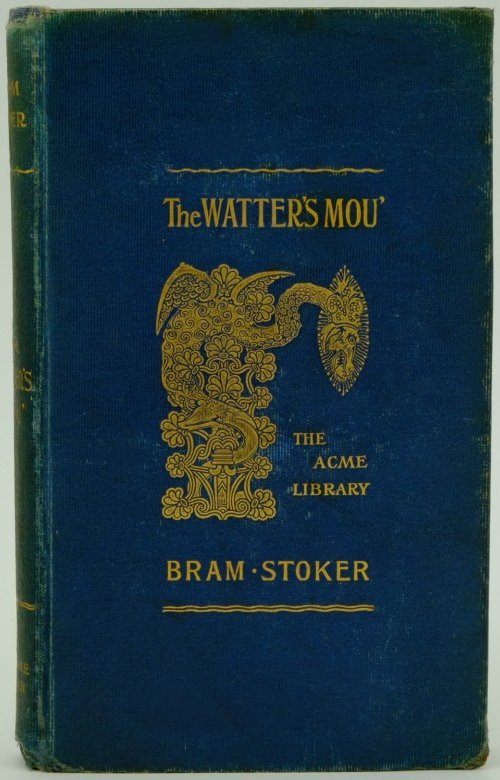
The Watter’s Mou’
By
Bram Stoker

The Watter’s Mou’ Contents
The Watter’s Mou’ Chapter I
The Watter’s Mou’ Chapter II
The Watter’s Mou’ Chapter III
The Watter’s Mou’ Chapter IV
The Watter’s Mou’ Chapter V
The Watter’s Mou’
The Watter’s Mou’ Chapter I
It threatened to be a wild night. All day banks of sea-fog had come and gone, sweeping on shore with the south-east wind, which is so fatal at Cruden Bay, and indeed all along the coast of Aberdeenshire, and losing themselves in the breezy expanses of the high uplands beyond. As yet the wind only came in puffs, followed by intervals of ominous calm; but the barometer had been falling for days, and the sky had on the previous night been streaked with great “mare’s-tails” running in the direction of the dangerous wind. Up to early morning the wind had been south-westerly, but had then “backed” to south-east; and the sudden change, no less than the backing, was ominous indeed. From the waste of sea came a ceaseless muffled roar, which seemed loudest and most full of dangerous import when it came through the mystery of the driving fog. Whenever the fog-belts would lift or disperse, or disappear inland before the gusts of wind, the sea would look as though swept with growing anger; for though there were neither big waves as during a storm, nor a great swell as after one, all the surface of the water as far as the eye could reach was covered with little waves tipped with white. Closer together grew these waves as the day wore on, the angrier ever the curl of the white water where they broke. In the North Sea it does not take long for the waves to rise; and all along the eastern edge of Buchan it was taken for granted that there would be wild work on the coast before the night was over.
In the little look-out house on the top of the cliff over the tiny harbour of Port Erroll the coastguard on duty was pacing rapidly to and fro. Every now and again he would pause, and lifting a field-glass from the desk, sweep the horizon from Girdleness at the south of Aberdeen, when the lifting of the mist would let him see beyond the Scaurs, away to the north, where the high cranes of the Blackman quarries at Murdoch Head seemed to cleave the sky like gigantic gallows-trees.
He was manifestly in high spirits, and from the manner in which, one after another, he looked again and again at the Martini-Henry rifle in the rack, the navy revolver stuck muzzle down on a spike, and the cutlass in its sheath hanging on the wall, it was easy to see that his interest arose from something connected with his work as a coastguard. On the desk lay an open telegram smoothed down by his hard hands, with the brown envelope lying beside it. It gave some sort of clue to his excitement, although it did not go into detail. “Keep careful watch tonight; run expected; spare no efforts; most important.”
William Barrow, popularly known as Sailor Willy, was a very young man to be a chief boatman in the preventive service, albeit that his station was one of the smallest on the coast. He had been allowed, as a reward for saving the life of his lieutenant, to join the coast service, and had been promoted to chief boatman as a further reward for a clever capture of smugglers, wherein he had shown not only great bravery, but much ability and power of rapid organisation.
The Aberdeen coast is an important one in the way of guarding on account of the vast number of fishing-smacks which, during the season, work from Peterhead up and down the coast, and away on the North Sea right to the shores of Germany and Holland. This vast coming and going affords endless opportunities for smuggling; and, despite of all vigilance, a considerable amount of “stuff” finds its way to the consumers without the formality of the Custom House. The fish traffic is a quick traffic, and its returns come all at once, so that a truly enormous staff would be requisite to examine adequately the thousand fish-smacks which use the harbour of Peterhead, and on Sundays pack its basins with a solid mass of boats. The coast-line for some forty miles south is favourable for this illicit traffic. The gneiss and granite formations broken up by every convulsion of nature, and worn by the strain and toil of ages into every conceivable form of rocky beauty, offers an endless variety of narrow creeks and bays where the daring, to whom the rocks and the currents and the tides are known, may find secret entrance and speedy exit for their craft. This season the smuggling had been chiefly of an overt kind – that is, the goods had been brought into the harbour amongst the fish and nets, and had been taken through the streets under the eyes of the unsuspecting Customs officers. Some of these takes were so large, that the authorities had made up their minds that there must be a great amount of smuggling going on. The secret agents in the German, Dutch, Flemish, and French ports were asked to make extra exertions in discovering the amount of the illicit trade, and their later reports were of an almost alarming nature. They said that really vast amounts of tobacco, brandy, rum, silks, laces, and all sorts of excisable commodities were being secretly shipped in the British fishing-fleet; and as only a very small proportion of this was discovered, it was manifest that smuggling to a large extent was once more to the fore. Accordingly precautions were doubled all along the east coast frequented by the fishing-fleets. Not only were the coastguards warned of the danger and cautioned against devices which might keep them from their work at critical times, but they were apprised of every new shipment as reported from abroad. Furthermore, the detectives of the service were sent about to parts where the men were suspected of laxity-or worse.
Thus it was that Sailor Willy, with the experience of two promotions for cause, and with the sense of responsibility which belonged to his office, felt in every way elated at the possibility of some daring work before him. He knew, of course, that a similar telegram had been received at every station on the coast, and that the chance of an attempt being made in Cruden Bay or its surroundings was a small one; but he was young and brave and hopeful, and with an adamantine sense of integrity to support him in his work. It was unfortunate that his comrade was absent, ill in the hospital at Aberdeen, and that the strain at present on the service, together with the men away on annual training and in the naval manoeuvres, did not permit of a substitute being sent to him. However, he felt strong enough to undertake any amount of duty – he was strong enough and handsome enough to have a good opinion of himself, and too brave and too sensible to let his head be turned by vanity.
As he walked to and fro there was in the distance of his mind – in that dim background against which in a man’s mind a woman’s form finds suitable projection – some sort of vague hope that a wild dream of rising in the world might be some time realised. He knew that every precaution in his power had been already taken, and felt that he could indulge in fancies without detriment to his work. He had signalled the coastguard at Whinnyfold on the south side of the Bay, and they had exchanged ideas by means of the signal language. His appliances for further signalling by day or night were in perfect order, and he had been right over his whole boundary since he had received the telegram seeing that all things were in order. Willy Barrow was not one to leave things to chance where duty was concerned.
His day-dreams were not all selfish. They were at least so far unselfish that the results were to be shared with another; for Willy Barrow was engaged to be married. Maggie MacWhirter was the daughter of an old fisherman who had seen days more prosperous than the present. He had once on a time owned a fishing-smack, but by degrees he had been compelled to borrow on her, till now, when, although he was nominal owner, the boat was so heavily mortgaged that at any moment he might lose his entire possession. That such an event was not unlikely was manifest, for the mortgagee was no other than Solomon Mendoza of Hamburg and Aberdeen, who had changed in like manner the ownership of a hundred boats, and who had the reputation of being as remorseless as he was rich. MacWhirter had long been a widower, and Maggie since a little girl had kept house for her father and her two brothers, Andrew and Niel. Andrew was twenty-seven – six years older than Maggie – and Niel had just turned twenty. The elder brother was a quiet, self-contained, hard-working man, who now and again manifested great determination, though generally at unexpected times; the younger was rash, impetuous, and passionate, and though in his moments of quiescence more tender to those he cared for than was usual with men of his class, he was a never-ending source of anxiety to his father and his sister. Andrew, or Sandy as he was always called, took him with consistent quietness.
The present year, although a good one in the main, had been but poor for MacWhirter’s boat. Never once had he had a good take of fish – not one-half the number of crans of the best boat; and the season was so far advanced, and the supply had been so plentiful, that a few days before, the notice had been up at Peterhead that after the following week the buyers would not take any more herring.
This notice naturally caused much excitement, and the whole fishing industry determined to make every effort to improve the shining hours left to them. Exertions were on all sides redoubled, and on sea and shore there was little idleness. Naturally the smuggling interest bestirred itself too; its chance for the year was in the rush and bustle and hurry of the coming and going fleet, and anything held over for a chance had to be ventured now or left over for a year – which might mean indefinitely. Great ventures were therefore taken by some of the boats; and from their daring the authorities concluded that either heavy bribes were given, or else that the goods were provided by others than the fishermen who undertook to run them. A few important seizures, however, made the men wary; and it was understood from the less frequent but greater importance of the seizures, that the price for “running” had greatly gone up. There was much passionate excitement amongst those who were found out and their friends, and a general wish to discover the informers. Some of the smuggling fishermen at first refused to pay the fines until they were told who had informed. This position being unsupportable, they had instead paid the fines and cherished hatred in their hearts. Some of the more reckless and turbulent spirits had declared their intention of avenging themselves on the informers when they should be known. It was only natural that this feeling of rage should extend to the Customs officers and men of the preventive service, who stood between the unscrupulous adventurers and their harvest; and altogether matters had become somewhat strained between the fishermen and the authorities.
The Port Erroll boats, like those from Collieston, were all up at Peterhead, and of course amongst them MacWhirter’s boat the Sea Gull with her skipper and his two sons. It Was now Friday night, and the boats had been out for several days, so that it was pretty certain that there would be a full harbor at Peterhead on the Saturday. A marriage had been arranged to take place this evening between Thomas Keith of Boddam and Alice MacDonald, whose father kept the public-house The Jamie Fleeman on the northern edge of the Erroll estate. Though the occasion was to be a grand one, the notice of it had been short indeed. It was said by the bride’s friends that it had been fixed so hurriedly because the notice of the closing of the fishing season had been so suddenly given out at Peterhead. Truth to tell, some sort of explanation was necessary, for it was only on Wednesday morning that word had been sent to the guests, and as these came from all sorts of places between Peterhead and Collieston, and taking a sweep of some ten miles inland, there was need of some preparation. The affair was to top all that had ever been seen at Port Erroll, and as The Jamie Fleeman was but a tiny place – nothing, in fact, but a wayside public-house – it was arranged that it was to take place in the new barn and storehouses Matthew Beagrie had just built on the inner side of the sandhills, where they came close to the Water of Cruden.
Throughout all the east side of Buchan there had for some time existed a wonder amongst the quiet-going people as to the strange prosperity of MacDonald. His public-house had, of course, a practical monopoly; for as there was not a licensed house on the Erroll estate, and as his was the nearest house of call to the port, he naturally got what custom there was going. The fishermen all along the coast for some seven or eight miles went to him either to drink or to get their liquor for drinking elsewhere; and not a few of the Collieston men on their Saturday journey home from Peterhead and their Sunday journey out there again made a detour to have a glass and a chat and a pipe, if time permitted, with “Tammas Mac” – for such was his sobriquet. To the authorities he and his house were also sources of interest; for there was some kind of suspicion that some of the excellent brandy and cigars which he dispensed had arrived by a simpler road than that through the Custom House. It was at this house, in the good old days of smuggling, that the coastguards used to be entertained when a run was on foot, and where they slept off their drunkenness whilst the cargoes were being hidden or taken inland in the ready carts. Of course all this state of things had been altered, and there was as improved a decorum amongst the smugglers as there was a sterner rule and discipline amongst the coastguards. It was many a long year since Philip Kennedy met his death at Kirkton at the hands of the exciseman Anderson. Comparatively innocent deception was now the smugglers’ only wile.
Tonight the whole country-side was to be at the wedding, and the dance which was to follow it; and for this occasion the lion was to lie down with the lamb, for the coastguards were bidden to the feast with the rest. Sailor Willy had looked forward to the dance with delight, for Maggie was to be there, and on the Billy Ruffian, which had been his last ship, he had been looked on as the best dancer before the mast. If there be any man who shuns a dance in which he knows he can shine, and at which his own particular girl is to be present, that man is not to be found in the Royal Naval Marine, even amongst those of them who have joined in the preventive service. Maggie was no less delighted, although she had a source of grief which for the present she had kept all to herself. Her father had of late been much disturbed about affairs. He had not spoken of them to her, and she did not dare to mention the matter to him; for old MacWhirter was a closemouthed man, and did not exchange many confidences even with his own children. But Maggie guessed at the cause of the sadness – of the down-bent head when none were looking; the sleepless nights and the deep smothered groans which now and again marked his heavy sleep told the tale loudly enough to reach the daughter’s ears. For the last few weeks, whenever her father was at home, Maggie had herself lain awake listening, listening, in increasing agony of spirit, for one of these half moans or for the sound of the tossing of the restless man. He was as gentle and kind to his daughter as ever; but on his leaving the last time there had been an omission on his part which troubled her to the quick. For the first time in his life he had not kissed her as he went away.
On the previous day Sailor Willy had said he would come to the wedding and the dance if his duties should permit him; and, when asked if he could spare a few rockets for the occasion, promised that he would let off three Board of Trade rockets, which he could now deal with as it was three months since he had used any. He was delighted at the opportunity of meeting the fisherfolk and his neighbours; for his officers had impressed on him the need of being on good terms with all around him, both for the possibility which it would always afford him of knowing how things were going on, and for the benefit of the rocket-service whenever there might be need of willing hands and hearts to work with him, for in the Board of Trade rocket-service much depends on voluntary aid. That very afternoon he had fixed the rockets on the wall of the barn with staples, so that he could fire them from below with a slow match, which he fixed ready. When he had got the telegram he had called in to Maggie and told her if he did not come to fetch her she was to go on to the wedding by herself, and that he would try to join her later. She had appeared a little startled when he told her he might not be present; but after a pause smiled, and said she would go, and that he was not to lose any time coming when he was free. Now that every arrangement was complete, and as he had between puffs of the sea-fog got a clean sweep of the horizon and saw that there was no sail of any kind within sight, he thought he might have a look through the village and keep in evidence so as not to create any suspicion in the minds of the people. As he went through the street he noticed that nearly every house door was closed – all the women were at the new barn. It was now eight o’clock, and the darkness, which is slow of coming in the North, was closing in. Down by the barn there were quite a number of carts, and the horses had not been taken out, though the wedding was not to be till nine o’clock, or perhaps even later; for Mrs MacDonald had taken care to tell her friends that Keith might not get over from Boddam till late. Willy looked at the carts carefully – some idea seemed to have struck him. Their lettering shewed them to be from all parts round, and the names mostly of those who had not the best reputation. When his brief survey was finished he looked round and then went swiftly behind the barn so that no one might see him. As he went he muttered reflectively:
“Too many light carts and fast horses – too much silence in the barn – too little liquor going, to be all safe. There’s something up here tonight.” He was under the lee of the barn and looked up where he had fixed the rockets ready to fire. This gave him a new idea.
“I fixed them low so as to go over the sandhills and not be noticeable at Collieston or beyond. They are now placed up straight and will be seen for fifty miles if the weather be clear.”
It was too dark to see very clearly, and he would not climb up to examine them lest he should be noticed and his purpose of acquiring information frustrated; but then and there he made up his mind that Port Erroll or its neighbourhood had been the spot chosen for the running of the smuggled goods. He determined to find out more, and straightaway went round to the front and entered the room.








Mr. Bram Stoker appears to have a very catholic taste so far as the selection of scenes for his stories is concerned.
If we remember aright, Ireland gave him the scenery for a novel of mystery and exciting adventure. Here Scotland and the wild Buchan coast in Aberdeenshire supply him with the material for a story of storm and smuggling, and of the eternal struggle between love and duty. The word “smuggling” suggests that the time of The Watter’s Mou is considerably anterior to the present day.
The abundant descriptions of the wild scenery in the vicinity of Peterhead, and the wild waves that dash upon a dangerous coast, suggest the possibility of Mr. Stoker’s having studied both upon the spot, and having made a background for them in a quite imaginary tragedy.
His descriptions, taken altogether, are better than his story, which, although good enough in its way, is slightly conventional. The villain of the piece, the “merchant” Mendoza, who is the true inspirer and capitalist of the smuggling which is carried on at ‘The Watter’s Mou’ and elsewhere, is rather conventional, being “an elderly man with a bald head, a ragged grey beard, a hooked nose, and an evil smile.”
At the same time, it is only fair to say that Mr. Bram Stoker has made no pretence of writing an elaborate novel. He has tried to write an idyll that closes in tragedy, and he has succeeded admirably.
The Spectator
(26th January, 1895)