The Jewel of Seven Stars by Bram Stoker
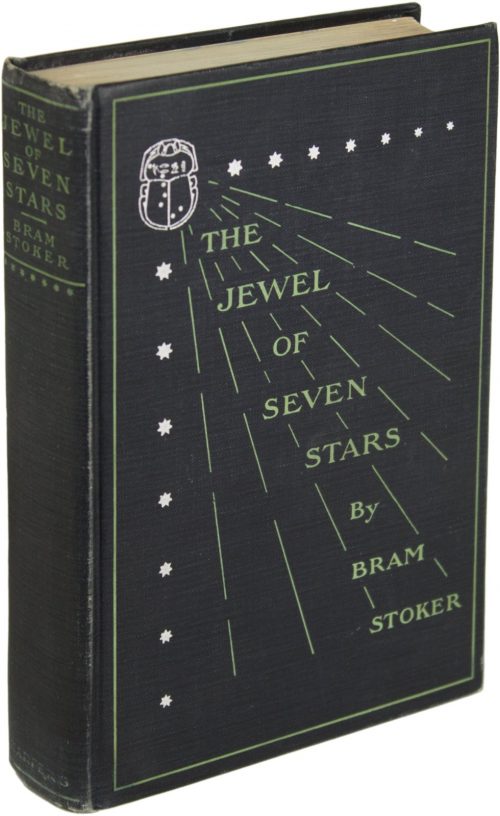
The Jewel of Seven Stars
by
Bram Stoker

The Jewel of Seven Stars Contents
The Jewel of Seven Stars Chapter I. A Summons in the Night
The Jewel of Seven Stars Chapter II. Strange Instructions
The Jewel of Seven Stars Chapter III. The Watchers
The Jewel of Seven Stars Chapter IV. The Second Attempt
The Jewel of Seven Stars Chapter V. More Strange Instructions
The Jewel of Seven Stars Chapter VI. Suspicions
The Jewel of Seven Stars Chapter VII. The Traveller’s Loss
The Jewel of Seven Stars Chapter VIII. The Finding of the Lamps
The Jewel of Seven Stars Chapter IX. The Need of Knowledge
The Jewel of Seven Stars Chapter X. The Valley of the Sorcerer
The Jewel of Seven Stars Chapter XI. A Queen’s Tomb
The Jewel of Seven Stars Chapter XII. The Magic Coffer
The Jewel of Seven Stars Chapter XIII. Awaking From the Trance
The Jewel of Seven Stars Chapter XIV. The Birth-Mark
The Jewel of Seven Stars Chapter XV. The Purpose of Queen Tera
The Jewel of Seven Stars Chapter XVI. The Cavern
The Jewel of Seven Stars Chapter XVII. Doubts and Fears
The Jewel of Seven Stars Chapter XVIII. The Lesson of the “Ka”
The Jewel of Seven Stars Chapter XIX. The Great Experiment
The Jewel of Seven Stars Chapter I. A Summons in the Night
It all seemed so real that I could hardly imagine that it had ever occurred before; and yet each episode came, not as a fresh step in the logic of things, but as something expected. It is in such a wise that memory plays its pranks for good or ill; for pleasure or pain; for weal or woe. It is thus that life is bittersweet, and that which has been done becomes eternal.
Again, the light skiff, ceasing to shoot through the lazy water as when the oars flashed and dripped, glided out of the fierce July sunlight into the cool shade of the great drooping willow branches—I standing up in the swaying boat, she sitting still and with deft fingers guarding herself from stray twigs or the freedom of the resilience of moving boughs. Again, the water looked golden-brown under the canopy of translucent green; and the grassy bank was of emerald hue. Again, we sat in the cool shade, with the myriad noises of nature both without and within our bower merging into that drowsy hum in whose sufficing environment the great world with its disturbing trouble, and its more disturbing joys, can be effectually forgotten. Again, in that blissful solitude the young girl lost the convention of her prim, narrow upbringing, and told me in a natural, dreamy way of the loneliness of her new life. With an undertone of sadness she made me feel how in that spacious home each one of the household was isolated by the personal magnificence of her father and herself; that there confidence had no altar, and sympathy no shrine; and that there even her father’s face was as distant as the old country life seemed now. Once more, the wisdom of my manhood and the experience of my years laid themselves at the girl’s feet. It was seemingly their own doing; for the individual “I” had no say in the matter, but only just obeyed imperative orders. And once again the flying seconds multiplied themselves endlessly. For it is in the arcana of dreams that existences merge and renew themselves, change and yet keep the same—like the soul of a musician in a fugue. And so memory swooned, again and again, in sleep.
It seems that there is never to be any perfect rest. Even in Eden the snake rears its head among the laden boughs of the Tree of Knowledge. The silence of the dreamless night is broken by the roar of the avalanche; the hissing of sudden floods; the clanging of the engine bell marking its sweep through a sleeping American town; the clanking of distant paddles over the sea…. Whatever it is, it is breaking the charm of my Eden. The canopy of greenery above us, starred with diamond-points of light, seems to quiver in the ceaseless beat of paddles; and the restless bell seems as though it would never cease….
All at once the gates of Sleep were thrown wide open, and my waking ears took in the cause of the disturbing sounds. Waking existence is prosaic enough—there was somebody knocking and ringing at someone’s street door.
I was pretty well accustomed in my Jermyn Street chambers to passing sounds; usually I did not concern myself, sleeping or waking, with the doings, however noisy, of my neighbours. But this noise was too continuous, too insistent, too imperative to be ignored. There was some active intelligence behind that ceaseless sound; and some stress or need behind the intelligence. I was not altogether selfish, and at the thought of someone’s need I was, without premeditation, out of bed. Instinctively I looked at my watch. It was just three o’clock; there was a faint edging of grey round the green blind which darkened my room. It was evident that the knocking and ringing were at the door of our own house; and it was evident, too, that there was no one awake to answer the call. I slipped on my dressing-gown and slippers, and went down to the hall door. When I opened it there stood a dapper groom, with one hand pressed unflinchingly on the electric bell whilst with the other he raised a ceaseless clangour with the knocker. The instant he saw me the noise ceased; one hand went up instinctively to the brim of his hat, and the other produced a letter from his pocket. A neat brougham was opposite the door, the horses were breathing heavily as though they had come fast. A policeman, with his night lantern still alight at his belt, stood by, attracted to the spot by the noise.
“Beg pardon, sir, I’m sorry for disturbing you, but my orders was imperative; I was not to lose a moment, but to knock and ring till someone came. May I ask you, sir, if Mr. Malcolm Ross lives here?”
“I am Mr. Malcolm Ross.”
“Then this letter is for you, sir, and the bro’am is for you too, sir!”
I took, with a strange curiosity, the letter which he handed to me. As a barrister I had had, of course, odd experiences now and then, including sudden demands upon my time; but never anything like this. I stepped back into the hall, closing the door to, but leaving it ajar; then I switched on the electric light. The letter was directed in a strange hand, a woman’s. It began at once without “dear sir” or any such address:
“You said you would like to help me if I needed it; and I believe you meant what you said. The time has come sooner than I expected. I am in dreadful trouble, and do not know where to turn, or to whom to apply. An attempt has, I fear, been made to murder my Father; though, thank God, he still lives. But he is quite unconscious. The doctors and police have been sent for; but there is no one here whom I can depend on. Come at once if you are able to; and forgive me if you can. I suppose I shall realise later what I have done in asking such a favour; but at present I cannot think. Come! Come at once! MARGARET TRELAWNY.”
Pain and exultation struggled in my mind as I read; but the mastering thought was that she was in trouble and had called on me—me! My dreaming of her, then, was not altogether without a cause. I called out to the groom:
“Wait! I shall be with you in a minute!” Then I flew upstairs.
A very few minutes sufficed to wash and dress; and we were soon driving through the streets as fast as the horses could go. It was market morning, and when we got out on Piccadilly there was an endless stream of carts coming from the west; but for the rest the roadway was clear, and we went quickly. I had told the groom to come into the brougham with me so that he could tell me what had happened as we went along. He sat awkwardly, with his hat on his knees as he spoke.
“Miss Trelawny, sir, sent a man to tell us to get out a carriage at once; and when we was ready she come herself and gave me the letter and told Morgan—the coachman, sir—to fly. She said as I was to lose not a second, but to keep knocking till someone come.”
“Yes, I know, I know—you told me! What I want to know is, why she sent for me. What happened in the house?”
“I don’t quite know myself, sir; except that master was found in his room senseless, with the sheets all bloody, and a wound on his head. He couldn’t be waked nohow. Twas Miss Trelawny herself as found him.”
“How did she come to find him at such an hour? It was late in the night, I suppose?”
“I don’t know, sir; I didn’t hear nothing at all of the details.”
As he could tell me no more, I stopped the carriage for a moment to let him get out on the box; then I turned the matter over in my mind as I sat alone. There were many things which I could have asked the servant; and for a few moments after he had gone I was angry with myself for not having used my opportunity. On second thought, however, I was glad the temptation was gone. I felt that it would be more delicate to learn what I wanted to know of Miss Trelawny’s surroundings from herself, rather than from her servants.
We bowled swiftly along Knightsbridge, the small noise of our well-appointed vehicle sounding hollowly in the morning air. We turned up the Kensington Palace Road and presently stopped opposite a great house on the left-hand side, nearer, so far as I could judge, the Notting Hill than the Kensington end of the avenue. It was a truly fine house, not only with regard to size but to architecture. Even in the dim grey light of the morning, which tends to diminish the size of things, it looked big.
Miss Trelawny met me in the hall. She was not in any way shy. She seemed to rule all around her with a sort of high-bred dominance, all the more remarkable as she was greatly agitated and as pale as snow. In the great hall were several servants, the men standing together near the hall door, and the women clinging together in the further corners and doorways. A police superintendent had been talking to Miss Trelawny; two men in uniform and one plain-clothes man stood near him. As she took my hand impulsively there was a look of relief in her eyes, and she gave a gentle sigh of relief. Her salutation was simple.
“I knew you would come!”
The clasp of the hand can mean a great deal, even when it is not intended to mean anything especially. Miss Trelawny’s hand somehow became lost in my own. It was not that it was a small hand; it was fine and flexible, with long delicate fingers—a rare and beautiful hand; it was the unconscious self-surrender. And though at the moment I could not dwell on the cause of the thrill which swept me, it came back to me later.
She turned and said to the police superintendent:
“This is Mr. Malcolm Ross.” The police officer saluted as he answered:
“I know Mr. Malcolm Ross, miss. Perhaps he will remember I had the honour of working with him in the Brixton Coining case.” I had not at first glance noticed who it was, my whole attention having been taken with Miss Trelawny.
“Of course, Superintendent Dolan, I remember very well!” I said as we shook hands. I could not but note that the acquaintanceship seemed a relief to Miss Trelawny. There was a certain vague uneasiness in her manner which took my attention; instinctively I felt that it would be less embarrassing for her to speak with me alone. So I said to the Superintendent:
“Perhaps it will be better if Miss Trelawny will see me alone for a few minutes. You, of course, have already heard all she knows; and I shall understand better how things are if I may ask some questions. I will then talk the matter over with you if I may.”
“I shall be glad to be of what service I can, sir,” he answered heartily.
Following Miss Trelawny, I moved over to a dainty room which opened from the hall and looked out on the garden at the back of the house. When we had entered and I had closed the door she said:
“I will thank you later for your goodness in coming to me in my trouble; but at present you can best help me when you know the facts.”
“Go on,” I said. “Tell me all you know and spare no detail, however trivial it may at the present time seem to be.” She went on at once:
“I was awakened by some sound; I do not know what. I only know that it came through my sleep; for all at once I found myself awake, with my heart beating wildly, listening anxiously for some sound from my Father’s room. My room is next Father’s, and I can often hear him moving about before I fall asleep. He works late at night, sometimes very late indeed; so that when I wake early, as I do occasionally, or in the grey of the dawn, I hear him still moving. I tried once to remonstrate with him about staying up so late, as it cannot be good for him; but I never ventured to repeat the experiment. You know how stern and cold he can be—at least you may remember what I told you about him; and when he is polite in this mood he is dreadful. When he is angry I can bear it much better; but when he is slow and deliberate, and the side of his mouth lifts up to show the sharp teeth, I think I feel—well, I don’t know how! Last night I got up softly and stole to the door, for I really feared to disturb him. There was not any noise of moving, and no kind of cry at all; but there was a queer kind of dragging sound, and a slow, heavy breathing. Oh! it was dreadful, waiting there in the dark and the silence, and fearing—fearing I did not know what!
“At last I took my courage a deux mains, and turning the handle as softly as I could, I opened the door a tiny bit. It was quite dark within; I could just see the outline of the windows. But in the darkness the sound of breathing, becoming more distinct, was appalling. As I listened, this continued; but there was no other sound. I pushed the door open all at once. I was afraid to open it slowly; I felt as if there might be some dreadful thing behind it ready to pounce out on me! Then I switched on the electric light, and stepped into the room. I looked first at the bed. The sheets were all crumpled up, so that I knew Father had been in bed; but there was a great dark red patch in the centre of the bed, and spreading to the edge of it, that made my heart stand still. As I was gazing at it the sound of the breathing came across the room, and my eyes followed to it. There was Father on his right side with the other arm under him, just as if his dead body had been thrown there all in a heap. The track of blood went across the room up to the bed, and there was a pool all around him which looked terribly red and glittering as I bent over to examine him. The place where he lay was right in front of the big safe. He was in his pyjamas. The left sleeve was torn, showing his bare arm, and stretched out toward the safe. It looked—oh! so terrible, patched all with blood, and with the flesh torn or cut all around a gold chain bangle on his wrist. I did not know he wore such a thing, and it seemed to give me a new shock of surprise.”
She paused a moment; and as I wished to relieve her by a moment’s divergence of thought, I said:
“Oh, that need not surprise you. You will see the most unlikely men wearing bangles. I have seen a judge condemn a man to death, and the wrist of the hand he held up had a gold bangle.” She did not seem to heed much the words or the idea; the pause, however, relieved her somewhat, and she went on in a steadier voice:
“I did not lose a moment in summoning aid, for I feared he might bleed to death. I rang the bell, and then went out and called for help as loudly as I could. In what must have been a very short time—though it seemed an incredibly long one to me—some of the servants came running up; and then others, till the room seemed full of staring eyes, and dishevelled hair, and night clothes of all sorts.
“We lifted Father on a sofa; and the housekeeper, Mrs. Grant, who seemed to have her wits about her more than any of us, began to look where the flow of blood came from. In a few seconds it became apparent that it came from the arm which was bare. There was a deep wound—not clean-cut as with a knife, but like a jagged rent or tear—close to the wrist, which seemed to have cut into the vein. Mrs. Grant tied a handkerchief round the cut, and screwed it up tight with a silver paper-cutter; and the flow of blood seemed to be checked at once. By this time I had come to my senses—or such of them as remained; and I sent off one man for the doctor and another for the police. When they had gone, I felt that, except for the servants, I was all alone in the house, and that I knew nothing—of my Father or anything else; and a great longing came to me to have someone with me who could help me. Then I thought of you and your kind offer in the boat under the willow-tree; and, without waiting to think, I told the men to get a carriage ready at once, and I scribbled a note and sent it on to you.”
She paused. I did not like to say just then anything of how I felt. I looked at her; I think she understood, for her eyes were raised to mine for a moment and then fell, leaving her cheeks as red as peony roses. With a manifest effort she went on with her story:
“The Doctor was with us in an incredibly short time. The groom had met him letting himself into his house with his latchkey, and he came here running. He made a proper tourniquet for poor Father’s arm, and then went home to get some appliances. I dare say he will be back almost immediately. Then a policeman came, and sent a message to the station; and very soon the Superintendent was here. Then you came.”
There was a long pause, and I ventured to take her hand for an instant. Without a word more we opened the door, and joined the Superintendent in the hall. He hurried up to us, saying as he came:
“I have been examining everything myself, and have sent off a message to Scotland Yard. You see, Mr. Ross, there seemed so much that was odd about the case that I thought we had better have the best man of the Criminal Investigation Department that we could get. So I sent a note asking to have Sergeant Daw sent at once. You remember him, sir, in that American poisoning case at Hoxton.”
“Oh yes,” I said, “I remember him well; in that and other cases, for I have benefited several times by his skill and acumen. He has a mind that works as truly as any that I know. When I have been for the defence, and believed my man was innocent, I was glad to have him against us!”
“That is high praise, sir!” said the Superintendent gratified: “I am glad you approve of my choice; that I did well in sending for him.”
I answered heartily:
“Could not be better. I do not doubt that between you we shall get at the facts—and what lies behind them!”
We ascended to Mr. Trelawny’s room, where we found everything exactly as his daughter had described.
There came a ring at the house bell, and a minute later a man was shown into the room. A young man with aquiline features, keen grey eyes, and a forehead that stood out square and broad as that of a thinker. In his hand he had a black bag which he at once opened. Miss Trelawny introduced us: “Doctor Winchester, Mr. Ross, Superintendent Dolan.” We bowed mutually, and he, without a moment’s delay, began his work. We all waited, and eagerly watched him as he proceeded to dress the wound. As he went on he turned now and again to call the Superintendent’s attention to some point about the wound, the latter proceeding to enter the fact at once in his notebook.
“See! several parallel cuts or scratches beginning on the left side of the wrist and in some places endangering the radial artery.
“These small wounds here, deep and jagged, seem as if made with a blunt instrument. This in particular would seem as if made with some kind of sharp wedge; the flesh round it seems torn as if with lateral pressure.”
Turning to Miss Trelawny he said presently:
“Do you think we might remove this bangle? It is not absolutely necessary, as it will fall lower on the wrist where it can hang loosely; but it might add to the patient’s comfort later on.” The poor girl flushed deeply as she answered in a low voice:
“I do not know. I—I have only recently come to live with my Father; and I know so little of his life or his ideas that I fear I can hardly judge in such a matter. The Doctor, after a keen glance at her, said in a very kindly way:
“Forgive me! I did not know. But in any case you need not be distressed. It is not required at present to move it. Were it so I should do so at once on my own responsibility. If it be necessary later on, we can easily remove it with a file. Your Father doubtless has some object in keeping it as it is. See! there is a tiny key attached to it….” As he was speaking he stopped and bent lower, taking from my hand the candle which I held and lowering it till its light fell on the bangle. Then motioning me to hold the candle in the same position, he took from his pocket a magnifying-glass which he adjusted. When he had made a careful examination he stood up and handed the magnifying-glass to Dolan, saying as he did so:
“You had better examine it yourself. That is no ordinary bangle. The gold is wrought over triple steel links; see where it is worn away. It is manifestly not meant to be removed lightly; and it would need more than an ordinary file to do it.”
The Superintendent bent his great body; but not getting close enough that way knelt down by the sofa as the Doctor had done. He examined the bangle minutely, turning it slowly round so that no particle of it escaped observation. Then he stood up and handed the magnifying-glass to me. “When you have examined it yourself,” he said, “let the lady look at it if she will,” and he commenced to write at length in his notebook.
I made a simple alteration in his suggestion. I held out the glass toward Miss Trelawny, saying:
“Had you not better examine it first?” She drew back, slightly raising her hand in disclaimer, as she said impulsively:
“Oh no! Father would doubtless have shown it to me had he wished me to see it. I would not like to without his consent.” Then she added, doubtless fearing lest her delicacy of view should give offence to the rest of us:
“Of course it is right that you should see it. You have to examine and consider everything; and indeed—indeed I am grateful to you…”
She turned away; I could see that she was crying quietly. It was evident to me that even in the midst of her trouble and anxiety there was a chagrin that she knew so little of her father; and that her ignorance had to be shown at such a time and amongst so many strangers. That they were all men did not make the shame more easy to bear, though there was a certain relief in it. Trying to interpret her feelings I could not but think that she must have been glad that no woman’s eyes—of understanding greater than man’s—were upon her in that hour.
When I stood up from my examination, which verified to me that of the Doctor, the latter resumed his place beside the couch and went on with his ministrations. Superintendent Dolan said to me in a whisper:
“I think we are fortunate in our doctor!” I nodded, and was about to add something in praise of his acumen, when there came a low tapping at the door.