The Chain of Destiny by Bram Stoker
First published in four instalments between May 1st 1875 and May 22nd 1875 : The Shamrock, Irish National Newspaper and Publishing Co., Dublin
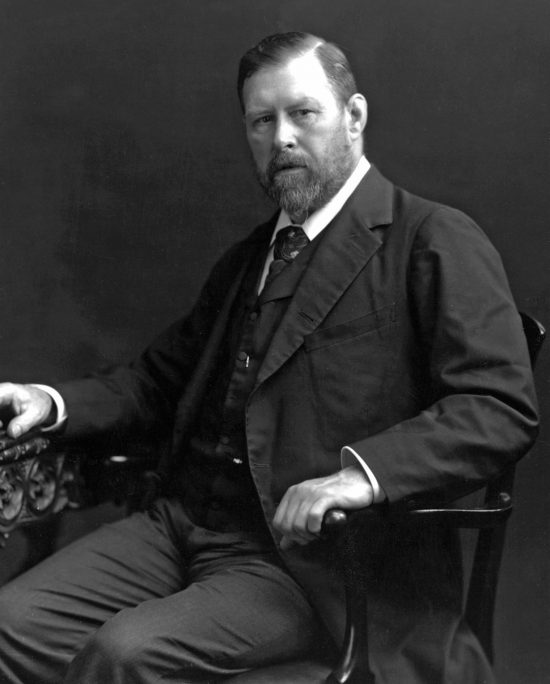
Bram Stoker Photograph
The Chain of Destiny
By
Bram Stoker
The Chain of Destiny Contents
The Chain of Destiny Chapter I A Warning
The Chain of Destiny Chapter II More Links
The Chain of Destiny Chapter III The Third To-morrow
The Chain of Destiny Chapter IV Afterwards
The Chain of Destiny
The Chain of Destiny Chapter I A Warning
It was so late in the evening when I arrived at Scarp that I had but little opportunity of observing the external appearance of the house; but, as far as I could judge in the dim twilight, it was a very stately edifice of seemingly great age, built of white stone. When I passed the porch, however, I could observe its internal beauties much more closely, for a large wood fire burned in the hall and all the rooms and passages were lighted. The hall was almost baronial in its size, and opened on to a staircase of dark oak so wide and so generous in its slope that a carriage might almost have been driven up it. The rooms were large and lofty, with their walls, like those of the staircase, panelled with oak black from age. This sombre material would have made the house intensely gloomy but for the enormous width and height of both rooms and passages. As it was, the effect was a homely combination of size and warmth. The windows were set in deep embrasures, and, on the ground story, reached from quite level with the floor to almost the ceiling. The fireplaces were quite in the old style, large and surrounded with massive oak carvings, representing on each some scene from Biblical history, and at the side of each fireplace rose a pair of massive carved iron fire-dogs. It was altogether just such a house as would have delighted the heart of Washington Irving or Nathaniel Hawthorne.
The house had been lately restored; but in effecting the restoration comfort had not been forgotten, and any modern improvement which tended to increase the homelike appearance of the rooms had been added. The old diamond-paned casements, which had remained probably from the Elizabethan age, had given place to more useful plate glass; and, in like manner, many other changes had taken place. But so judiciously had every change been effected that nothing of the new clashed with the old, but the harmony of all the parts seemed complete.
I thought it no wonder that Mrs. Trevor had fallen in love with Scarp the first time she had seen it. Mrs. Trevor’s liking the place was tantamount to her husband’s buying it, for he was so wealthy that he could get almost anything money could purchase. He was himself a man of good taste, but still he felt his inferiority to his wife in this respect so much that he never dreamt of differing in opinion from her on any matter of choice or judgment. Mrs. Trevor had, without exception, the best taste of any one whom I ever knew, and, strange to say, her taste was not confined to any branch of art. She did not write, or paint, or sing; but still her judgment in writing, painting, or music, was unquestioned by her friends. It seemed as if nature had denied to her the power of execution in any separate branch of art, in order to make her perfect in her appreciation of what was beautiful and true in all. She was perfect in the art of harmonising-the art of every-day life. Her husband used to say, with a far-fetched joke, that her star must have been in the House of Libra, because everything which she said and did showed such a nicety of balance.
Mr. and Mrs. Trevor were the most model couple I ever knew-they really seemed not twain, but one. They appeared to have adopted something of the French idea of man and wife-that they should not be the less like friends because they were linked together by indissoluble bonds-that they should share their pleasures as well as their sorrows. The former outbalanced the latter, for both husband and wife were of that happy temperament which can take pleasure from everything, and find consolation even in the chastening rod of affliction.
Still, through their web of peaceful happiness ran a thread of care. One that cropped up in strange places, and disappeared again, but which left a quiet tone over the whole fabric-they had no child.
“They had their share of sorrow, for when time was ripe
The still affection of the heart became an outward
breathing type,
That into stillness passed again,
But left a want unknown before.”
There was something simple and holy in their patient endurance of their lonely life-for lonely a house must ever be without children to those who love truly. Theirs was not the eager, disappointed longing of those whose union had proved fruitless. It was the simple, patient, hopeless resignation of those who find that a common sorrow draws them more closely together than many common joys. I myself could note the warmth of their hearts and their strong philoprogenitive feeling in their manner towards me.
From the time when I lay sick in college when Mrs. Trevor appeared to my fever-dimmed eyes like an angel of mercy, I felt myself growing in their hearts. Who can imagine my gratitude to the lady who, merely because she heard of my sickness and desolation from a college friend, came and nursed me night and day till the fever left me. When I was sufficiently strong to be moved she had me brought away to the country, where good air, care, and attention soon made me stronger than ever. From that time I became a constant visitor at the Trevors’ house; and as month after month rolled by I felt that I was growing in their affections. For four summers I spent my long vacation in their house, and each year I could feel Mr. Trevor’s shake of the hand grow heartier, and his wife’s kiss on my forehead-for so she always saluted me-grow more tender and motherly.
Their liking for me had now grown so much that in their heart of hearts-and it was a sanctum common to them both-they secretly loved me as a son. Their love was returned manifold by the lonely boy, whose devotion to the kindest friends of his youth and his trouble had increased with his growth into manhood. Even in my own heart I was ashamed to confess how I loved them both-how I worshipped Mrs. Trevor as I adored the mother whom I had lost so young, and whose eyes shone sometimes even then upon me, like stars, in my sleep.
It is strange how timorous we are when our affections are concerned. Merely because I had never told her how I loved her as a mother, because she had never told me how she loved me as a son, I used sometimes to think of her with a sort of lurking suspicion that I was trusting too much to my imagination. Sometimes even I would try to avoid thinking of her altogether, till my yearning would grow too strong to be repelled, and then I would think of her long and silently, and would love her more and more. My life was so lonely that I clung to her as the only thing I had to love. Of course I loved her husband, too, but I never thought about him in the same way; for men are less demonstrative about their affections to each other, and even acknowledge them to themselves less.
Mrs. Trevor was an excellent hostess. She always let her guests see that they were welcome, and, unless in the case of casual visitors, that they were expected. She was, as may be imagined, very popular with all classes; but what is more rare, she was equally popular with both sexes. To be popular with her own sex is the touchstone of a woman’s worth. To the houses of the peasantry she came, they said, like an angel, and brought comfort wherever she came. She knew the proper way to deal with the poor; she always helped them materially, but never offended their feelings in so doing. Young people all adored her.
My curiosity had been aroused as to the sort of place Scarp was; for, in order to give me a surprise, they would not tell me anything about it, but said that I must wait and judge it for myself. I had looked forward to my visit with both expectation and curiosity.
When I entered the hall, Mrs. Trevor came out to welcome me and kissed me on the forehead, after her usual manner. Several of the old servants came near, smiling and bowing, and wishing welcome to “Master Frank.” I shook hands with several of them, whilst their mistress looked on with a pleased smile.
As we went into a snug parlour, where a table was laid out with the materials for a comfortable supper, Mrs. Trevor said to me:
“I am glad you came so soon, Frank. We have no one here at present, so you will be quite alone with us for a few days; and you will be quite alone with me this evening, for Charley is gone to a dinner-party at Westholm.”
I told her that I was glad that there was no one else at Scarp, for that I would rather be with her and her husband than any one else in the world. She smiled as she said:
“Frank, if any one else said that, I would put it down as a mere compliment; but I know you always speak the truth. It is all very well to be alone with an old couple like Charley and me for two or three days; but just you wait till Thursday, and you will look on the intervening days as quite wasted.”
“Why?” I inquired.
“Because, Frank, there is a girl coming to stay with me then, with whom I intend you to fall in love.”
I answered jocosely:
“Oh, thank you, Mrs. Trevor, very much for your kind intentions- but suppose for a moment that they should be impracticable. ‘One man may lead a horse to the pond’s brink.’ ‘The best laid schemes o’ mice an’ men.’ Eh?”
“Frank, don’t be silly. I do not want to make you fall in love against your inclination; but I hope and I believe that you will.”
“Well, I’m sure I hope you won’t be disappointed; but I never yet heard a person praised that I did not experience a disappointment when I came to know him or her.”
“Frank, did I praise any one?”
“Well, I am vain enough to think that your saying that you knew I would fall in love with her was a sort of indirect praise.”
“Dear, me, Frank, how modest you have grown. ‘A sort of indirect praise!’ Your humility is quite touching.”
“May I ask who the lady is, as I am supposed to be an interested party?”
“I do not know that I ought to tell you on account of your having expressed any doubt as to her merits. Besides, I might weaken the effect of the introduction. If I stimulate your curiosity it will be a point in my favour.”
“Oh, very well; I suppose I must only wait?”
“Ah, well, Frank, I will tell you. It is not fair to keep you waiting. She is a Miss Fothering.”
“Fothering? Fothering? I think I know that name. I remember hearing it somewhere, a long time ago, if I do not mistake. Where does she come from?”
“Her father is a clergyman in Norfolk, but he belongs to the Warwickshire family. I met her at Winthrop, Sir Harry Blount’s place, a few months ago, and took a great liking for her, which she returned, and so we became fast friends. I made her promise to pay me a visit this summer, so she and her sister are coming here on Thursday to stay for some time.”
“And, may I be bold enough to inquire what she is like?”
“You may inquire if you like, Frank; but you won’t get an answer. I shall not try to describe her. You must wait and judge for yourself.”
“Wait,” said I, “three whole days? How can I do that? Do, tell me.”
She remained firm to her determination. I tried several times in the course of the evening to find out something more about Miss Fothering, for my curiosity was roused; but all the answer I could get on the subject was-“Wait, Frank; wait, and judge for yourself.”
When I was bidding her good night, Mrs. Trevor said to me-
“By-the-bye, Frank, you will have to give up the room which you will sleep in to-night, after to-morrow. I will have such a full house that I cannot let you have a doubled-bedded room all to yourself; so I will give that room to the Miss Fotherings, and move you up to the second floor. I just want you to see the room, as it has a romantic look about it, and has all the old furniture that was in it when we came here. There are several pictures in it worth looking at.”
My bedroom was a large chamber-immense for a bedroom-with two windows opening level with the floor, like those of the parlours and drawingrooms. The furniture was old-fashioned, but not old enough to be curious, and on the walls hung many pictures-portraits- the house was full of portraits-and landscapes. I just glanced at these, intending to examine them in the morning, and went to bed. There was a fire in the room, and I lay awake for some time looking dreamily at the shadows of the furniture flitting over the walls and ceiling as the flames of the wood fire leaped and fell, and the red embers dropped whitening on the hearth. I tried to give the rein to my thoughts, but they kept constantly to the one subject-the mysterious Miss Fothering, with whom I was to fall in love. I was sure that I had heard her name somewhere, and I had at times lazy recollections of a child’s face. At such times I would start awake from my growing drowsiness, but before I could collect my scattered thoughts the idea had eluded me. I could remember neither when nor where I had heard the name, nor could I recall even the expression of the child’s face. It must have been long, long ago, when I was young. When I was young my mother was alive. My mother-mother- mother. I found myself half awakening, and repeating the word over and over again. At last I fell asleep.
I thought that I awoke suddenly to that peculiar feeling which we sometimes have on starting from sleep, as if some one had been speaking in the room, and the voice is still echoing through it. All was quite silent, and the fire had gone out. I looked out of the window that lay straight opposite the foot of the bed, and observed a light outside, which gradually grew brighter till the room was almost as light as by day. The window looked like a picture in the framework formed by the cornice over the foot of the bed, and the massive pillars shrouded in curtains which supported it.
With the new accession of light I looked round the room, but nothing was changed. All was as before, except that some of the objects of furniture and ornament were shown in stronger relief than hitherto. Amongst these, those most in relief were the other bed, which was placed across the room, and an old picture that hung on the wall at its foot. As the bed was merely the counterpart of the one in which I lay, my attention became fixed on the picture. I observed it closely and with great interest. It seemed old, and was the portrait of a young girl, whose face, though kindly and merry, bore signs of thought and a capacity for deep feeling-almost for passion. At some moments, as I looked at it, it called up before my mind a vision of Shakespeare’s Beatrice, and once I thought of Beatrice Cenci. But this was probably caused by the association of ideas suggested by the similarity of names.
The light in the room continued to grow even brighter, so I looked again out of the window to seek its source, and saw there a lovely sight. It seemed as if there were grouped without the window three lovely children, who seemed to float in mid-air. The light seemed to spring from a point far behind them, and by their side was something dark and shadowy, which served to set off their radiance.
The children seemed to be smiling in upon something in the room, and, following their glances, I saw that their eyes rested upon the other bed. There, strange to say, the head which I had lately seen in the picture rested upon the pillow. I looked at the wall, but the frame was empty, the picture was gone. Then I looked at the bed again, and saw the young girl asleep, with the expression of her face constantly changing, as though she were dreaming.
As I was observing her, a sudden look of terror spread over her face, and she sat up like a sleep-walker, with her eyes wide open, staring out of the window.
Again turning to the window, my gaze became fixed, for a great and weird change had taken place. The figures were still there, but their features and expressions had become woefully different. Instead of the happy innocent look of childhood was one of malignity. With the change the children had grown old, and now three hags, decrepit and deformed, like typical witches, were before me.
But a thousand times worse than this transformation was the change in the dark mass that was near them. From a cloud, misty and undefined, it became a sort of shadow with a form. This gradually, as I looked, grew darker and fuller, till at length it made me shudder. There stood before me the phantom of the Fiend.
There was a long period of dead silence, in which I could hear the beating of my heart; but at length the phantom spoke to the others. His words seemed to issue from his lips mechanically, and without expression-“To-morrow, and to-morrow, and to-morrow. The fairest and the best.” He looked so awful that the question arose in my mind-“Would I dare to face him without the window-would any one dare to go amongst those fiends?” A harsh, strident, diabolical laugh from without seemed to answer my unasked question in the negative.
But as well as the laugh I heard another sound-the tones of a sweet sad voice in despair coming across the room.
“Oh, alone, alone! is there no human thing near me? No hope-no hope. I shall go mad-or die.”
The last words were spoken with a gasp.
I tried to jump out of bed, but could not stir, my limbs were bound in sleep. The young girl’s head fell suddenly back upon the pillow, and the limp-hanging jaw and wide-open, purposeless mouth spoke but too plainly of what had happened.
Again I heard from without the fierce, diabolical laughter, which swelled louder and louder, till at last it grew so strong that in very horror I shook aside my sleep and sat up in bed. listened and heard a knocking at the door, but in another moment I became more awake, and knew that the sound came from the hall. It was, no doubt, Mr. Trevor returning from his party.
The hall-door was opened and shut, and then came a subdued sound of tramping and voices, but this soon died away, and there was silence throughout the house.
I lay awake for long thinking, and looking across the room at the picture and at the empty bed; for the moon now shone brightly, and the night was rendered still brighter by occasional flashes of summer lightning. At times the silence was broken by an owl screeching outside.
As I lay awake, pondering, I was very much troubled by what I had seen; but at length, putting several things together, I came to the conclusion that I had had a dream of a kind that might have been expected. The lightning, the knocking at the hall-door, the screeching of the owl, the empty bed, and the face in the picture, when grouped together, supplied materials for the main facts of the vision. The rest was, of course, the offspring of pure fancy, and the natural consequence of the component elements mentioned acting with each other in the mind.
I got up and looked out of the window, but saw nothing but the broad belt of moonlight glittering on the bosom of the lake, which extended miles and miles away, till its farther shore was lost in the night haze, and the green sward, dotted with shrubs and tall grasses, which lay between the lake and the house.
The vision had utterly faded. However, the dream-for so, I suppose, I should call it-was very powerful, and I slept no more till the sunlight was streaming broadly in at the window, and then I fell into a doze.