Dracula’s Guest : Dracula’s Guest and Other Weird Stories by Bram Stoker
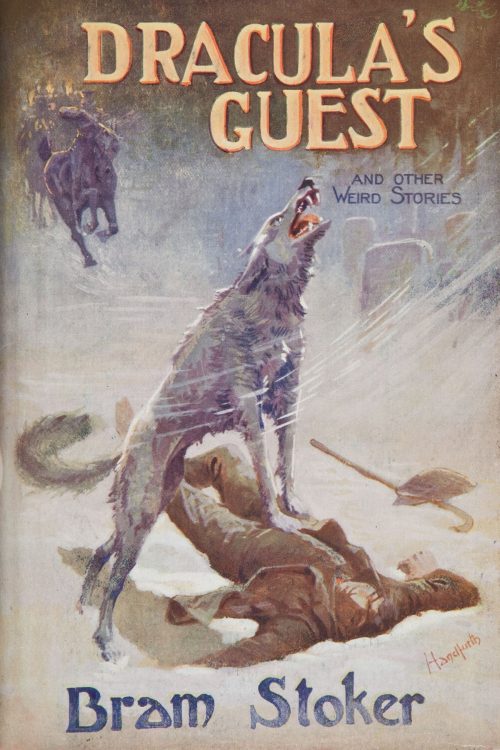
Dracula’s Guest
by
Bram Stoker
Dracula’s Guest
When we started for our drive the sun was shining brightly on Munich, and the air was full of the joyousness of early summer. Just as we were about to depart, Herr Delbrück (the maître d’hôtel of the Quatre Saisons, where I was staying) came down, bareheaded, to the carriage and, after wishing me a pleasant drive, said to the coachman, still holding his hand on the handle of the carriage door:
‘Remember you are back by nightfall. The sky looks bright but there is a shiver in the north wind that says there may be a sudden storm. But I am sure you will not be late.’ Here he smiled, and added, ‘for you know what night it is.’
Johann answered with an emphatic, ‘Ja, mein Herr,’ and, touching his hat, drove off quickly. When we had cleared the town, I said, after signalling to him to stop:
‘Tell me, Johann, what is tonight?’
He crossed himself, as he answered laconically: ‘Walpurgis nacht.’ Then he took out his watch, a great, old-fashioned German silver thing as big as a turnip, and looked at it, with his eyebrows gathered together and a little impatient shrug of his shoulders. I realised that this was his way of respectfully protesting against the unnecessary delay, and sank back in the carriage, merely motioning him to proceed. He started off rapidly, as if to make up for lost time. Every now and then the horses seemed to throw up their heads and sniffed the air suspiciously. On such occasions I often looked round in alarm. The road was pretty bleak, for we were traversing a sort of high, wind-swept plateau. As we drove, I saw a road that looked but little used, and which seemed to dip through a little, winding valley. It looked so inviting that, even at the risk of offending him, I called Johann to stop—and when he had pulled up, I told him I would like to drive down that road. He made all sorts of excuses, and frequently crossed himself as he spoke. This somewhat piqued my curiosity, so I asked him various questions. He answered fencingly, and repeatedly looked at his watch in protest. Finally I said:
‘Well, Johann, I want to go down this road. I shall not ask you to come unless you like; but tell me why you do not like to go, that is all I ask.’ For answer he seemed to throw himself off the box, so quickly did he reach the ground. Then he stretched out his hands appealingly to me, and implored me not to go. There was just enough of English mixed with the German for me to understand the drift of his talk. He seemed always just about to tell me something—the very idea of which evidently frightened him; but each time he pulled himself up, saying, as he crossed himself: ‘Walpurgis-Nacht!’
I tried to argue with him, but it was difficult to argue with a man when I did not know his language. The advantage certainly rested with him, for although he began to speak in English, of a very crude and broken kind, he always got excited and broke into his native tongue—and every time he did so, he looked at his watch. Then the horses became restless and sniffed the air. At this he grew very pale, and, looking around in a frightened way, he suddenly jumped forward, took them by the bridles and led them on some twenty feet. I followed, and asked why he had done this. For answer he crossed himself, pointed to the spot we had left and drew his carriage in the direction of the other road, indicating a cross, and said, first in German, then in English: ‘Buried him—him what killed themselves.’
I remembered the old custom of burying suicides at cross-roads: ‘Ah! I see, a suicide. How interesting!’ But for the life of me I could not make out why the horses were frightened.
Whilst we were talking, we heard a sort of sound between a yelp and a bark. It was far away; but the horses got very restless, and it took Johann all his time to quiet them. He was pale, and said, ‘It sounds like a wolf—but yet there are no wolves here now.’
‘No?’ I said, questioning him; ‘isn’t it long since the wolves were so near the city?’
‘Long, long,’ he answered, ‘in the spring and summer; but with the snow the wolves have been here not so long.’
Whilst he was petting the horses and trying to quiet them, dark clouds drifted rapidly across the sky. The sunshine passed away, and a breath of cold wind seemed to drift past us. It was only a breath, however, and more in the nature of a warning than a fact, for the sun came out brightly again. Johann looked under his lifted hand at the horizon and said:
‘The storm of snow, he comes before long time.’ Then he looked at his watch again, and, straightway holding his reins firmly—for the horses were still pawing the ground restlessly and shaking their heads—he climbed to his box as though the time had come for proceeding on our journey.
I felt a little obstinate and did not at once get into the carriage.
‘Tell me,’ I said, ‘about this place where the road leads,’ and I pointed down.
Again he crossed himself and mumbled a prayer, before he answered, ‘It is unholy.’
‘What is unholy?’ I enquired.
‘The village.’
‘Then there is a village?’
‘No, no. No one lives there hundreds of years.’ My curiosity was piqued, ‘But you said there was a village.’
‘There was.’
‘Where is it now?’
Whereupon he burst out into a long story in German and English, so mixed up that I could not quite understand exactly what he said, but roughly I gathered that long ago, hundreds of years, men had died there and been buried in their graves; and sounds were heard under the clay, and when the graves were opened, men and women were found rosy with life, and their mouths red with blood. And so, in haste to save their lives (aye, and their souls!—and here he crossed himself) those who were left fled away to other places, where the living lived, and the dead were dead and not—not something. He was evidently afraid to speak the last words. As he proceeded with his narration, he grew more and more excited. It seemed as if his imagination had got hold of him, and he ended in a perfect paroxysm of fear—white-faced, perspiring, trembling and looking round him, as if expecting that some dreadful presence would manifest itself there in the bright sunshine on the open plain. Finally, in an agony of desperation, he cried:
‘Walpurgis nacht!’ and pointed to the carriage for me to get in. All my English blood rose at this, and, standing back, I said:
‘You are afraid, Johann—you are afraid. Go home; I shall return alone; the walk will do me good.’ The carriage door was open. I took from the seat my oak walking-stick—which I always carry on my holiday excursions—and closed the door, pointing back to Munich, and said, ‘Go home, Johann—Walpurgis-nacht doesn’t concern Englishmen.’
The horses were now more restive than ever, and Johann was trying to hold them in, while excitedly imploring me not to do anything so foolish. I pitied the poor fellow, he was deeply in earnest; but all the same I could not help laughing. His English was quite gone now. In his anxiety he had forgotten that his only means of making me understand was to talk my language, so he jabbered away in his native German. It began to be a little tedious. After giving the direction, ‘Home!’ I turned to go down the cross-road into the valley.
With a despairing gesture, Johann turned his horses towards Munich. I leaned on my stick and looked after him. He went slowly along the road for a while: then there came over the crest of the hill a man tall and thin. I could see so much in the distance. When he drew near the horses, they began to jump and kick about, then to scream with terror. Johann could not hold them in; they bolted down the road, running away madly. I watched them out of sight, then looked for the stranger, but I found that he, too, was gone.
With a light heart I turned down the side road through the deepening valley to which Johann had objected. There was not the slightest reason, that I could see, for his objection; and I daresay I tramped for a couple of hours without thinking of time or distance, and certainly without seeing a person or a house. So far as the place was concerned, it was desolation itself. But I did not notice this particularly till, on turning a bend in the road, I came upon a scattered fringe of wood; then I recognised that I had been impressed unconsciously by the desolation of the region through which I had passed.
I sat down to rest myself, and began to look around. It struck me that it was considerably colder than it had been at the commencement of my walk—a sort of sighing sound seemed to be around me, with, now and then, high overhead, a sort of muffled roar. Looking upwards I noticed that great thick clouds were drifting rapidly across the sky from North to South at a great height. There were signs of coming storm in some lofty stratum of the air. I was a little chilly, and, thinking that it was the sitting still after the exercise of walking, I resumed my journey.
The ground I passed over was now much more picturesque. There were no striking objects that the eye might single out; but in all there was a charm of beauty. I took little heed of time and it was only when the deepening twilight forced itself upon me that I began to think of how I should find my way home. The brightness of the day had gone. The air was cold, and the drifting of clouds high overhead was more marked. They were accompanied by a sort of far-away rushing sound, through which seemed to come at intervals that mysterious cry which the driver had said came from a wolf. For a while I hesitated. I had said I would see the deserted village, so on I went, and presently came on a wide stretch of open country, shut in by hills all around. Their sides were covered with trees which spread down to the plain, dotting, in clumps, the gentler slopes and hollows which showed here and there. I followed with my eye the winding of the road, and saw that it curved close to one of the densest of these clumps and was lost behind it.
As I looked there came a cold shiver in the air, and the snow began to fall. I thought of the miles and miles of bleak country I had passed, and then hurried on to seek the shelter of the wood in front. Darker and darker grew the sky, and faster and heavier fell the snow, till the earth before and around me was a glistening white carpet the further edge of which was lost in misty vagueness. The road was here but crude, and when on the level its boundaries were not so marked, as when it passed through the cuttings; and in a little while I found that I must have strayed from it, for I missed underfoot the hard surface, and my feet sank deeper in the grass and moss. Then the wind grew stronger and blew with ever increasing force, till I was fain to run before it. The air became icy-cold, and in spite of my exercise I began to suffer. The snow was now falling so thickly and whirling around me in such rapid eddies that I could hardly keep my eyes open. Every now and then the heavens were torn asunder by vivid lightning, and in the flashes I could see ahead of me a great mass of trees, chiefly yew and cypress all heavily coated with snow.
I was soon amongst the shelter of the trees, and there, in comparative silence, I could hear the rush of the wind high overhead. Presently the blackness of the storm had become merged in the darkness of the night. By-and-by the storm seemed to be passing away: it now only came in fierce puffs or blasts. At such moments the weird sound of the wolf appeared to be echoed by many similar sounds around me.
Now and again, through the black mass of drifting cloud, came a straggling ray of moonlight, which lit up the expanse, and showed me that I was at the edge of a dense mass of cypress and yew trees. As the snow had ceased to fall, I walked out from the shelter and began to investigate more closely. It appeared to me that, amongst so many old foundations as I had passed, there might be still standing a house in which, though in ruins, I could find some sort of shelter for a while. As I skirted the edge of the copse, I found that a low wall encircled it, and following this I presently found an opening. Here the cypresses formed an alley leading up to a square mass of some kind of building. Just as I caught sight of this, however, the drifting clouds obscured the moon, and I passed up the path in darkness. The wind must have grown colder, for I felt myself shiver as I walked; but there was hope of shelter, and I groped my way blindly on.
I stopped, for there was a sudden stillness. The storm had passed; and, perhaps in sympathy with nature’s silence, my heart seemed to cease to beat. But this was only momentarily; for suddenly the moonlight broke through the clouds, showing me that I was in a graveyard, and that the square object before me was a great massive tomb of marble, as white as the snow that lay on and all around it. With the moonlight there came a fierce sigh of the storm, which appeared to resume its course with a long, low howl, as of many dogs or wolves. I was awed and shocked, and felt the cold perceptibly grow upon me till it seemed to grip me by the heart. Then while the flood of moonlight still fell on the marble tomb, the storm gave further evidence of renewing, as though it was returning on its track. Impelled by some sort of fascination, I approached the sepulchre to see what it was, and why such a thing stood alone in such a place. I walked around it, and read, over the Doric door, in German:
COUNTESS DOLINGEN OF GRATZ
IN STYRIA
SOUGHT AND FOUND DEATH
1801
On the top of the tomb, seemingly driven through the solid marble—for the structure was composed of a few vast blocks of stone—was a great iron spike or stake. On going to the back I saw, graven in great Russian letters:
‘The dead travel fast.’
There was something so weird and uncanny about the whole thing that it gave me a turn and made me feel quite faint. I began to wish, for the first time, that I had taken Johann’s advice. Here a thought struck me, which came under almost mysterious circumstances and with a terrible shock. This was Walpurgis Night!
Walpurgis Night, when, according to the belief of millions of people, the devil was abroad—when the graves were opened and the dead came forth and walked. When all evil things of earth and air and water held revel. This very place the driver had specially shunned. This was the depopulated village of centuries ago. This was where the suicide lay; and this was the place where I was alone—unmanned, shivering with cold in a shroud of snow with a wild storm gathering again upon me! It took all my philosophy, all the religion I had been taught, all my courage, not to collapse in a paroxysm of fright.
And now a perfect tornado burst upon me. The ground shook as though thousands of horses thundered across it; and this time the storm bore on its icy wings, not snow, but great hailstones which drove with such violence that they might have come from the thongs of Balearic slingers—hailstones that beat down leaf and branch and made the shelter of the cypresses of no more avail than though their stems were standing-corn. At the first I had rushed to the nearest tree; but I was soon fain to leave it and seek the only spot that seemed to afford refuge, the deep Doric doorway of the marble tomb. There, crouching against the massive bronze door, I gained a certain amount of protection from the beating of the hailstones, for now they only drove against me as they ricocheted from the ground and the side of the marble.
As I leaned against the door, it moved slightly and opened inwards. The shelter of even a tomb was welcome in that pitiless tempest, and I was about to enter it when there came a flash of forked-lightning that lit up the whole expanse of the heavens. In the instant, as I am a living man, I saw, as my eyes were turned into the darkness of the tomb, a beautiful woman, with rounded cheeks and red lips, seemingly sleeping on a bier. As the thunder broke overhead, I was grasped as by the hand of a giant and hurled out into the storm. The whole thing was so sudden that, before I could realise the shock, moral as well as physical, I found the hailstones beating me down. At the same time I had a strange, dominating feeling that I was not alone. I looked towards the tomb. Just then there came another blinding flash, which seemed to strike the iron stake that surmounted the tomb and to pour through to the earth, blasting and crumbling the marble, as in a burst of flame. The dead woman rose for a moment of agony, while she was lapped in the flame, and her bitter scream of pain was drowned in the thundercrash. The last thing I heard was this mingling of dreadful sound, as again I was seized in the giant-grasp and dragged away, while the hailstones beat on me, and the air around seemed reverberant with the howling of wolves. The last sight that I remembered was a vague, white, moving mass, as if all the graves around me had sent out the phantoms of their sheeted-dead, and that they were closing in on me through the white cloudiness of the driving hail.
Gradually there came a sort of vague beginning of consciousness; then a sense of weariness that was dreadful. For a time I remembered nothing; but slowly my senses returned. My feet seemed positively racked with pain, yet I could not move them. They seemed to be numbed. There was an icy feeling at the back of my neck and all down my spine, and my ears, like my feet, were dead, yet in torment; but there was in my breast a sense of warmth which was, by comparison, delicious. It was as a nightmare—a physical nightmare, if one may use such an expression; for some heavy weight on my chest made it difficult for me to breathe.
This period of semi-lethargy seemed to remain a long time, and as it faded away I must have slept or swooned. Then came a sort of loathing, like the first stage of sea-sickness, and a wild desire to be free from something—I knew not what. A vast stillness enveloped me, as though all the world were asleep or dead—only broken by the low panting as of some animal close to me. I felt a warm rasping at my throat, then came a consciousness of the awful truth, which chilled me to the heart and sent the blood surging up through my brain. Some great animal was lying on me and now licking my throat. I feared to stir, for some instinct of prudence bade me lie still; but the brute seemed to realise that there was now some change in me, for it raised its head. Through my eyelashes I saw above me the two great flaming eyes of a gigantic wolf. Its sharp white teeth gleamed in the gaping red mouth, and I could feel its hot breath fierce and acrid upon me.
For another spell of time I remembered no more. Then I became conscious of a low growl, followed by a yelp, renewed again and again. Then, seemingly very far away, I heard a ‘Holloa! holloa!’ as of many voices calling in unison. Cautiously I raised my head and looked in the direction whence the sound came; but the cemetery blocked my view. The wolf still continued to yelp in a strange way, and a red glare began to move round the grove of cypresses, as though following the sound. As the voices drew closer, the wolf yelped faster and louder. I feared to make either sound or motion. Nearer came the red glow, over the white pall which stretched into the darkness around me. Then all at once from beyond the trees there came at a trot a troop of horsemen bearing torches. The wolf rose from my breast and made for the cemetery. I saw one of the horsemen (soldiers by their caps and their long military cloaks) raise his carbine and take aim. A companion knocked up his arm, and I heard the ball whizz over my head. He had evidently taken my body for that of the wolf. Another sighted the animal as it slunk away, and a shot followed. Then, at a gallop, the troop rode forward—some towards me, others following the wolf as it disappeared amongst the snow-clad cypresses.
As they drew nearer I tried to move, but was powerless, although I could see and hear all that went on around me. Two or three of the soldiers jumped from their horses and knelt beside me. One of them raised my head, and placed his hand over my heart.
‘Good news, comrades!’ he cried. ‘His heart still beats!’
Then some brandy was poured down my throat; it put vigour into me, and I was able to open my eyes fully and look around. Lights and shadows were moving among the trees, and I heard men call to one another. They drew together, uttering frightened exclamations; and the lights flashed as the others came pouring out of the cemetery pell-mell, like men possessed. When the further ones came close to us, those who were around me asked them eagerly:
‘Well, have you found him?’
The reply rang out hurriedly:
‘No! no! Come away quick—quick! This is no place to stay, and on this of all nights!’
‘What was it?’ was the question, asked in all manner of keys. The answer came variously and all indefinitely as though the men were moved by some common impulse to speak, yet were restrained by some common fear from giving their thoughts.
‘It—it—indeed!’ gibbered one, whose wits had plainly given out for the moment.
‘A wolf—and yet not a wolf!’ another put in shudderingly.
‘No use trying for him without the sacred bullet,’ a third remarked in a more ordinary manner.
‘Serve us right for coming out on this night! Truly we have earned our thousand marks!’ were the ejaculations of a fourth.
‘There was blood on the broken marble,’ another said after a pause—’the lightning never brought that there. And for him—is he safe? Look at his throat! See, comrades, the wolf has been lying on him and keeping his blood warm.’
The officer looked at my throat and replied:
‘He is all right; the skin is not pierced. What does it all mean? We should never have found him but for the yelping of the wolf.’
‘What became of it?’ asked the man who was holding up my head, and who seemed the least panic-stricken of the party, for his hands were steady and without tremor. On his sleeve was the chevron of a petty officer.
‘It went to its home,’ answered the man, whose long face was pallid, and who actually shook with terror as he glanced around him fearfully. ‘There are graves enough there in which it may lie. Come, comrades—come quickly! Let us leave this cursed spot.’
The officer raised me to a sitting posture, as he uttered a word of command; then several men placed me upon a horse. He sprang to the saddle behind me, took me in his arms, gave the word to advance; and, turning our faces away from the cypresses, we rode away in swift, military order.
As yet my tongue refused its office, and I was perforce silent. I must have fallen asleep; for the next thing I remembered was finding myself standing up, supported by a soldier on each side of me. It was almost broad daylight, and to the north a red streak of sunlight was reflected, like a path of blood, over the waste of snow. The officer was telling the men to say nothing of what they had seen, except that they found an English stranger, guarded by a large dog.
‘Dog! that was no dog,’ cut in the man who had exhibited such fear. ‘I think I know a wolf when I see one.’
The young officer answered calmly: ‘I said a dog.’
‘Dog!’ reiterated the other ironically. It was evident that his courage was rising with the sun; and, pointing to me, he said, ‘Look at his throat. Is that the work of a dog, master?’
Instinctively I raised my hand to my throat, and as I touched it I cried out in pain. The men crowded round to look, some stooping down from their saddles; and again there came the calm voice of the young officer:
‘A dog, as I said. If aught else were said we should only be laughed at.’
I was then mounted behind a trooper, and we rode on into the suburbs of Munich. Here we came across a stray carriage, into which I was lifted, and it was driven off to the Quatre Saisons—the young officer accompanying me, whilst a trooper followed with his horse, and the others rode off to their barracks.
When we arrived, Herr Delbrück rushed so quickly down the steps to meet me, that it was apparent he had been watching within. Taking me by both hands he solicitously led me in. The officer saluted me and was turning to withdraw, when I recognised his purpose, and insisted that he should come to my rooms. Over a glass of wine I warmly thanked him and his brave comrades for saving me. He replied simply that he was more than glad, and that Herr Delbrück had at the first taken steps to make all the searching party pleased; at which ambiguous utterance the maître d’hôtel smiled, while the officer pleaded duty and withdrew.
‘But Herr Delbrück,’ I enquired, ‘how and why was it that the soldiers searched for me?’
He shrugged his shoulders, as if in depreciation of his own deed, as he replied:
‘I was so fortunate as to obtain leave from the commander of the regiment in which I served, to ask for volunteers.’
‘But how did you know I was lost?’ I asked.
‘The driver came hither with the remains of his carriage, which had been upset when the horses ran away.’
‘But surely you would not send a search-party of soldiers merely on this account?’
‘Oh, no!’ he answered; ‘but even before the coachman arrived, I had this telegram from the Boyar whose guest you are,’ and he took from his pocket a telegram which he handed to me, and I read:
Bistritz.
Be careful of my guest—his safety is most precious to me. Should aught happen to him, or if he be missed, spare nothing to find him and ensure his safety. He is English and therefore adventurous. There are often dangers from snow and wolves and night. Lose not a moment if you suspect harm to him. I answer your zeal with my fortune.—Dracula.
As I held the telegram in my hand, the room seemed to whirl around me; and, if the attentive maître d’hôtel had not caught me, I think I should have fallen. There was something so strange in all this, something so weird and impossible to imagine, that there grew on me a sense of my being in some way the sport of opposite forces—the mere vague idea of which seemed in a way to paralyse me. I was certainly under some form of mysterious protection. From a distant country had come, in the very nick of time, a message that took me out of the danger of the snow-sleep and the jaws of the wolf.
Dracula’s Guest End
Dracula’s Guest and Other Weird Stories
Dracula’s Guest
The Judge’s House
The Squaw
The Secret of the Growing Gold
The Gipsy Prophecy
The Coming of Abel Behenna
The Burial of the Rats
A Dream of Red Hands
Crooken Sands