This I can and do endure as becomes a man. It was the horrible never-ending oscillation between hope and despair which I could not longer have endured, without total loss of reason."

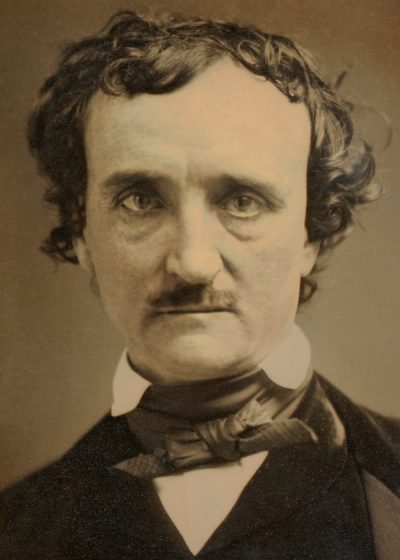
The poet at this period was residing in a small but elegant little home, superintended by his ever-faithful guardian, his wife's mother--his own aunt, Mrs. Clemm, the lady whom he so gratefully addressed in after years in the well-known sonnet, as "more than mother unto me." But a change came o'er the spirit of his dream! His severance from 'Graham's', owing to we know not what causes, took place, and his fragile schemes of happiness faded as fast as the sunset. His means melted away, and he became unfitted by mental trouble and ill-health to earn more. The terrible straits to which he and his unfortunate beloved ones were reduced may be comprehended after perusal of these words from Mr. A. B. Harris's reminiscences.

Referring to the poet's residence in Spring Gardens, Philadelphia, this writer says:

"It was during their stay there that Mrs. Poe, while singing one evening, ruptured a blood-vessel, and after that she suffered a hundred deaths. She could not bear the slightest exposure, and needed the utmost care; and all those conveniences as to apartment and surroundings which are so important in the case of an invalid were almost matters of life and death to her. And yet the room where she lay for weeks, hardly able to breathe, except as she was fanned, was a little narrow place, with the ceiling so low over the narrow bed that her head almost touched it. But no one dared to speak, Mr. Poe was so sensitive and irritable; 'quick as steel and flint,' said one who knew him in those days. And he would not allow a word about the danger of her dying: the mention of it drove him wild."

Is it to be wondered at, should it not indeed be forgiven him, if, impelled by the anxieties and privations at home, the unfortunate poet, driven to the brink of madness, plunged still deeper into the Slough of Despond? Unable to provide for the pressing necessities of his beloved wife, the distracted man

"would steal out of the house at night, and go off and wander about the street for hours, proud, heartsick, despairing, not knowing which way to turn, or what to do, while Mrs. Clemm would endure the anxiety at home as long as she could, and then start off in search of him."

During his calmer moments Poe exerted all his efforts to proceed with his literary labors. He continued to contribute to 'Graham's Magazine,' the proprietor of which periodical remained his friend to the end of his life, and also to some other leading publications of Philadelphia and New York. A suggestion having been made to him by N. P. Willis, of the latter city, he determined to once more wander back to it, as he found it impossible to live upon his literary earnings where he was.

Accordingly, about the middle of 1845, Poe removed to New York, and shortly afterwards was engaged by Willis and his partner Morris as sub-editor on the 'Evening Mirror'. He was, says Willis,

"employed by us for several months as critic and subeditor.... He resided with his wife and mother at Fordham, a few miles out of town, but was at his desk in the office from nine in the morning till the evening paper went to press. With the highest admiration for his genius, and a willingness to let it atone for more than ordinary irregularity, we were led by common report to expect a very capricious attention to his duties, and occasionally a scene of violence and difficulty. Time went on, however, and he was invariably punctual and industrious. With his pale, beautiful, and intellectual face, as a reminder of what genius was in him, it was impossible, of course, not to treat him always with deferential courtsey.... With a prospect of taking the lead in another periodical, he at last voluntarily gave up his employment with us."

A few weeks before Poe relinquished his laborious and ill-paid work on the 'Evening Mirror', his marvellous poem of "The Raven" was published. The effect was magical. Never before, nor, indeed, ever since, has a single short poem produced such a great and immediate enthusiasm. It did more to render its author famous than all his other writings put together. It made him the literary lion of the season; called into existence innumerable parodies; was translated into various languages, and, indeed, created quite a literature of its own. Poe was naturally delighted with the success his poem had attained, and from time to time read it in his musical manner in public halls or at literary receptions. Nevertheless he affected to regard it as a work of art only, and wrote his essay entitled the "Philosophy of Composition," to prove that it was merely a mechanical production made in accordance with certain set rules.

Although our poet's reputation was now well established, he found it still a difficult matter to live by his pen. Even when in good health, he wrote slowly and with fastidious care, and when his work was done had great difficulty in getting publishers to accept it.

Please Support the Classic Literature Library

Buy Edgar Allan Poe Books from Amazon.com

Poetical Works Page 10

Edgar Allan Poe

American Authors

Free Books in the public domain from the Classic Literature Library ©

Edgar Allan Poe
Classic Literature Library

All Pages of This Book
Poetical Works
The Poetry Did It
New Poems
Phantasmagoria and Other Poems
Travel Guides
Insurance Jokes