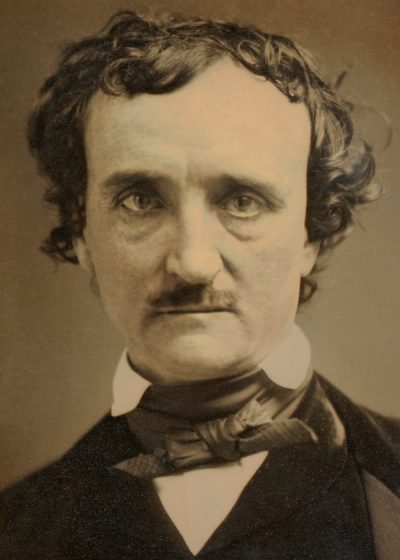
Poe became a contributor to the new venture, and in November of the year 1840 consented to assume the post of editor.
Under Poe's management, assisted by the liberality of Mr. Graham, 'Graham's Magazine' became a grand success. To its pages Poe contributed some of his finest and most popular tales, and attracted to the publication the pens of many of the best contemporary authors. The public was not slow in showing its appreciation of 'pabulum' put before it, and, so its directors averred, in less than two years the circulation rose from five to fifty-two thousand copies.
A great deal of this success was due to Poe's weird and wonderful stories; still more, perhaps, to his trenchant critiques and his startling theories anent cryptology. As regards the tales now issued in 'Graham's', attention may especially be drawn to the world-famed "Murders in the Rue Morgue," the first of a series--'"une espece de trilogie,"' as Baudelaire styles them--illustrative of an analytic phase of Poe's peculiar mind. This 'trilogie' of tales, of which the later two were "The Purloined Letter" and "The Mystery of Marie Roget," was avowedly written to prove the capability of solving the puzzling riddles of life by identifying another person's mind by our own. By trying to follow the processes by which a person would reason out a certain thing, Poe propounded the theory that another person might ultimately arrive, as it were, at that person's conclusions, indeed, penetrate the innermost arcanum of his brain and read his most secret thoughts. Whilst the public was still pondering over the startling proposition, and enjoying perusal of its apparent proofs, Poe still further increased his popularity and drew attention to his works by putting forward the attractive but less dangerous theorem that "human ingenuity could not construct a cipher which human ingenuity could not solve."
This cryptographic assertion was made in connection with what the public deemed a challenge, and Poe was inundated with ciphers more or less abstruse, demanding solution. In the correspondence which ensued in 'Graham's Magazine' and other publications, Poe was universally acknowledged to have proved his case, so far as his own personal ability to unriddle such mysteries was concerned. Although he had never offered to undertake such a task, he triumphantly solved every cryptogram sent to him, with one exception, and that exception he proved conclusively was only an imposture, for which no solution was possible.
The outcome of this exhaustive and unprofitable labor was the fascinating story of "The Gold Bug," a story in which the discovery of hidden treasure is brought about by the unriddling of an intricate cipher.
The year 1841 may be deemed the brightest of Poe's checkered career. On every side acknowledged to be a new and brilliant literary light, chief editor of a powerful magazine, admired, feared, and envied, with a reputation already spreading rapidly in Europe as well as in his native continent, the poet might well have hoped for prosperity and happiness. But dark cankers were gnawing his heart. His pecuniary position was still embarrassing. His writings, which were the result of slow and careful labor, were poorly paid, and his remuneration as joint editor of 'Graham's' was small. He was not permitted to have undivided control, and but a slight share of the profits of the magazine he had rendered world-famous, whilst a fearful domestic calamity wrecked all his hopes, and caused him to resort to that refuge of the broken-hearted--to that drink which finally destroyed his prospects and his life.
Edgar Poe's own account of this terrible malady and its cause was made towards the end of his career. Its truth has never been disproved, and in its most important points it has been thoroughly substantiated. To a correspondent he writes in January 1848:
"You say, 'Can you hint to me what was "that terrible evil" which caused the "irregularities" so profoundly lamented?' Yes, I can do more than hint. This evil was the greatest which can befall a man. Six years ago, a wife whom I loved as no man ever loved before, ruptured a blood-vessel in singing. Her life was despaired of. I took leave of her forever, and underwent all the agonies of her death. She recovered partially, and I again hoped. At the end of a year, the vessel broke again. I went through precisely the same scene.... Then again--again-- and even once again at varying intervals. Each time I felt all the agonies of her death--and at each accession of the disorder I loved her more dearly and clung to her life with more desperate pertinacity. But I am constitutionally sensitive--nervous in a very unusual degree. I became insane, with long intervals of horrible sanity. During these fits of absolute unconsciousness, I drank--God only knows how often or how much. As a matter of course, my enemies referred the insanity to the drink rather than the drink to the insanity. I had, indeed, nearly abandoned all hope of a permanent cure, when I found one in the death of my wife.