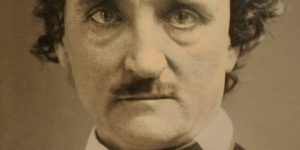
Highly-colored pictures have been drawn of his eccentric behavior at the Academy, but the fact remains that he wilfully, or at any rate purposely, flung away his cadetship. It is surmised with plausibility that the second marriage of Mr. Allan, and his expressed intention of withdrawing his help and of not endowing or bequeathing this adopted son any of his property, was the mainspring of Poe's action. Believing it impossible to continue without aid in a profession so expensive as was a military life, he determined to relinquish it and return to his long cherished attempt to become an author.

Expelled from the institution that afforded board and shelter, and discarded by his former protector, the unfortunate and penniless young man yet a third time attempted to get a start in the world of letters by means of a volume of poetry. If it be true, as alleged, that several of his brother cadets aided his efforts by subscribing for his little work, there is some possibility that a few dollars rewarded this latest venture. Whatever may have resulted from the alleged aid, it is certain that in a short time after leaving the Military Academy Poe was reduced to sad straits. He disappeared for nearly two years from public notice, and how he lived during that period has never been satisfactorily explained. In 1833 he returns to history in the character of a winner of a hundred-dollar award offered by a newspaper for the best story.

The prize was unanimously adjudged to Poe by the adjudicators, and Mr. Kennedy, an author of some little repute, having become interested by the young man's evident genius, generously assisted him towards obtaining a livelihood by literary labor. Through his new friend's introduction to the proprietor of the 'Southern Literary Messenger', a moribund magazine published at irregular intervals, Poe became first a paid contributor, and eventually the editor of the publication, which ultimately he rendered one of the most respected and profitable periodicals of the day. This success was entirely due to the brilliancy and power of Poe's own contributions to the magazine.

In March, 1834, Mr. Allan died, and if our poet had maintained any hopes of further assistance from him, all doubt was settled by the will, by which the whole property of the deceased was left to his second wife and her three sons. Poe was not named.

On the 6th May, 1836, Poe, who now had nothing but his pen to trust to, married his cousin, Virginia Clemm, a child of only fourteen, and with her mother as housekeeper, started a home of his own. In the meantime his various writings in the 'Messenger' began to attract attention and to extend his reputation into literary circles, but beyond his editorial salary of about $520 brought him no pecuniary reward.

In January, 1837, for reasons never thoroughly explained, Poe severed his connection with the 'Messenger', and moved with all his household goods from Richmond to New York. Southern friends state that Poe was desirous of either being admitted into partnership with his employer, or of being allowed a larger share of the profits which his own labors procured. In New York his earnings seem to have been small and irregular, his most important work having been a republication from the 'Messenger' in book form of his Defoe-like romance entitled 'Arthur Gordon Pym'. The truthful air of "The Narrative," as well as its other merits, excited public curiosity both in England and America; but Poe's remuneration does not appear to have been proportionate to its success, nor did he receive anything from the numerous European editions the work rapidly passed through.

In 1838 Poe was induced by a literary friend to break up his New York home and remove with his wife and aunt (her mother) to Philadelphia. The Quaker city was at that time quite a hotbed for magazine projects, and among the many new periodicals Poe was enabled to earn some kind of a living. To Burton's 'Gentleman's Magazine' for 1837 he had contributed a few articles, but in 1840 he arranged with its proprietor to take up the editorship. Poe had long sought to start a magazine of his own, and it was probably with a view to such an eventuality that one of his conditions for accepting the editorship of the 'Gentleman's Magazine' was that his name should appear upon the title-page.

Poe worked hard at the 'Gentleman's' for some time, contributing to its columns much of his best work; ultimately, however, he came to loggerheads with its proprietor, Burton, who disposed of the magazine to a Mr. Graham, a rival publisher. At this period Poe collected into two volumes, and got them published as 'Tales of the Grotesque and Arabesques', twenty-five of his stories, but he never received any remuneration, save a few copies of the volumes, for the work. For some time the poet strove most earnestly to start a magazine of his own, but all his efforts failed owing to his want of capital.

The purchaser of Burton's magazine, having amalgamated it with another, issued the two under the title of 'Graham's Magazine'.

Please Support the Classic Literature Library

Buy Edgar Allan Poe Books from Amazon.com

Poetical Works Page 08

Edgar Allan Poe

American Authors

Free Books in the public domain from the Classic Literature Library ©

Edgar Allan Poe
Classic Literature Library

All Pages of This Book
Poetical Works
The Poetry Did It
New Poems
Phantasmagoria and Other Poems
Travel Guides
Insurance Jokes